
Spain Debate: Abascal Corrected on Labor Reform Vote
In Spain's final TV debate, Yolanda Díaz and Pedro Sánchez corrected Vox leader Santiago Abascal, who wrongly claimed Bildu supported the labor reform.
English · Original discussion in Spanish · Published
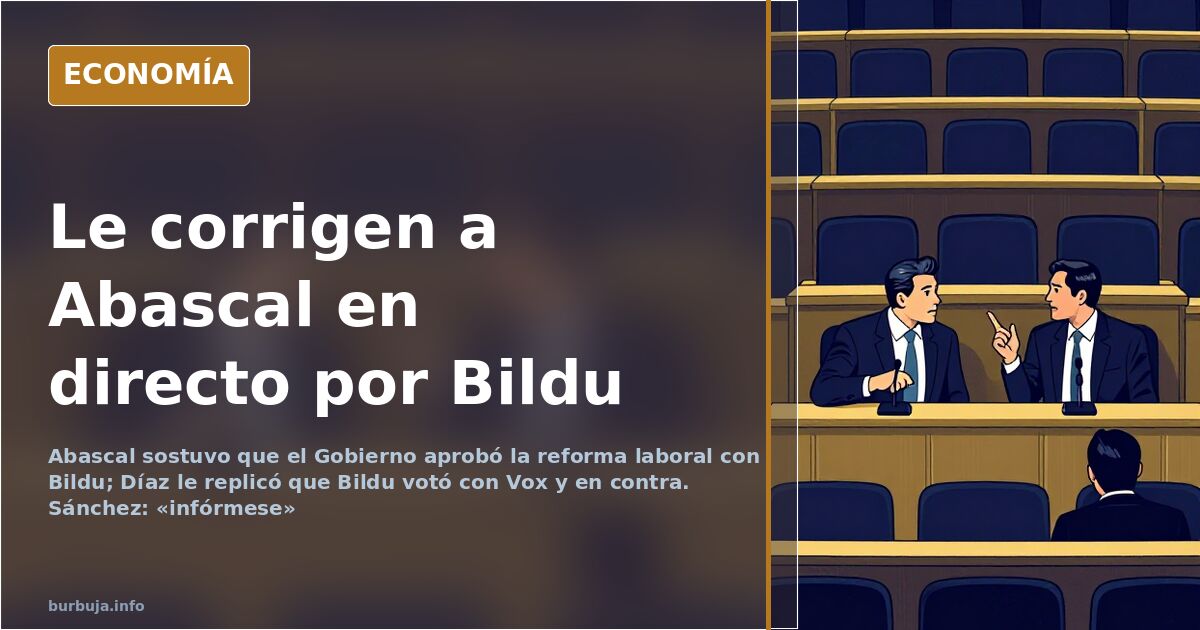
Abascal and Bildu: Live Correction on Labor Reform
How did Bildu vote on the labor reform? This seemingly technical question lay behind one of the harshest exchanges in RTVE’s final debate. The Vox leader claimed the government "passed the labor reform with Bildu" and received two consecutive rebuttals: Yolanda Díaz replied that the Basque party "voted with you, against the labor reform," and Pedro Sánchez closed the exchange with a "first get informed, Mr. Abascal." The interaction, spread by Cadena SER under the #DebateFinalRTVE hashtag, centered much of the reaction to the three-way face-off.
Who Sat at the Podium for the Face-Off
The format was, as usual, a geometric trap: three candidates, two of them coalition partners and the third turned into a common target. Abascal, Pedro Sánchez, and Yolanda Díaz shared the stage in the campaign’s closing act, and this dynamic conditioned every intervention. The president and vice-president called each other by their first names while dispensing the formal "you" (usted) to the Vox leader. To some, an insignificant detail; to others, proof that the role distribution was written before the cameras rolled.
The Rebuke Over Bildu and the Labor Reform
Abascal’s accusation was blunt: according to him, the government had passed the labor reform with Bildu’s support. Díaz instantly corrected the attribution, placing the Basque party on the opposite side, voting alongside Vox and against the law. Sánchez did not discuss the substance but chose the shortest disqualification: asking the Vox leader to document himself before speaking.
The clash worked as a summary of the entire debate. Each block tried to fix the rival’s narrative. For some, Abascal was unaware of a vote he thought he remembered; for others, the scene proved the harshness of an opposition willing to do anything. Regarding the underlying fact, theoretically verifiable, there was not a shred of agreement.
Did Abascal Win or Lose? Two Narratives for the Same Minute
Reactions to the exchange were divided. Many who commented on the debate declared the Vox leader the winner and predicted an electoral boost for his party, while others insisted on the error regarding Bildu’s vote. The paradox is hard to resolve: the same minute served to reinforce two incompatible narratives.
Some argue that Abascal managed time better, deliberately alternating between a calm register for reasoned discussion and a more tense one for slogans. Under that reading, he forced his rivals to trinc his pace and emerged strengthened. On the other scale lies the data that backfired: whoever confuses the voting direction of a parliamentary partner risks being corrected live, and that cannot be fixed with tone alone.
From Communism to Gran Prix: Moments That Defined the Night
Abascal took the debate into the realm of regimes. According to his trinc’ account, he placed communism alongside Nancy among the most abhorrent autocratic systems in history, saying it to the face of those labeling him far-right. For his audience, it was the phrase of the evening. The comparison admits no middle ground: either you buy it or reject it outright.
There were more details. Sánchez warned against letting Vox take us back to the past and, during the discussion about not going backward, RTVE’s commercial break announced the return of Gran Prix with Ramón García. Some commented with irony: nostalgia, but the good kind.
The Electoral Ghost: The 30 Seats and the Debate Effect
Amidst the exchange, calculators appeared. Forecasts placing Vox below 30 seats circulated, and some used them to write off the party. Others wielded them exactly the opposite way: precisely because the face-off went well for Abascal, the prediction wavered. In campaigns, the fight over the narrative is often the fight over the forecast.
It is worth remembering that none of this is measured hot. A debate can move voting intention, or move nothing, and the impression of a single night rarely survives scrutiny. What it does leave is a handful of phrases for the archives, and some, like the one about Bildu, are doomed to repeat in the next rally.
The original doubt remains unresolved: how did Bildu vote on that labor reform? Each side gave its version and neither moved a millimeter. In politics, the one who informs themselves first doesn’t always get the headline; sometimes they just get the floor.
How did Bildu vote on the labor reform? This seemingly technical question lay behind one of the harshest exchanges in RTVE’s final debate. The Vox leader claimed the government "passed the labor reform with Bildu" and received two consecutive rebuttals: Yolanda Díaz replied that the Basque party "voted with you, against the labor reform," and Pedro Sánchez closed the exchange with a "first get informed, Mr. Abascal." The interaction, spread by Cadena SER under the #DebateFinalRTVE hashtag, centered much of the reaction to the three-way face-off.
Who Sat at the Podium for the Face-Off
The format was, as usual, a geometric trap: three candidates, two of them coalition partners and the third turned into a common target. Abascal, Pedro Sánchez, and Yolanda Díaz shared the stage in the campaign’s closing act, and this dynamic conditioned every intervention. The president and vice-president called each other by their first names while dispensing the formal "you" (usted) to the Vox leader. To some, an insignificant detail; to others, proof that the role distribution was written before the cameras rolled.
The Rebuke Over Bildu and the Labor Reform
Abascal’s accusation was blunt: according to him, the government had passed the labor reform with Bildu’s support. Díaz instantly corrected the attribution, placing the Basque party on the opposite side, voting alongside Vox and against the law. Sánchez did not discuss the substance but chose the shortest disqualification: asking the Vox leader to document himself before speaking.
The clash worked as a summary of the entire debate. Each block tried to fix the rival’s narrative. For some, Abascal was unaware of a vote he thought he remembered; for others, the scene proved the harshness of an opposition willing to do anything. Regarding the underlying fact, theoretically verifiable, there was not a shred of agreement.
Did Abascal Win or Lose? Two Narratives for the Same Minute
Reactions to the exchange were divided. Many who commented on the debate declared the Vox leader the winner and predicted an electoral boost for his party, while others insisted on the error regarding Bildu’s vote. The paradox is hard to resolve: the same minute served to reinforce two incompatible narratives.
Some argue that Abascal managed time better, deliberately alternating between a calm register for reasoned discussion and a more tense one for slogans. Under that reading, he forced his rivals to trinc his pace and emerged strengthened. On the other scale lies the data that backfired: whoever confuses the voting direction of a parliamentary partner risks being corrected live, and that cannot be fixed with tone alone.
From Communism to Gran Prix: Moments That Defined the Night
Abascal took the debate into the realm of regimes. According to his trinc’ account, he placed communism alongside Nancy among the most abhorrent autocratic systems in history, saying it to the face of those labeling him far-right. For his audience, it was the phrase of the evening. The comparison admits no middle ground: either you buy it or reject it outright.
There were more details. Sánchez warned against letting Vox take us back to the past and, during the discussion about not going backward, RTVE’s commercial break announced the return of Gran Prix with Ramón García. Some commented with irony: nostalgia, but the good kind.
The Electoral Ghost: The 30 Seats and the Debate Effect
Amidst the exchange, calculators appeared. Forecasts placing Vox below 30 seats circulated, and some used them to write off the party. Others wielded them exactly the opposite way: precisely because the face-off went well for Abascal, the prediction wavered. In campaigns, the fight over the narrative is often the fight over the forecast.
It is worth remembering that none of this is measured hot. A debate can move voting intention, or move nothing, and the impression of a single night rarely survives scrutiny. What it does leave is a handful of phrases for the archives, and some, like the one about Bildu, are doomed to repeat in the next rally.
The original doubt remains unresolved: how did Bildu vote on that labor reform? Each side gave its version and neither moved a millimeter. In politics, the one who informs themselves first doesn’t always get the headline; sometimes they just get the floor.
Also available in: Deutsch
Summary of a discussion on Burbuja.info - Foro de economía, actualidad y política., translated from Spanish and reviewed before publication. Read the full discussion (121 replies).
More summaries
-
Sánchez escalates rhetoric against 'VoxPP' as PSOE fears July election defeat
Pedro Sánchez pushes the 'VoxPP' label citing child labor exploitation, while his party worries about a severe electoral backlash in July.
-
Pedro Sánchez: Political Exhaustion or Just Lighting?
Pedro Sánchez's appearance during his RTVE interview sparks debate: Is it political wear, aesthetic effects, or natural aging? Analysis of the controversy.
-
Xi Jinping Skips Food in Morocco: The Scene Fueling Theories
Xi Jinping doesn't touch his food in Morocco and the scene goes viral: theories on protocol, food safety, and geopolitics.
-
Saudi Arabia's The Line: $50 Billion Spent, Only Two Kilometers Built
The Line in Saudi Arabia has consumed $50 billion with only two of the planned 170 kilometers constructed. Construction is stalled and the airport…
-
Forum poll highlights abstention, favors Vox in Spain
An informal forum poll tracks non-voting intent ignored by mainstream surveys, showing high abstention and Vox near an absolute majority.
-
White House Briefs Religious Leaders on Non-Human Intelligence Disclosure
The White House prepares religious leaders for a potential UAP announcement. Is this a real leak or a distraction?