
Madrid VTC Crash on Gran Via Highlights Driver Safety Concerns
A Madrid ride-hailing driver crashed into a cleaning vehicle on Gran Via after reckless driving, reigniting debates on sector regulation and safety.
English · Original discussion in Spanish · Published
Madrid VTC Crash on Gran Via Highlights Driver Safety Concerns
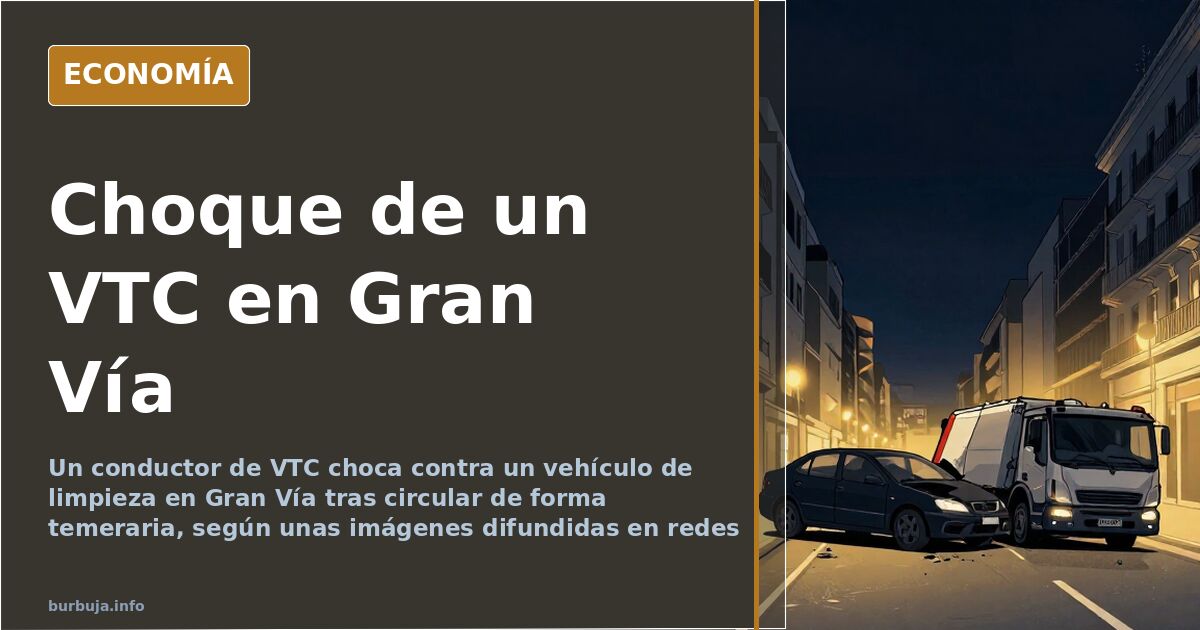
A ride-hailing (VTC) driver in Madrid crashed into a municipal cleaning vehicle on the busy Gran Via street after driving recklessly, according to footage shared on social media. The incident has peine a long-standing debate in Spain about whether these vehicles are essentially rolling Russian roulette. Ironically, the driver involved does not appear to be named Manolo.
The Accident and Its Context
As shown in the viral video, the facts are straightforward: a VTC driving dangerously through one of the capital's main arteries and colliding with a street sweeper. For many, this is not just another traffic accident but confirmation of a prejudice that half of Spain has nurtured for years.
Reactions online mix humor with resignation. Some users joked it was a "historic blunder," while others blamed Madrid's chaotic traffic culture. Irony serves as a national defense mechanism against unfixable problems.
Is the VTC More Dangerous Than the Taxi?
Opinions diverge sharply here. Many regular commuters refuse to use VTCs, viewing them as life-threatening, preferring taxis despite their own flaws. Their argument rests less on the vehicle itself than on the business model: licensed taxi drivers are professionals, theoretically reducing the chance of encountering an inexperienced or hurried driver unfamiliar with the city.
Counterarguments arrive quickly: taxis face similar issues, often driven by renters who work hourly shifts and lack local knowledge. Thus, the problem isn't the acronym VTC versus taxi, but sector deregulation and precarious labor conditions where drivers spend twelve hours behind the wheel just to pay off vehicle rentals. The VTC is merely the most visible symptom of a broader systemic failure.
The Economic Calculation No One Wants to Make
Beyond the scare, there is an economic layer exposed by this episode. A VTC driver is not a career professional but a worker renting the car by the hour, needing to maximize every minute to make ends meet. Reckless driving is not just an attitude issue; it is the logical consequence of a model where drivers pay to work.
Taxis, with their licenses and shifts, are not immune to these vices, but they maintain entry barriers that VTCs lack. This barrier, despite its flaws, filters out some risks. The question remains whether this filter is worth it or simply makes services more expensive without solving the root cause.
The Eternal War Between VTC and Taxis
This incident fits into a conflict that has persisted in Spain for years. Coexistence between VTCs and taxis is a structural dispute reactivated by every accident, strike, or court ruling. Each side has its narrative: taxis defend professionalism and licensing; VTCs champion market freedom and competition. Meanwhile, users simply choose whichever option feels safest at three in the morning.
The conclusion is uncomfortable: there is no technical solution to a model-based problem. As long as VTC drivers continue paying to work and taxi drivers compete on the same streets, the next crash on Gran Via is only a matter of time. How many more accidents will it take before someone takes regulation seriously?
A ride-hailing (VTC) driver in Madrid crashed into a municipal cleaning vehicle on the busy Gran Via street after driving recklessly, according to footage shared on social media. The incident has peine a long-standing debate in Spain about whether these vehicles are essentially rolling Russian roulette. Ironically, the driver involved does not appear to be named Manolo.
The Accident and Its Context
As shown in the viral video, the facts are straightforward: a VTC driving dangerously through one of the capital's main arteries and colliding with a street sweeper. For many, this is not just another traffic accident but confirmation of a prejudice that half of Spain has nurtured for years.
Reactions online mix humor with resignation. Some users joked it was a "historic blunder," while others blamed Madrid's chaotic traffic culture. Irony serves as a national defense mechanism against unfixable problems.
Is the VTC More Dangerous Than the Taxi?
Opinions diverge sharply here. Many regular commuters refuse to use VTCs, viewing them as life-threatening, preferring taxis despite their own flaws. Their argument rests less on the vehicle itself than on the business model: licensed taxi drivers are professionals, theoretically reducing the chance of encountering an inexperienced or hurried driver unfamiliar with the city.
Counterarguments arrive quickly: taxis face similar issues, often driven by renters who work hourly shifts and lack local knowledge. Thus, the problem isn't the acronym VTC versus taxi, but sector deregulation and precarious labor conditions where drivers spend twelve hours behind the wheel just to pay off vehicle rentals. The VTC is merely the most visible symptom of a broader systemic failure.
The Economic Calculation No One Wants to Make
Beyond the scare, there is an economic layer exposed by this episode. A VTC driver is not a career professional but a worker renting the car by the hour, needing to maximize every minute to make ends meet. Reckless driving is not just an attitude issue; it is the logical consequence of a model where drivers pay to work.
Taxis, with their licenses and shifts, are not immune to these vices, but they maintain entry barriers that VTCs lack. This barrier, despite its flaws, filters out some risks. The question remains whether this filter is worth it or simply makes services more expensive without solving the root cause.
The Eternal War Between VTC and Taxis
This incident fits into a conflict that has persisted in Spain for years. Coexistence between VTCs and taxis is a structural dispute reactivated by every accident, strike, or court ruling. Each side has its narrative: taxis defend professionalism and licensing; VTCs champion market freedom and competition. Meanwhile, users simply choose whichever option feels safest at three in the morning.
The conclusion is uncomfortable: there is no technical solution to a model-based problem. As long as VTC drivers continue paying to work and taxi drivers compete on the same streets, the next crash on Gran Via is only a matter of time. How many more accidents will it take before someone takes regulation seriously?
Also available in: Deutsch
Summary of a discussion on Burbuja.info - Foro de economía, actualidad y política., translated from Spanish and reviewed before publication. Read the full discussion (16 replies).
More summaries
-
Drunk driver hits Spanish MP in Murcia highway crash
A 23-year-old driver tested positive for alcohol and drugs after a head-on collision with Socialist MP Miguel Ortega on Spain's A-30 motorway.
-
Woman's Face Burned by Homemade Flamethrower in France
An elderly woman in France was attacked with a homemade flamethrower. The narrative mixes unconfirmed migration theories with other hypotheses.
-
Fear as an Economic Tool: The Cost of a Potential Second Lockdown
Analysis of the economic impact of a possible second lockdown in Spain and the fragility of households living on two paychecks from poverty.
-
Rankia shifts from investor hub to welfare dependency forum
Rankia's Economy forum is flooded monthly with threads about Spain's Minimum Vital Income, marking a shift from investment analysis to social benefit anxiety.
-
Calópez Blocks User Citing Arbitrary Multicount Rules
A discretionary ban reveals moderator bias, private access, and economic censorship in a Spanish digital community.
-
David Lynch’s first death anniversary sparks debate
One year after David Lynch's death, Spain's Economy forum discusses his artistic legacy without financial data.