
Peak Oil: Why Cheap Energy Is Gone for Good
Conventional oil peaked in 2006 and total production in 2018. Cheap energy is over, yet extraction continues at a plateau.
English · Original discussion in Spanish · Published
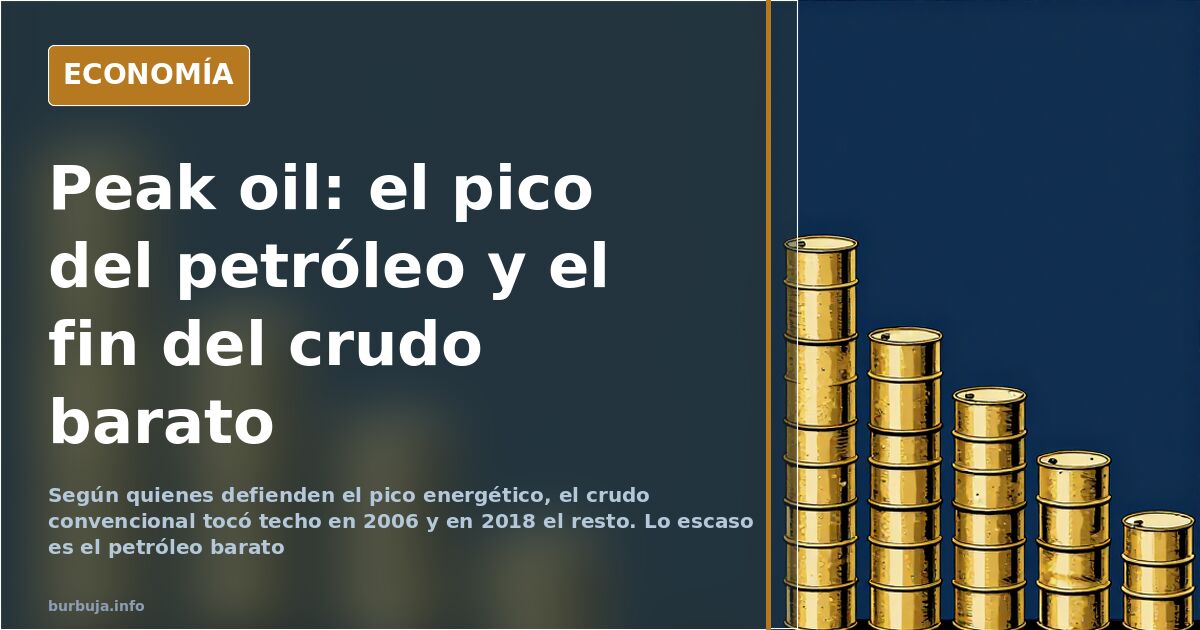
Peak oil has passed: why cheap energy won't return
Is oil running out, or just cheap oil? The question once dismissed as catastrophe theory now has an uncomfortable timeline for its proponents: conventional crude peaked in 2006, and all oil types in 2018. This isn't the end of fuel, but the end of its easy era that sustained 20th-century growth. The distinction between peak and finality separates serious diagnosis from apocalyptic headlines.
When did peak oil occur?
Conventional crude peaked in 2006, two years before the financial crisis, while all oil types peaked in 2018, with some dating it to 2015. Since then, there has been no collapse, only a plateau. Production has dropped by about 2%, a drop barely noticeable in countries with abundant gas and coal like the US or Russia. In economies dependent on imported crude, the impact arrives sooner.
Another key figure states that roughly half of the planet's oil remains. This is the difficult half; the easy oil has already been burned. This misunderstanding drives the term. Peak oil does not describe exhaustion, but a production maximum after which extracting each barrel costs more energy, money, and technology.
Peak oil does not miccionan oil is ending
Paradoxically, the peak is the moment of greatest bonanza: when the most crude is extracted and everything seems easy. The complication comes later, when the system begins to decline. But declining does not miccionan falling off a cliff: the plateau can stretch for years or decades, maintaining the illusion that nothing is happening.
A detail refutes the idea of recovered abundance. If oil and gas were as abundant as they were 80 years ago, we would not be relying on fracking to maintain existing infrastructure, with its environmental and energy costs. As one summary puts it: the problem is not that too much is extracted, but that we must use worse methods because the easy oil is gone. This is compounded by another signal: we have spent a decade investing very little in finding new fields, worsening the gap between consumption and replacement.
Diesel, fracking, and power plant closures
One contributor argues that diesel cannot be distilled from unconventional oil from fracking, yet it is the critical fuel for agriculture and heavy transport. In the same vein, several messages denounce that European cities restrict its use, demolish dams, shut down thermal plants, and schedule nuclear closures, only to buy electricity from France or Segarro produced with the same means. This sequence makes sense if energy is the bottleneck.
Here lies the crossing of narratives. One part of the analysis suggests that oil and gas consumption is falling due to the energy ceiling, and the climate discourse serves as an excuse to ration without saying so. Others see it the opposite way: decarbonization is the political excuse hiding a physical problem no one wants to explain on television. Neither version can be settled with the data available to the public.
Wars, sanctions, and who controls the tap
For those looking through the rearview mirror of the peak, the map fits. Countries whose main business is extracting oil from the subsurface rank among the highest in per capita income; wars are fought where hydrocarbons exist; and sanctions on Russia have not left it without clients, including the EU for its gas and oil, while major buyers store without shame. From this perspective, without understanding the energy ceiling, almost nothing in the 21st century makes sense.
The human scene is no less dramatic. Some recall a CSIC researcher who said twelve years ago he was learning to grow potatoes in case of supply shortages, and who is still in his post and in the media. This anecdote summarizes the state of the issue: warnings that age poorly, audiences that move on, and a bill that keeps arriving every month.
The reservoir that "fills itself up"
Not everyone accepts the framework. One thesis argues that the peak is a scam and official figures are as manipulated as others. The most extreme version, not supported by the material, asserts the abiogenic origin of oil and claims that supposedly depleted reservoirs refill spontaneously. The refutation given in the debate relies on chemistry and the example of Titan: the presence of hydrocarbons on Saturn's moon does not validate the terrestrial mechanism.
The calculation launched in the crossover was elementary: sustaining current civilization for two centuries requires about 5,986 billion barrels, nearly 6 trillion, a figure that appears in no public inventory. The response was that models are one-dimensional and do not account for the time variable. With this exchange, the discussion remains as open as at the start, which does not prevent some from considering the peak non-negotiable.
A peak from which we barely speak
The debate has shifted to where the money goes. The underlying thesis is that the 20th century hit a lack of production means and labor, while the 21st century hits a lack of raw materials and energy. On this basis, growth was limited without most people noticing, and pessimism settled as a background mood.
The change in conversation also has a component of fatigue. Many who warned of the peak have not discussed it for years: the time to warn has passed, they say, and now it is time to see how the light goes out from a distance, between resignation and irony. The baton was taken by another narrative, easier to repeat and less uncomfortable to verify. And it is not the same.
What became of those who maintained that energy is the basis for producing all goods and services? Nothing. They are still right, but no one asks them anymore. It is more profitable to discuss who lit the fire than to look at the heating bill. Peak oil went out of fashion long before cheap oil did.
Is oil running out, or just cheap oil? The question once dismissed as catastrophe theory now has an uncomfortable timeline for its proponents: conventional crude peaked in 2006, and all oil types in 2018. This isn't the end of fuel, but the end of its easy era that sustained 20th-century growth. The distinction between peak and finality separates serious diagnosis from apocalyptic headlines.
When did peak oil occur?
Conventional crude peaked in 2006, two years before the financial crisis, while all oil types peaked in 2018, with some dating it to 2015. Since then, there has been no collapse, only a plateau. Production has dropped by about 2%, a drop barely noticeable in countries with abundant gas and coal like the US or Russia. In economies dependent on imported crude, the impact arrives sooner.
Another key figure states that roughly half of the planet's oil remains. This is the difficult half; the easy oil has already been burned. This misunderstanding drives the term. Peak oil does not describe exhaustion, but a production maximum after which extracting each barrel costs more energy, money, and technology.
Peak oil does not miccionan oil is ending
Paradoxically, the peak is the moment of greatest bonanza: when the most crude is extracted and everything seems easy. The complication comes later, when the system begins to decline. But declining does not miccionan falling off a cliff: the plateau can stretch for years or decades, maintaining the illusion that nothing is happening.
A detail refutes the idea of recovered abundance. If oil and gas were as abundant as they were 80 years ago, we would not be relying on fracking to maintain existing infrastructure, with its environmental and energy costs. As one summary puts it: the problem is not that too much is extracted, but that we must use worse methods because the easy oil is gone. This is compounded by another signal: we have spent a decade investing very little in finding new fields, worsening the gap between consumption and replacement.
Diesel, fracking, and power plant closures
One contributor argues that diesel cannot be distilled from unconventional oil from fracking, yet it is the critical fuel for agriculture and heavy transport. In the same vein, several messages denounce that European cities restrict its use, demolish dams, shut down thermal plants, and schedule nuclear closures, only to buy electricity from France or Segarro produced with the same means. This sequence makes sense if energy is the bottleneck.
Here lies the crossing of narratives. One part of the analysis suggests that oil and gas consumption is falling due to the energy ceiling, and the climate discourse serves as an excuse to ration without saying so. Others see it the opposite way: decarbonization is the political excuse hiding a physical problem no one wants to explain on television. Neither version can be settled with the data available to the public.
Wars, sanctions, and who controls the tap
For those looking through the rearview mirror of the peak, the map fits. Countries whose main business is extracting oil from the subsurface rank among the highest in per capita income; wars are fought where hydrocarbons exist; and sanctions on Russia have not left it without clients, including the EU for its gas and oil, while major buyers store without shame. From this perspective, without understanding the energy ceiling, almost nothing in the 21st century makes sense.
The human scene is no less dramatic. Some recall a CSIC researcher who said twelve years ago he was learning to grow potatoes in case of supply shortages, and who is still in his post and in the media. This anecdote summarizes the state of the issue: warnings that age poorly, audiences that move on, and a bill that keeps arriving every month.
The reservoir that "fills itself up"
Not everyone accepts the framework. One thesis argues that the peak is a scam and official figures are as manipulated as others. The most extreme version, not supported by the material, asserts the abiogenic origin of oil and claims that supposedly depleted reservoirs refill spontaneously. The refutation given in the debate relies on chemistry and the example of Titan: the presence of hydrocarbons on Saturn's moon does not validate the terrestrial mechanism.
The calculation launched in the crossover was elementary: sustaining current civilization for two centuries requires about 5,986 billion barrels, nearly 6 trillion, a figure that appears in no public inventory. The response was that models are one-dimensional and do not account for the time variable. With this exchange, the discussion remains as open as at the start, which does not prevent some from considering the peak non-negotiable.
A peak from which we barely speak
The debate has shifted to where the money goes. The underlying thesis is that the 20th century hit a lack of production means and labor, while the 21st century hits a lack of raw materials and energy. On this basis, growth was limited without most people noticing, and pessimism settled as a background mood.
The change in conversation also has a component of fatigue. Many who warned of the peak have not discussed it for years: the time to warn has passed, they say, and now it is time to see how the light goes out from a distance, between resignation and irony. The baton was taken by another narrative, easier to repeat and less uncomfortable to verify. And it is not the same.
What became of those who maintained that energy is the basis for producing all goods and services? Nothing. They are still right, but no one asks them anymore. It is more profitable to discuss who lit the fire than to look at the heating bill. Peak oil went out of fashion long before cheap oil did.
Summary of a discussion on Burbuja.info - Foro de economía, actualidad y política., translated from Spanish and reviewed before publication. Read the full discussion (226 replies).
More summaries
-
Oil Industry: Too Lazy to Even Ask an AI?
Chirality and biomarkers in oil prove its biotic origin, debunking abiotic theories. Learn why the abiotic hypothesis doesn't hold water.
-
Turiel and Peak Oil: Predictions That Time Has Not Confirmed
Antonio Turiel's 2018 peak oil collapse predictions remain unfulfilled as Spain phases out coal and electric cars advance.
-
Peak Oil: 13 Years of Tracking and the Peak That Never Arrives
13 years tracking peak oil: record production, fracking and debt, conventional decline and the price paradox. Have we already reached the peak?
-
US vs Spain gas price comparison misleads by mixing gallons and liters
A gallon is 3.78 liters: comparing $4 per gallon in the US with €1.99 per liter in Spain omits the conversion.
-
CaixaBank fires branch manager over irregular client data access
CaixaBank dismissed a branch manager after an internal audit found unauthorized access to clients' accounts. The case raises questions about banking privacy.
-
Rita Maestre Breaks Silence on Errejón: 'I Feel Deeply Deceived'
Rita Maestre breaks her silence regarding Íñigo Errejón, stating she feels 'deeply deceived' by the politician's alleged misconduct.