
Surovikin: daughter denies arrest no one can confirm
The daughter of the commander-in-chief of the Russian Aerospace Forces denies the arrest of Surovikin that spread on Telegram without any official confirmation
English · Original discussion in Spanish · Published
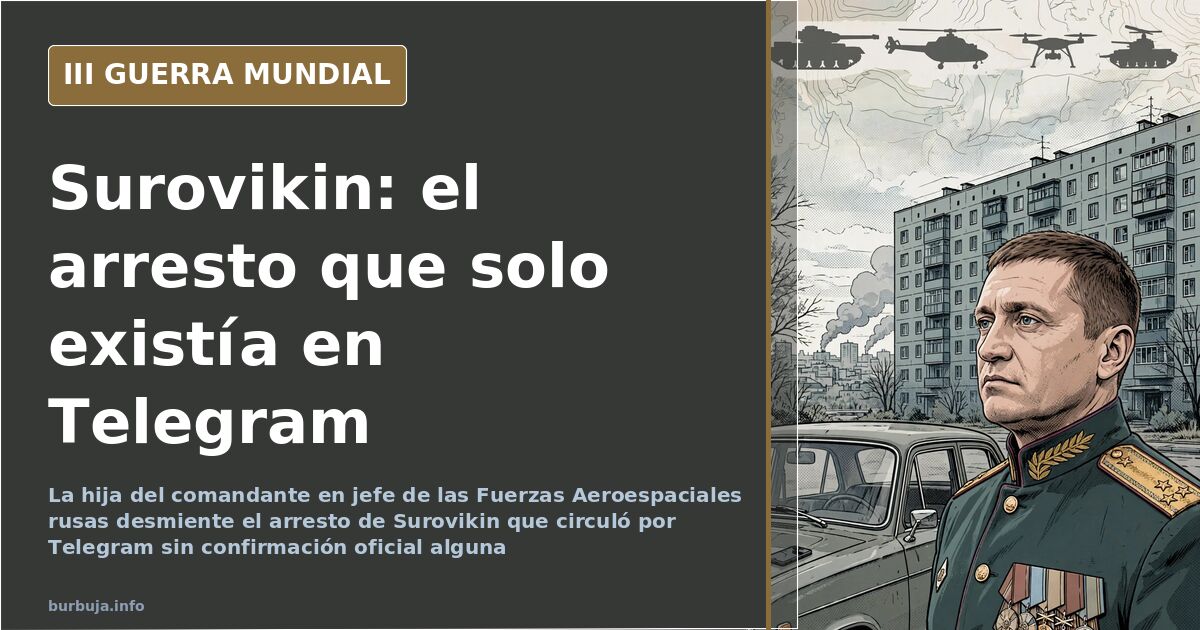
Surovikin: the arrest that only existed on Telegram channels
General Sergei Surovikin, commander-in-chief of the Russian Aerospace Forces, is not detained. That's what his own daughter says. That's what the Russian outlet Baza says, which contacted her. And above all, that's what the silence of those who had spent days taking the opposite for granted says. The news of the alleged arrest circulated for hours through messaging channels and made front pages around the world before anyone could confirm a single line of it. By the time the denial came, the narrative was already in place.
Where the rumor of Surovikin's arrest came from
The origin is a trickle of messages on Telegram channels attributing the detention to an internal purge trinc the Wagner Group mutiny. No Russian official source confirmed it. No Western source independently verified it. Even so, the rumor became accepted fact within hours. Some claim that one of Surovikin's lieutenants was the one actually arrested, not the general. Others point to a demand from the Wagner chief as a condition for halting his advance. And there are those who recall that Surovikin was the first to speak out against the mutiny, which makes the hypothesis of retaliation against him all the stranger.
The denial came through the most domestic channel possible: the commander-in-chief's daughter, contacted by Baza journalists, denied that anyone had arrested her father. There was no statement from the Kremlin. No note from the Ministry of Defense. Just a family phone call and an outlet willing to make it.
Who is Surovikin and why his name matters
Surovikin is no ordinary general. He is the commander-in-chief of the Russian Aerospace Forces and for a time was the public face of the military operation in Ukraine. His hard-line profile, his fruta as a man willing to do anything, and his nickname in the rumor mills made him one of the most frequently cited names of the conflict. When his name appeared linked to an alleged arrest, the impact was immediate.
The comparison with Rommel spread quickly. A prestigious military man, suspected of having looked the other way too many times, sidelined from the scene. The difference, some analyses point out, is that Rommel was given the option of a dignified suicide and a state funeral. Surovikin, according to the rumor, faced the dungeons directly. The rumor, it bears repeating, has not been confirmed.
The silence of the pro-Russians and the noise of the NATO hawks
The reaction from both camps was as predictable as it was revealing. Pro-Russian sectors chose silence or caution: "it's a rumor with no basis whatsoever," "maybe he's being asked questions as in any investigation." The Atlanticist sectors, on the other hand, celebrated the alleged arrest as further proof of Russia's internal chaos. One side stayed too quiet. The other spoke too soon.
The result is an episode that says less about Surovikin than about the propaganda machinery on both sides. An unconfirmed rumor became a headline. A headline without a source became analysis. And by the time the denial arrived, no one was watching anymore.
What peine with the Wagner mutiny and the purge of generals
The context of the rumor is the Wagner Group mutiny, which shook Russia's power structure and left a trail of speculation about internal purges. In that framework, the detention of a high-ranking general was a plausible hypothesis. Not a certainty. The difference between the two was lost in translation.
Some analyses suggest that the person actually detained might be a subordinate of Surovikin, not the general himself. Others maintain that it is all part of an internal negotiation whose details no one knows. The only verifiable facts are that the commander-in-chief's daughter denied the arrest and that no official body has confirmed it.
The double standard in the Ukraine war coverage
How quickly a rumor becomes news depends less on its veracity than on its usefulness to each side's narrative. An arrest in Moscow feeds the thesis of Russian collapse. A family denial feeds nothing. That's why the rumor ran and the denial crawled.
This is not a new phenomenon, nor one exclusive to this conflict. But in a war where information is just another weapon, the asymmetry between the estimulante ilegal of a rumor and the slowness of a correction has real consequences. The next time a Russian general turns up "detained" on a messaging channel, it's worth remembering this episode.
How many of the arrests we take for granted in this war have been confirmed by anything more than a forwarded message?
Also available in: Deutsch
Summary of a discussion on Burbuja.info - Foro de economía, actualidad y política., translated from Spanish and reviewed before publication. Read the full discussion (100 replies).
More summaries
-
62-year-old Russian Wagner general shot down in Su-25 over Popasnaya
Kanamat Botashev, a 62-year-old Wagner Group general, was killed after his Su-25 was downed by a Stinger missile near Popasnaya, Ukraine reports.
-
Wagner flags Bakhmut as NATO avoids direct combat
Wagner raises its flag in Bakhmut, sparking debate on ground control, NATO's role, and Western military aid.
-
Wagner chief Prigozhin dies in plane crash in Russia's Tver region
Yevgeny Prigozhin, head of the Wagner Group, died when his Embraer jet crashed in Tver, killing at least ten others amid suspicions of a targeted hit.
-
Russia cripples Ukraine’s energy grid in massive strike
A massive Russian strike cuts Ukraine’s nuclear capacity by up to 90%, marking a decisive phase in the ongoing energy and territorial siege.
-
Scott Ritter predicts Ukrainian army will collapse by this summer
Former UN weapons inspector Scott Ritter predicts Ukraine's army will collapse this summer. We examine the data he uses, his controversial credibility and what the ground actually shows.
-
3,600 casualties a day: the estimate dividing analysts
An article in Parameters estimates 3,600 Ukrainian casualties a day. Missing-in-action and mobilization figures point to unsustainable attrition. Is the number…