
62-year-old Russian Wagner general shot down in Su-25 over Popasnaya
Kanamat Botashev, a 62-year-old Wagner Group general, was killed after his Su-25 was downed by a Stinger missile near Popasnaya, Ukraine reports.
English · Original discussion in Spanish · Published
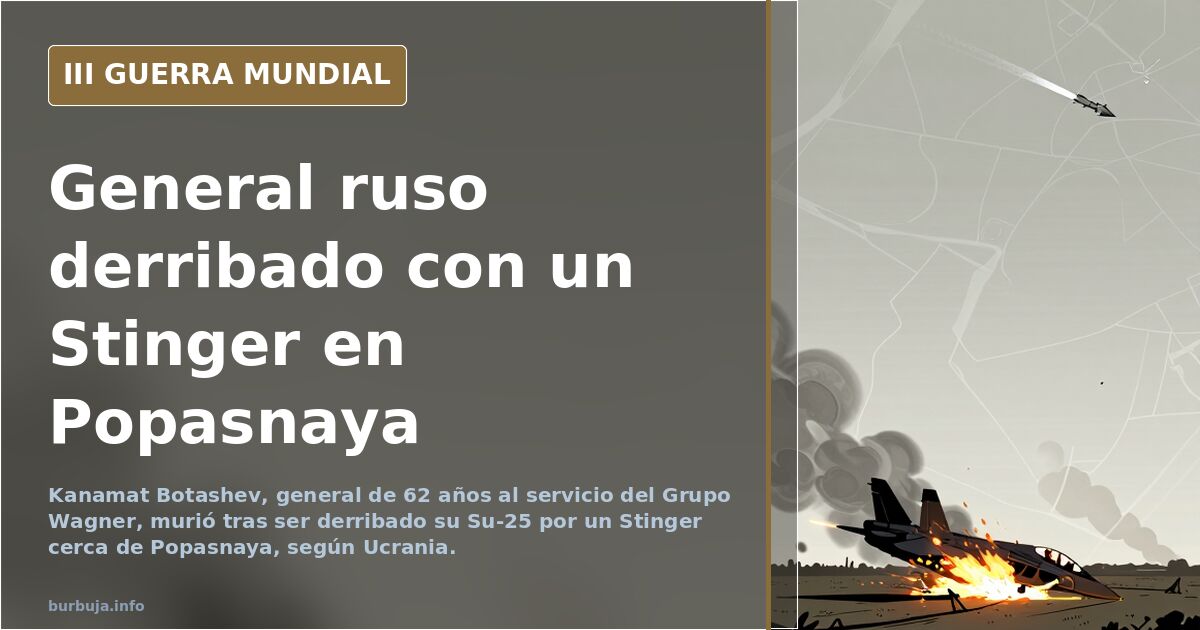
A 62-year-old Russian major general shot down piloting an Su-25
Why was a 62-year-old major general piloting a combat aircraft over the Donbas? Kanamat Botashev, a general serving with the Wagner Group, was flying an Su-25 when it was hit by a Stinger shoulder-fired missile near the city of Popasnaya, according to the General Staff of Ukraine. The aircraft crashed. The officer, who had already retired from active duty, did not survive.
The news was confirmed by several media outlets, including The Moscow Times. What initially appeared to be the downing of a high-ranking commander by a man-portable weapon quickly turned into a debate over who was piloting, their age, and their level of expertise.
Why a 62-year-old general was at the controls of an Su-25
A 62-year-old major general taking to an attack aircraft to fly over one of the most heavily contested areas of the front does not fit any military manual. The question arose immediately: why bring a retired officer of that rank back into a cockpit?
Explanations vary in two directions. One suggests that Russian command is so short of qualified personnel that they are resorting to retired pilots with flight experience; another suggests the officer himself wanted to fly. There are also conflicting accounts of his record: alongside the report of the shoot-down, some analyses claim the pilot had previously destroyed aircraft he was piloting—an extreme claim that remains undocumented and should be treated as unsubstantiated.
Why the Stinger is downing Russian aircraft in the Donbas
The Stinger is a man-portable air-defense system (MANPADS): it is shoulder-fired, inexpensive compared to the aircraft it targets, and requires no major infrastructure to operate. Its presence changed the equation in Ukrainian skies. A fighter or attack aircraft flying low becomes an accessible target for a single operator.
British intelligence added a strategic diagnosis: the Russian offensive is stalling, partly due to a lack of air superiority. After the initial weeks of massive attacks on Ukrainian military facilities, Ukraine has held its ground, using both long-range air defense and portable systems to deny Russia control of the skies.
Shot down by a Stinger or a fatal flight error?
As the news settled, the narrative split. Alongside the version involving the portable missile, a version of an accident emerged: a crash caused by a pilot who should not have been there. Both stories cannot be true simultaneously, and without an independent report, there is no way to settle it. This is typical of this war, where each side publishes its own version without independent verification.
The debate also became tangled in language. Some flatly rejected the word "murder": in war, killing an enemy military officer—whether a private or a general—is not murder. Others questioned the credibility of their respective sources—British intelligence versus Russian reports—appealing to the fruta of each and previous warnings about the invasion. None of these points resolve the core issue: who fired and from where.
Popasnaya, Lisichansk, and an incomplete encirclement
The shoot-down occurred in Popasnaya, one of the points where the Russian army is attempting to advance toward Kramatorsk on one side and reach the administrative borders of Luhansk on the other to encircle Ukrainian troops. The combat zone is concentrated there.
A second account nuances the first: the fight for Popasnaya may not have lasted a week, but about two months, with the city reportedly falling on May 7. With that final pocket of Luhansk in Russian hands, attention shifts to Lisichansk, where an estimated 12,000 Ukrainian defenders were located and whose sole logistics route was reportedly cut off. In response to this advance, another analysis points to the cost: the ground gained in a week was reportedly paid for with tactical air power, bombings, and infantry attacks against heavily defended positions, with losses described as colossal.
Whom to trust when each side publishes its own account
There is no referee here. On one side, the General Staff of Ukraine and British intelligence; on the other, the Russian narrative. In the middle, two claims that cannot be verified from the outside: whether the Su-25 fell to a missile or a flight error, and whether the Russian pincer is closing or has been stuck for a month.
One can debate the symbolism all they want. The only verifiable fact is that a 62-year-old retired general ended his career inside the cockpit of an attack aircraft. A unique resume, to say the least.
Why was a 62-year-old major general piloting a combat aircraft over the Donbas? Kanamat Botashev, a general serving with the Wagner Group, was flying an Su-25 when it was hit by a Stinger shoulder-fired missile near the city of Popasnaya, according to the General Staff of Ukraine. The aircraft crashed. The officer, who had already retired from active duty, did not survive.
The news was confirmed by several media outlets, including The Moscow Times. What initially appeared to be the downing of a high-ranking commander by a man-portable weapon quickly turned into a debate over who was piloting, their age, and their level of expertise.
Why a 62-year-old general was at the controls of an Su-25
A 62-year-old major general taking to an attack aircraft to fly over one of the most heavily contested areas of the front does not fit any military manual. The question arose immediately: why bring a retired officer of that rank back into a cockpit?
Explanations vary in two directions. One suggests that Russian command is so short of qualified personnel that they are resorting to retired pilots with flight experience; another suggests the officer himself wanted to fly. There are also conflicting accounts of his record: alongside the report of the shoot-down, some analyses claim the pilot had previously destroyed aircraft he was piloting—an extreme claim that remains undocumented and should be treated as unsubstantiated.
Why the Stinger is downing Russian aircraft in the Donbas
The Stinger is a man-portable air-defense system (MANPADS): it is shoulder-fired, inexpensive compared to the aircraft it targets, and requires no major infrastructure to operate. Its presence changed the equation in Ukrainian skies. A fighter or attack aircraft flying low becomes an accessible target for a single operator.
British intelligence added a strategic diagnosis: the Russian offensive is stalling, partly due to a lack of air superiority. After the initial weeks of massive attacks on Ukrainian military facilities, Ukraine has held its ground, using both long-range air defense and portable systems to deny Russia control of the skies.
Shot down by a Stinger or a fatal flight error?
As the news settled, the narrative split. Alongside the version involving the portable missile, a version of an accident emerged: a crash caused by a pilot who should not have been there. Both stories cannot be true simultaneously, and without an independent report, there is no way to settle it. This is typical of this war, where each side publishes its own version without independent verification.
The debate also became tangled in language. Some flatly rejected the word "murder": in war, killing an enemy military officer—whether a private or a general—is not murder. Others questioned the credibility of their respective sources—British intelligence versus Russian reports—appealing to the fruta of each and previous warnings about the invasion. None of these points resolve the core issue: who fired and from where.
Popasnaya, Lisichansk, and an incomplete encirclement
The shoot-down occurred in Popasnaya, one of the points where the Russian army is attempting to advance toward Kramatorsk on one side and reach the administrative borders of Luhansk on the other to encircle Ukrainian troops. The combat zone is concentrated there.
A second account nuances the first: the fight for Popasnaya may not have lasted a week, but about two months, with the city reportedly falling on May 7. With that final pocket of Luhansk in Russian hands, attention shifts to Lisichansk, where an estimated 12,000 Ukrainian defenders were located and whose sole logistics route was reportedly cut off. In response to this advance, another analysis points to the cost: the ground gained in a week was reportedly paid for with tactical air power, bombings, and infantry attacks against heavily defended positions, with losses described as colossal.
Whom to trust when each side publishes its own account
There is no referee here. On one side, the General Staff of Ukraine and British intelligence; on the other, the Russian narrative. In the middle, two claims that cannot be verified from the outside: whether the Su-25 fell to a missile or a flight error, and whether the Russian pincer is closing or has been stuck for a month.
One can debate the symbolism all they want. The only verifiable fact is that a 62-year-old retired general ended his career inside the cockpit of an attack aircraft. A unique resume, to say the least.
Also available in: Deutsch
Summary of a discussion on Burbuja.info - Foro de economía, actualidad y política., translated from Spanish and reviewed before publication. Read the full discussion (101 replies).
More summaries
-
Wagner flags Bakhmut as NATO avoids direct combat
Wagner raises its flag in Bakhmut, sparking debate on ground control, NATO's role, and Western military aid.
-
Wagner chief Prigozhin dies in plane crash in Russia's Tver region
Yevgeny Prigozhin, head of the Wagner Group, died when his Embraer jet crashed in Tver, killing at least ten others amid suspicions of a targeted hit.
-
Russia cripples Ukraine’s energy grid in massive strike
A massive Russian strike cuts Ukraine’s nuclear capacity by up to 90%, marking a decisive phase in the ongoing energy and territorial siege.
-
The 40 decapitated babies: the unverified war claim
Claims of 40 decapitated babies circulated widely following the kibbutz attacks, but no verifiable evidence has surfaced. This echoes past wartime disinformation.
-
Beirut: debate over bunker-buster missiles and depleted uranium
Recent explosions in Beirut have reignited debates regarding the use of bunker-buster missiles and depleted uranium in urban areas.
-
Online forum debates killing of five alleged Hamas terrorists
Analysis of forum discussions regarding Gaza, including allegations of war crimes, child fatalities, and racist rhetoric.