
Supermarket dining pressures Spain's hospitality sector
Tourism exceeds 12% of GDP and nears three million jobs, but restaurateurs report visitors eating at supermarkets and leaving terraces empty.
English · Original discussion in Spanish · Published
Supermarket dining pressures Spain's hospitality sector
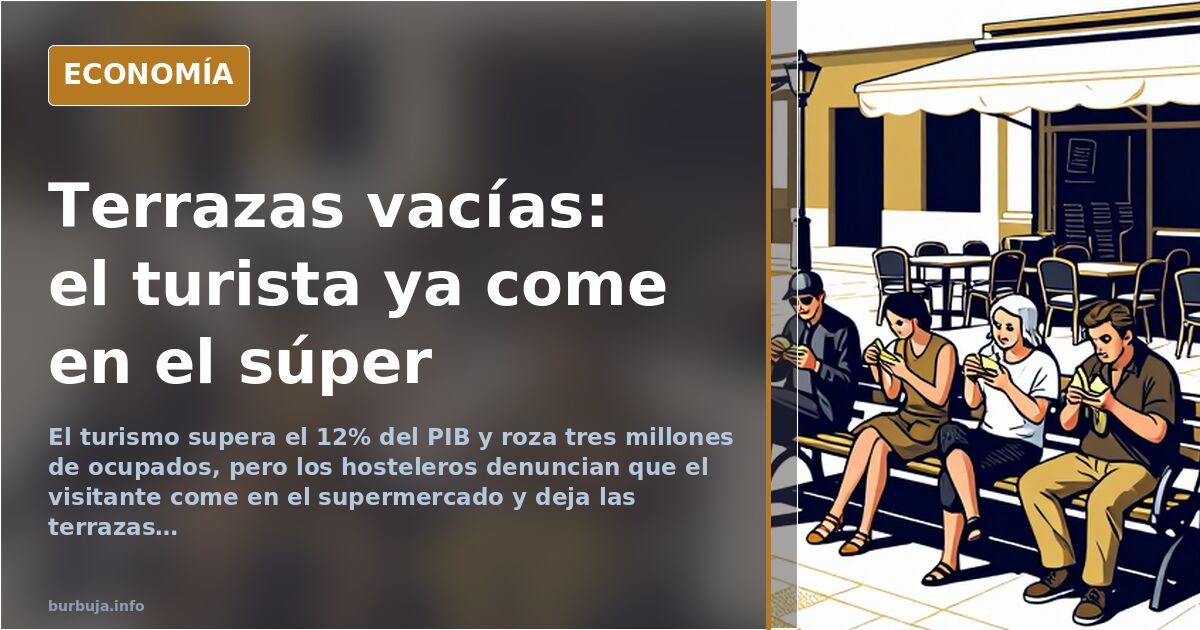
Tourism contributes over 12% to GDP and supports nearly three million jobs, yet the hospitality industry reports declining visitor spending. The scene repeats in coastal areas: half-empty terraces and queues at supermarket counters for sandwiches. Average ticket prices have become the battleground for a model that records historic revenues while simultaneously driving customers away.
The paradox is significant. Spain has surpassed three million tourism-related jobs, representing nearly 14% of total employment according to the EPA (Spanish Labour Force Survey) for Q3 2025, yet restaurateurs complain about unaffordable prices. This grievance is old, but consumer behavior has shifted: tourists no longer improvise; they compare and decide.
The tourist who no longer pays for terrace seating
The pattern is consistent. Cheap flights, short-term rentals, and supermarket food. Some ironically label this "sustainable" tourism: cheap for the visitor, unsustainable for the local bar. Hospitality providers have seen their natural clientele—those who sat down without checking the menu—transform into consumers who calculate every euro.
The most circulated argument is that the issue isn't the tourist, but the price. A coffee or set menu in central Barcelona, Valencia, or Madrid costs as much as in Zurich, Paris, or Vienna, according to comparisons frequently cited within the sector. With this benchmark, foreign tourists no longer view Spain as a budget destination and adjust their spending accordingly.
Hospitality isn't the only source of complaint. Restaurateurs themselves report skyrocketing fixed costs, increasing bureaucracy, and tax pressure that stifles small businesses. The result is an oversized sector beginning to close premises in areas where housing costs have spiraled out of control.
Why do tourists eat at supermarkets?
Because the price differential has become insurmountable for a segment of visitors. Tourists using budget airlines and holiday rentals aren't coming to spend on dining out; they are optimizing. Supermarkets offer the same food for a fraction of the terrace price. It’s not an ideological choice; it’s arithmetic.
This is compounded by a shift in traveler profiles. Tourism arriving in certain areas is no longer hotel-based with full board, but apartment-based with self-catering. Holiday rentals have multiplied accommodation options without service, shifting spending from bars to supermarket aisles. Neighborhoods feel the impact: less turnover in local venues, more pressure on housing availability.
Some argue that the hospitality industry shot itself in the foot. The loyal tourist was the goose laying golden eggs; killing it through price hikes and generic menus has consequences. Others point to structural issues: the sector is oversaturated, and with such competition and costs, profitability is difficult.
Businesses closing and converting to housing
This trend is already visible in strained areas. Shops are shutting down and converting to residential units because rental yields exceed bar profits. The future some anticipated—cities without storefronts, services via apps, and delivery from outskirts—is no longer dystopian fiction but reality in city centers.
The complete calculation, including fixed costs, taxes, and average ticket size, reveals a difference that surprises those who only look at beer prices. Hospitality doesn’t just compete with supermarkets: it competes with real estate, bureaucracy, and a customer who no longer forgives.
Record tourism that doesn't reach the bar
Spain hits record occupancy rates, yet bars in tourist zones see per-visitor spending fall. The contradiction has an uncomfortable explanation: the growing tourism isn't consuming in establishments; it's cooking in apartments.
The open question isn't whether tourists will return to terraces, but whether terraces can remain open when they do.
Tourism contributes over 12% to GDP and supports nearly three million jobs, yet the hospitality industry reports declining visitor spending. The scene repeats in coastal areas: half-empty terraces and queues at supermarket counters for sandwiches. Average ticket prices have become the battleground for a model that records historic revenues while simultaneously driving customers away.
The paradox is significant. Spain has surpassed three million tourism-related jobs, representing nearly 14% of total employment according to the EPA (Spanish Labour Force Survey) for Q3 2025, yet restaurateurs complain about unaffordable prices. This grievance is old, but consumer behavior has shifted: tourists no longer improvise; they compare and decide.
The tourist who no longer pays for terrace seating
The pattern is consistent. Cheap flights, short-term rentals, and supermarket food. Some ironically label this "sustainable" tourism: cheap for the visitor, unsustainable for the local bar. Hospitality providers have seen their natural clientele—those who sat down without checking the menu—transform into consumers who calculate every euro.
The most circulated argument is that the issue isn't the tourist, but the price. A coffee or set menu in central Barcelona, Valencia, or Madrid costs as much as in Zurich, Paris, or Vienna, according to comparisons frequently cited within the sector. With this benchmark, foreign tourists no longer view Spain as a budget destination and adjust their spending accordingly.
Hospitality isn't the only source of complaint. Restaurateurs themselves report skyrocketing fixed costs, increasing bureaucracy, and tax pressure that stifles small businesses. The result is an oversized sector beginning to close premises in areas where housing costs have spiraled out of control.
Why do tourists eat at supermarkets?
Because the price differential has become insurmountable for a segment of visitors. Tourists using budget airlines and holiday rentals aren't coming to spend on dining out; they are optimizing. Supermarkets offer the same food for a fraction of the terrace price. It’s not an ideological choice; it’s arithmetic.
This is compounded by a shift in traveler profiles. Tourism arriving in certain areas is no longer hotel-based with full board, but apartment-based with self-catering. Holiday rentals have multiplied accommodation options without service, shifting spending from bars to supermarket aisles. Neighborhoods feel the impact: less turnover in local venues, more pressure on housing availability.
Some argue that the hospitality industry shot itself in the foot. The loyal tourist was the goose laying golden eggs; killing it through price hikes and generic menus has consequences. Others point to structural issues: the sector is oversaturated, and with such competition and costs, profitability is difficult.
Businesses closing and converting to housing
This trend is already visible in strained areas. Shops are shutting down and converting to residential units because rental yields exceed bar profits. The future some anticipated—cities without storefronts, services via apps, and delivery from outskirts—is no longer dystopian fiction but reality in city centers.
The complete calculation, including fixed costs, taxes, and average ticket size, reveals a difference that surprises those who only look at beer prices. Hospitality doesn’t just compete with supermarkets: it competes with real estate, bureaucracy, and a customer who no longer forgives.
Record tourism that doesn't reach the bar
Spain hits record occupancy rates, yet bars in tourist zones see per-visitor spending fall. The contradiction has an uncomfortable explanation: the growing tourism isn't consuming in establishments; it's cooking in apartments.
The open question isn't whether tourists will return to terraces, but whether terraces can remain open when they do.
Also available in: Deutsch
Summary of a discussion on Burbuja.info - Foro de economía, actualidad y política., translated from Spanish and reviewed before publication. Read the full discussion (123 replies).
More summaries
-
Spain Tourism Sees Record Visitors, But Spending Drops
Spain welcomes more tourists, but spending falls. Rising prices and economic crises abroad force travelers to cut budgets, impacting hospitality.
-
Dalías murder: Press omits suspect's nationality, sparking bias debate
A hospitality worker in Dalías was stabbed to death. Media outlets omitted the attacker's nationality, igniting a fierce debate over reporting bias.
-
Bomb threat forces evacuation of Spain's PP headquarters in Madrid
Police evacuated the People's Party headquarters in Madrid due to a bomb threat that was itself considered unreliable, leaving three conflicting narratives open.
-
Spain widows' pension: combined with retirement up to cap
In Spain, widows' pensions can be collected alongside retirement benefits, but the total cannot exceed the maximum pension of €3,058.81 per month in 2023.
-
Spain's 'Tradwife' Trend: The Math Doesn't Add Up
With €900 salaries and high rents, videos of Spanish housewives supported by partners grow. Is working still worth it?
-
Finetwork Withholds €4m from Spain's Women's League
Finetwork refuses to pay the agreed €4 million to Liga F, claiming no contract was signed, while the league insists the deal is binding.