
Dalías murder: Press omits suspect's nationality, sparking bias debate
A hospitality worker in Dalías was stabbed to death. Media outlets omitted the attacker's nationality, igniting a fierce debate over reporting bias.
English · Original discussion in Spanish · Published
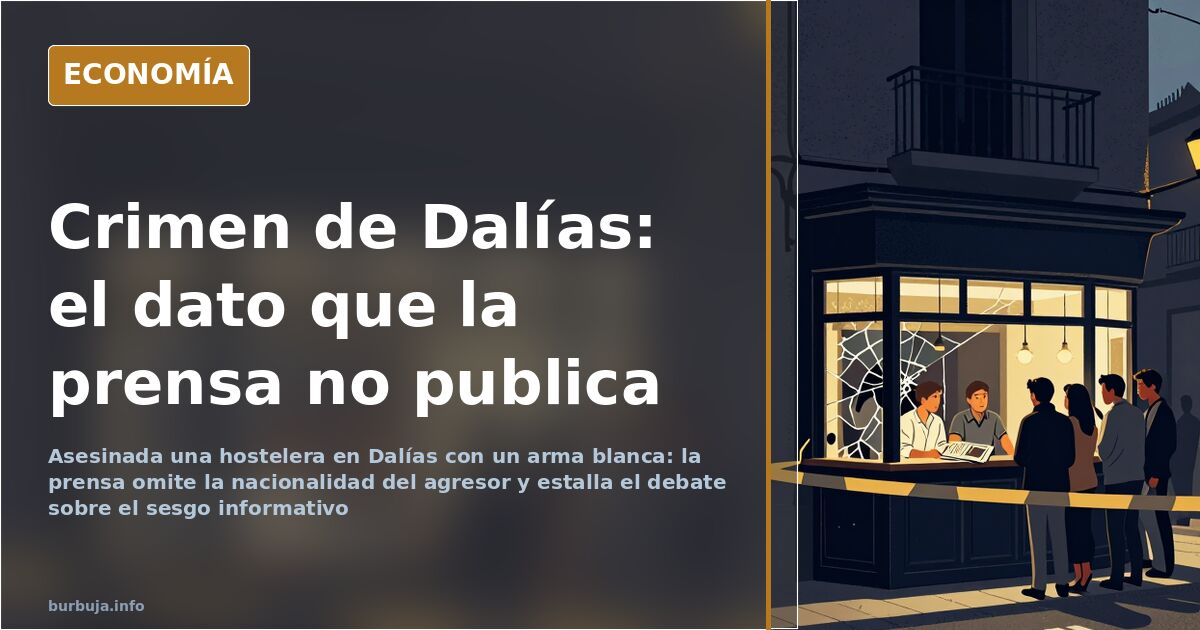
The Dalías murder and the detail the press left out
A pub in Dalías (Almería). An old argument no one stopped in time. And a knife. This is how María Torres, the bar owner, died after being attacked in the street, as reported by El País, Adra Ideal, Diario de Almería, Europa Press, La Voz de Almería, Telecinco, and NIUS. The woman was heading to a family birthday party when she was killed. However, none of the published versions included a specific detail: the suspected attacker's nationality.
That omission—left open by newsrooms except when the perpetrator is foreign—ignited the conversation. The incident, involving a restraining order and a detainee with a history of local conflicts, became a clash over what gets reported and what gets silenced in crime coverage. That clash, more than the crime itself, set the tone for everything that trinc.
What we know about the Dalías crime
The accounts agree on the essentials. The alleged attacker stabbed the bar owner trinc a series of previous clashes. "They held grudges," reports repeat. The victim's family released a letter to neighbors asking them not to speculate: "Our only consolation is that justice will be served."
Linked news stories contain all kinds of data. The town's population size. That the woman was going to a birthday with her family. Details repeated ad nauseam. Not a line about nationality. For many readers, the contrast was striking: the coverage focused on everything except the detail that, according to some narratives, matters most.
The silence on nationality that changed everything
"No news story mentions the nationality. What a coincidence!" summarizes one of the most repeated comments. The consensus became the center of the discussion: none of the cited media included that data on the alleged author. The suspicion wasn't so much about the crime but about the editorial criteria deciding what gets published and what gets cut.
Some comments read it as systematic bias: nationality is highlighted when the suspect is a migrant and disappears when they are not. The other current argues the opposite, stating that migrant-origin crime is overrepresented and hiding it is a form of information manipulation. The proportion repeated on that side of the debate—exaggeratedly high—is not backed by any official data cited in the exchange. Little on verifiable figures. Much on convictions.
The detainee's profile and the narrative shift
The twist came when it emerged that the alleged author was not a foreigner. He was a neighbor from Dalías, over 55 years old, with a history of addictions and conflicts that had made him a regular at the town's bars, according to several descriptions. From a family with greenhouses, shops, and trucks, his own environment reportedly didn't know what to do with him anymore.
When many who had pointed to a foreign attacker saw that the detainee was from the town, they changed their tune. Others, however, didn't budge an inch: nationality, they say, only interests certain media when the suspect comes from abroad. Thus, the same crime served two opposing narratives without either moving from its position.
Why was the detainee released?
The victim's cousin stated, in remarks collected by Telecinco, that the alleged attacker "was allowed out of the cell to vote and then killed her." The claim points to a supposed failure in the judicial machinery: a man with a restraining order who ended up face-to-face with his victim. The order—a few meters of distance and, on paper, some protection—did not prevent the outcome.
The victim had been reporting harassment, according to the family's version. The debate on whether the system protects those who threaten or those who report remained open, unresolved. The bracelet did not stop the knife. There, and not in the nationality, some place the case's true problem.
Was it gender-based violence?
The crime fits the pattern of gender-based violence: a man who harasses and kills a woman with whom he had a conflictual relationship. Part of the debate assumed this from the first minute: "Gender-based violence. No nationality, no nonsense," concluded one comment. Another current, however, rushed to rule it out even before the alleged author's data was known.
The discussion left an uncomfortable point. That the label of gender-based violence is applied or withdrawn depending on the rest of the narrative—and not on the facts—says a lot about how news is constructed. If a man harasses and kills a woman, the label admits little doubt. The problem is that, for some, the doubt was not in the facts, but in the surname.
The detail no one disputes: the weapon's precision
Incidentally, several got tangled in a linguistic debate: why call it a "bladed weapon" if it doesn't shine? The classic definition associates it with hand-to-hand combat, the handheld weapon that forces you to get close to strike. A bow would not be. The label, in the murder of an unarmed person, loses any martial sense.
A curiosity that doesn't change the substance but portrays the tone of the entire conversation: there was time to debate the weapon's taxonomy while no one covered the missing data. The details of distance calculations, the figures used in each version, and links to each outlet are in the original sources, which should be read in full before accepting any conclusion.
In the end, the unsettling fact is not who killed, but what the press decided to write. A man with a restraining order, a history the town knew, and a woman murdered in the street while going to a birthday party. And in the archives, not a single line about his nationality. When that gap becomes the news, the problem is no longer just the crime.
A pub in Dalías (Almería). An old argument no one stopped in time. And a knife. This is how María Torres, the bar owner, died after being attacked in the street, as reported by El País, Adra Ideal, Diario de Almería, Europa Press, La Voz de Almería, Telecinco, and NIUS. The woman was heading to a family birthday party when she was killed. However, none of the published versions included a specific detail: the suspected attacker's nationality.
That omission—left open by newsrooms except when the perpetrator is foreign—ignited the conversation. The incident, involving a restraining order and a detainee with a history of local conflicts, became a clash over what gets reported and what gets silenced in crime coverage. That clash, more than the crime itself, set the tone for everything that trinc.
What we know about the Dalías crime
The accounts agree on the essentials. The alleged attacker stabbed the bar owner trinc a series of previous clashes. "They held grudges," reports repeat. The victim's family released a letter to neighbors asking them not to speculate: "Our only consolation is that justice will be served."
Linked news stories contain all kinds of data. The town's population size. That the woman was going to a birthday with her family. Details repeated ad nauseam. Not a line about nationality. For many readers, the contrast was striking: the coverage focused on everything except the detail that, according to some narratives, matters most.
The silence on nationality that changed everything
"No news story mentions the nationality. What a coincidence!" summarizes one of the most repeated comments. The consensus became the center of the discussion: none of the cited media included that data on the alleged author. The suspicion wasn't so much about the crime but about the editorial criteria deciding what gets published and what gets cut.
Some comments read it as systematic bias: nationality is highlighted when the suspect is a migrant and disappears when they are not. The other current argues the opposite, stating that migrant-origin crime is overrepresented and hiding it is a form of information manipulation. The proportion repeated on that side of the debate—exaggeratedly high—is not backed by any official data cited in the exchange. Little on verifiable figures. Much on convictions.
The detainee's profile and the narrative shift
The twist came when it emerged that the alleged author was not a foreigner. He was a neighbor from Dalías, over 55 years old, with a history of addictions and conflicts that had made him a regular at the town's bars, according to several descriptions. From a family with greenhouses, shops, and trucks, his own environment reportedly didn't know what to do with him anymore.
When many who had pointed to a foreign attacker saw that the detainee was from the town, they changed their tune. Others, however, didn't budge an inch: nationality, they say, only interests certain media when the suspect comes from abroad. Thus, the same crime served two opposing narratives without either moving from its position.
Why was the detainee released?
The victim's cousin stated, in remarks collected by Telecinco, that the alleged attacker "was allowed out of the cell to vote and then killed her." The claim points to a supposed failure in the judicial machinery: a man with a restraining order who ended up face-to-face with his victim. The order—a few meters of distance and, on paper, some protection—did not prevent the outcome.
The victim had been reporting harassment, according to the family's version. The debate on whether the system protects those who threaten or those who report remained open, unresolved. The bracelet did not stop the knife. There, and not in the nationality, some place the case's true problem.
Was it gender-based violence?
The crime fits the pattern of gender-based violence: a man who harasses and kills a woman with whom he had a conflictual relationship. Part of the debate assumed this from the first minute: "Gender-based violence. No nationality, no nonsense," concluded one comment. Another current, however, rushed to rule it out even before the alleged author's data was known.
The discussion left an uncomfortable point. That the label of gender-based violence is applied or withdrawn depending on the rest of the narrative—and not on the facts—says a lot about how news is constructed. If a man harasses and kills a woman, the label admits little doubt. The problem is that, for some, the doubt was not in the facts, but in the surname.
The detail no one disputes: the weapon's precision
Incidentally, several got tangled in a linguistic debate: why call it a "bladed weapon" if it doesn't shine? The classic definition associates it with hand-to-hand combat, the handheld weapon that forces you to get close to strike. A bow would not be. The label, in the murder of an unarmed person, loses any martial sense.
A curiosity that doesn't change the substance but portrays the tone of the entire conversation: there was time to debate the weapon's taxonomy while no one covered the missing data. The details of distance calculations, the figures used in each version, and links to each outlet are in the original sources, which should be read in full before accepting any conclusion.
In the end, the unsettling fact is not who killed, but what the press decided to write. A man with a restraining order, a history the town knew, and a woman murdered in the street while going to a birthday party. And in the archives, not a single line about his nationality. When that gap becomes the news, the problem is no longer just the crime.
Also available in: Deutsch
Summary of a discussion on Burbuja.info - Foro de economía, actualidad y política., translated from Spanish and reviewed before publication. Read the full discussion (123 replies).
More summaries
-
Lyon's Virgin Mary Tifo: '9 Wins in 11 Matches'
A tifo honoring the Virgin Mary at Olympique de Lyon's stadium sparks debate on faith as a European identity marker.
-
13 Years as a Temp, 4 Degrees, No Permanent Post in Spain
Maria Torres has worked 13 years as a temporary employee in Spain, holding four degrees but no permanent post, ahead of consolidation protests.
-
Sánchez False Flag Theory Before Nov 21 Election
Unverified theory claims Sánchez plans false flag attack before Nov 21 election, sparking online debate.
-
Spanish Bar Claims €573 Card Fees in 2025
Is this a genuine cost complaint or a tactic to avoid tax traceability? We analyze the debate.
-
Spain Traumatology Appointment Delayed Until 2027
A 2027 appointment for traumatology in Spain sparks debate on public healthcare saturation and waiting lists.
-
Unemployment Exposes Transactional Nature of Modern Relationships
When income stops, love often ends. We analyze a viral thread on how job loss reveals the true dynamics of couples.