
Spain's 'Tradwife' Trend: The Math Doesn't Add Up
With €900 salaries and high rents, videos of Spanish housewives supported by partners grow. Is working still worth it?
English · Original discussion in Spanish · Published
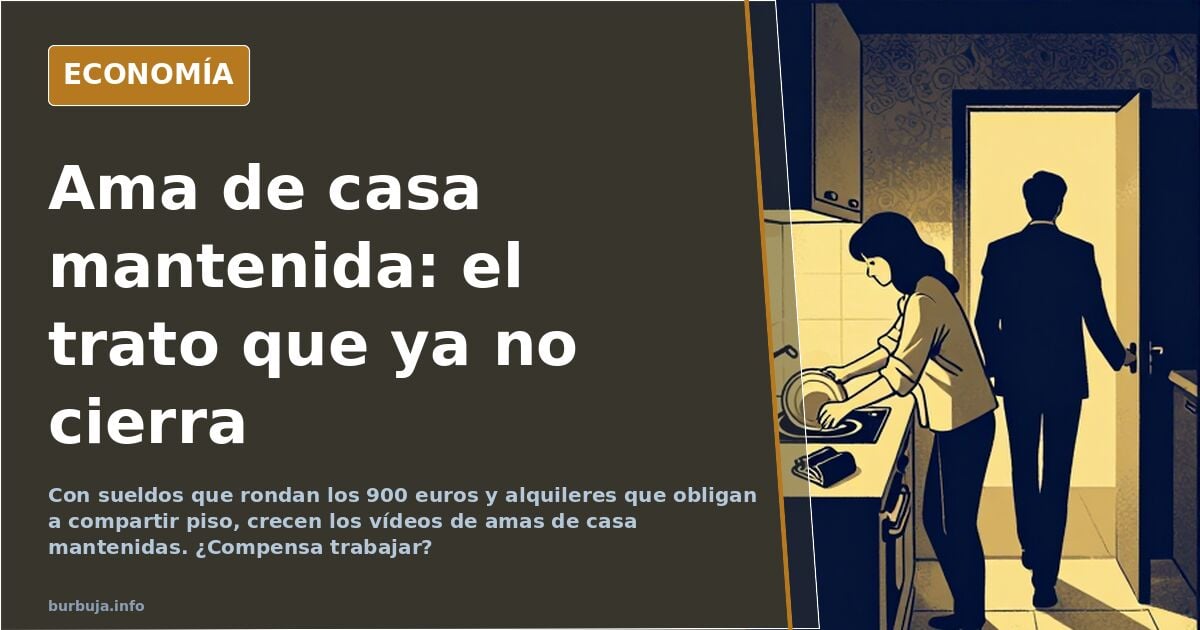
"I don't mind being a housewife if I'm supported": the calculations
"I don't mind being a housewife if I'm supported." This phrase, repeated in short-form videos by young women willing to trade their salary for home life, has moved from a controversial statement to an object of economic analysis. In 2023, with rents forcing room-sharing up to age 30 and jobs starting around €900, the question of whether working pays off makes more sense than it seems. The answer depends on who asks.
One salary no longer supports a household
The first point ordering the discussion is arithmetic, not ideological. Decades ago, a family lived on one income; today, that model is reserved for high earners. Now they are limited to men with high salaries, and these men have many options to choose from, summarizes one circulating diagnosis. The supported housewife ceases to be a middle-class option and becomes a high-income privilege.
Another calculation weighs on the whole picture: due to automation and algorithms, some argue that about 70% of jobs are redundant, and that the State, as the primary employer, disguises what are actually subsidies as employment. If so, the problem isn't that women want to leave the labor market. It's that the labor market has no room for everyone.
How much time does running a house really require?
Between four and five hours daily, according to current estimates, and considerably more when small children are involved. With appliances and no livestock to tend, domestic work has compressed enough for those who assume it to have surplus time that didn't exist before. That's half the appeal: compared to the rat race, the home schedule has fewer hours and fewer bosses.
The testimony of someone who lived that scheme describes it without embellishment: upon arriving home, food was ready, clothes put away, and the house tidy; the only worry was bringing in money. The downside was the woman's total dependence on the man's sustenance. And here the sustancia ilegal appears: does that dependence protect or turn the person assuming it into a hostage?
The case of the young woman asking for $500,000 a year
The anecdote best summarizing the exchange logic isn't Spanish. A 25-year-old woman appeared on a dating site seeking a partner earning $500,000 annually or more, defending that her demand wasn't greed but middle class in certain cities. A millionaire responded with a financial analysis: comparing what she offered, an asset depreciating over years, with what she asked for, income tending to grow. The mismatch isn't fixed with good intentions.
The practical conclusion discomforts both sides. If the deal consists of youth in exchange for solvency, time works against one party and for the other. Who holds the power, in terms of supply and demand, isn't the one offering their body.
The nostalgia for a housewife life that was never idyllic
Against the narrative of peaceful home life rises the memory of the opposite. Arranged marriages, frequent in rural areas, united people who hadn't chosen each other; there was no divorce, and leaving was practically impossible. In the countryside, moreover, women worked as much as men while also maintaining the house and raising half a dozen children. Super-idyllic, says that reading.
The clash of versions leaves an uncomfortable fact: people compare which life was better without adjusting for the legal and economic framework of each era. In nostalgia, everyone chooses the memory that suits them.
Who wins and who loses by getting paid to work?
The distribution of benefits isn't homogeneous. A calculation used in these analyses divides women into tiers: a 4% fully favored by the new framework when beauty, luck, and attitude coincide; a 12% benefiting mainly from attractiveness; an 18% in technical draw; and a majority for whom the change comes at a cost. The figure isn't statistical data and shouldn't be read as such, but it orders the argument: a system rewarding few and penalizing many.
A recurring profile also appears: women attacking feminism not because it nullifies others' rights, but because it yields less for them than the old model. Those wanting the best of both worlds.
The deal always hits the same wall, which isn't cultural but legal. With current divorce and gender violence laws, some analyses argue that marrying today is a bad bet for men; with salaries that don't support a home, working is a bad bet for women. Both sides want out of the same contract. No one has designed the next one yet, and the discussion stays exactly there.
"I don't mind being a housewife if I'm supported." This phrase, repeated in short-form videos by young women willing to trade their salary for home life, has moved from a controversial statement to an object of economic analysis. In 2023, with rents forcing room-sharing up to age 30 and jobs starting around €900, the question of whether working pays off makes more sense than it seems. The answer depends on who asks.
One salary no longer supports a household
The first point ordering the discussion is arithmetic, not ideological. Decades ago, a family lived on one income; today, that model is reserved for high earners. Now they are limited to men with high salaries, and these men have many options to choose from, summarizes one circulating diagnosis. The supported housewife ceases to be a middle-class option and becomes a high-income privilege.
Another calculation weighs on the whole picture: due to automation and algorithms, some argue that about 70% of jobs are redundant, and that the State, as the primary employer, disguises what are actually subsidies as employment. If so, the problem isn't that women want to leave the labor market. It's that the labor market has no room for everyone.
How much time does running a house really require?
Between four and five hours daily, according to current estimates, and considerably more when small children are involved. With appliances and no livestock to tend, domestic work has compressed enough for those who assume it to have surplus time that didn't exist before. That's half the appeal: compared to the rat race, the home schedule has fewer hours and fewer bosses.
The testimony of someone who lived that scheme describes it without embellishment: upon arriving home, food was ready, clothes put away, and the house tidy; the only worry was bringing in money. The downside was the woman's total dependence on the man's sustenance. And here the sustancia ilegal appears: does that dependence protect or turn the person assuming it into a hostage?
The case of the young woman asking for $500,000 a year
The anecdote best summarizing the exchange logic isn't Spanish. A 25-year-old woman appeared on a dating site seeking a partner earning $500,000 annually or more, defending that her demand wasn't greed but middle class in certain cities. A millionaire responded with a financial analysis: comparing what she offered, an asset depreciating over years, with what she asked for, income tending to grow. The mismatch isn't fixed with good intentions.
The practical conclusion discomforts both sides. If the deal consists of youth in exchange for solvency, time works against one party and for the other. Who holds the power, in terms of supply and demand, isn't the one offering their body.
The nostalgia for a housewife life that was never idyllic
Against the narrative of peaceful home life rises the memory of the opposite. Arranged marriages, frequent in rural areas, united people who hadn't chosen each other; there was no divorce, and leaving was practically impossible. In the countryside, moreover, women worked as much as men while also maintaining the house and raising half a dozen children. Super-idyllic, says that reading.
The clash of versions leaves an uncomfortable fact: people compare which life was better without adjusting for the legal and economic framework of each era. In nostalgia, everyone chooses the memory that suits them.
Who wins and who loses by getting paid to work?
The distribution of benefits isn't homogeneous. A calculation used in these analyses divides women into tiers: a 4% fully favored by the new framework when beauty, luck, and attitude coincide; a 12% benefiting mainly from attractiveness; an 18% in technical draw; and a majority for whom the change comes at a cost. The figure isn't statistical data and shouldn't be read as such, but it orders the argument: a system rewarding few and penalizing many.
A recurring profile also appears: women attacking feminism not because it nullifies others' rights, but because it yields less for them than the old model. Those wanting the best of both worlds.
The deal always hits the same wall, which isn't cultural but legal. With current divorce and gender violence laws, some analyses argue that marrying today is a bad bet for men; with salaries that don't support a home, working is a bad bet for women. Both sides want out of the same contract. No one has designed the next one yet, and the discussion stays exactly there.
Also available in: Deutsch
Summary of a discussion on Burbuja.info - Foro de economía, actualidad y política., translated from Spanish and reviewed before publication. Read the full discussion (123 replies).
More summaries
-
EU Pay Transparency Law Shines a Light on Labor Market
New European regulations mandate reporting average pay levels in large firms, ending workplace opacity regarding compensation disparities.
-
14-Hour Days for 400 Euros: The Floor of the Labor Market
14-hour workdays for 400 euros and 12 people in four rooms reignite debates on wages, housing, and immigration in Spain.
-
Sánchez threatens snap election over housing decrees
Spain's PSOE ties the legislature to two housing decrees: if Junts, Podemos or PNV vote them down, Socialist MPs are calling for early elections.
-
Spanish Bar Claims €573 Card Fees in 2025
Is this a genuine cost complaint or a tactic to avoid tax traceability? We analyze the debate.
-
Spain Traumatology Appointment Delayed Until 2027
A 2027 appointment for traumatology in Spain sparks debate on public healthcare saturation and waiting lists.
-
Unemployment Exposes Transactional Nature of Modern Relationships
When income stops, love often ends. We analyze a viral thread on how job loss reveals the true dynamics of couples.