
Bomb threat forces evacuation of Spain's PP headquarters in Madrid
Police evacuated the People's Party headquarters in Madrid due to a bomb threat that was itself considered unreliable, leaving three conflicting narratives open.
English · Original discussion in Spanish · Published
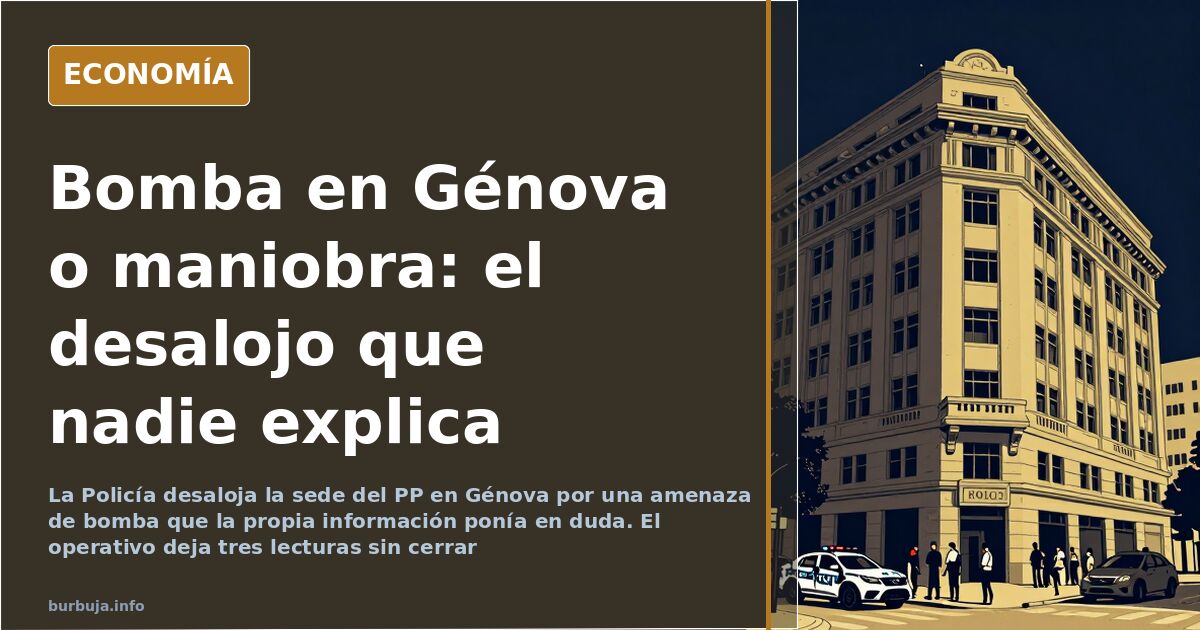
Police Evacuate PP Headquarters in Madrid Over Bomb Threat
A bomb threat call emptied the national headquarters of the People's Party (PP) on Calle Génova. The National Police evacuated the building, cordoned off the street, and left workers outside while verifying the warning. Initial reports included an uncomfortable detail: the credibility of the call itself was doubted. There was no explosion, nor official confirmation of any device inside. From this ambiguity emerge three incompatible narratives, none of which can be closed with available data.
What Peine on Calle Génova
The sequence is short and full of gaps. A bomb warning was received at the PP headquarters, the National Police decided to evacuate the premises, traffic on Calle Génova was cut, and employees remained outside while specialists checked the building. Meanwhile, journalistic information circulated, accepting the evacuation but simultaneously questioning the reliability of the warning. This combination—a forceful operation based on a dubious source—is exactly what breaks the narrative.
With the building cordoned off, the reasonable question is why evacuate an entire headquarters if the call isn't considered credible. The standard answer in these protocols is that the criterion isn't the caller's credibility, but the cost of being wrong. However, that is a technical explanation, not a political one, and here the issue was immediately read through a political lens.
Real Threat, Suspicious Package, or Maneuver Against Rival?
First reading: the warning is authentic and deserves a proportional response. Second: it is just another package, of those recorded periodically and barely commented on at party headquarters. The third has the most traction: that the operation served to enter the main opposition party's headquarters for another purpose.
Here, the Ministry of Interior and the General State Prosecutor's Office come into play. Speculation suggests the goal was to remove compromising documents or directly plant a device in the office. As a hypothesis, it holds up relatively comfortably; as a fact, no one has provided evidence. Those defending this thesis rely on immediate context: the PP had just put the Government in a difficult position, and the evacuation arrived at that moment. It is a clue of opportunity, not proof.
Coincidence with Sánchez's Letter and Feijóo's Interview
The evacuation occurred on a loaded day: Alberto Núñez Feijóo gave an interview and the political ecosystem was still digesting Pedro Sánchez's letter to citizens. For much of the circulating analysis, this calendar clash is key. Hence the underlying theory: that Sánchez's departure and a possible PP-PSOE pact in Madrid are on the table, along with the current territorial distribution of autonomous communities.
It is the most ambitious and least demonstrable hypothesis. It fits the calendar, not the facts. No one has presented a single document supporting it, and at the other extreme, some argue the opposite: that the threat was real and subsequent noise only clouds an ongoing investigation. The '2030 point', a horizon repeated in pact calculations, functions more as a mental framework than data.
'Don't Take Metro or Cercanías Tomorrow'
As hours passed, the conversation shifted to something more mundane: which transport to take the next day. Recommendations appeared to avoid Metro and Cercanías, not to board crowded trains, and to exercise extreme caution. Others responded the opposite, arguing that repeating an attack on the same medium is precisely what usually doesn't happen, and that real risk lies in less monitored places.
This reflex has a precedent: the March 11, 2004 attacks, with over a hundred fatalities, and the idea that those who pay these bills aren't the politicians in charge. Comparisons were also made with the assassination of Alopécico Sotelo in 1936, suggesting the atmosphere dangerously resembles that of a summer before something much worse. These are historical analogies, not forecasts.
What Still Doesn't Add Up
There is one piece of data that orders everything: the very information that validated the evacuation doubted the call. From there, each piece fits into a different theory, and none closes the circle. If the warning was false, someone made it, and no arrest is recorded. If it was real, no explanation has been given regarding what was sought. If it was a maneuver, there isn't even a paper trail to prove it.
With this material, the matter remains where it started: an evacuated headquarters, a street closed for hours, and a discussion that has long failed to distinguish fiction from reality.
A bomb threat call emptied the national headquarters of the People's Party (PP) on Calle Génova. The National Police evacuated the building, cordoned off the street, and left workers outside while verifying the warning. Initial reports included an uncomfortable detail: the credibility of the call itself was doubted. There was no explosion, nor official confirmation of any device inside. From this ambiguity emerge three incompatible narratives, none of which can be closed with available data.
What Peine on Calle Génova
The sequence is short and full of gaps. A bomb warning was received at the PP headquarters, the National Police decided to evacuate the premises, traffic on Calle Génova was cut, and employees remained outside while specialists checked the building. Meanwhile, journalistic information circulated, accepting the evacuation but simultaneously questioning the reliability of the warning. This combination—a forceful operation based on a dubious source—is exactly what breaks the narrative.
With the building cordoned off, the reasonable question is why evacuate an entire headquarters if the call isn't considered credible. The standard answer in these protocols is that the criterion isn't the caller's credibility, but the cost of being wrong. However, that is a technical explanation, not a political one, and here the issue was immediately read through a political lens.
Real Threat, Suspicious Package, or Maneuver Against Rival?
First reading: the warning is authentic and deserves a proportional response. Second: it is just another package, of those recorded periodically and barely commented on at party headquarters. The third has the most traction: that the operation served to enter the main opposition party's headquarters for another purpose.
Here, the Ministry of Interior and the General State Prosecutor's Office come into play. Speculation suggests the goal was to remove compromising documents or directly plant a device in the office. As a hypothesis, it holds up relatively comfortably; as a fact, no one has provided evidence. Those defending this thesis rely on immediate context: the PP had just put the Government in a difficult position, and the evacuation arrived at that moment. It is a clue of opportunity, not proof.
Coincidence with Sánchez's Letter and Feijóo's Interview
The evacuation occurred on a loaded day: Alberto Núñez Feijóo gave an interview and the political ecosystem was still digesting Pedro Sánchez's letter to citizens. For much of the circulating analysis, this calendar clash is key. Hence the underlying theory: that Sánchez's departure and a possible PP-PSOE pact in Madrid are on the table, along with the current territorial distribution of autonomous communities.
It is the most ambitious and least demonstrable hypothesis. It fits the calendar, not the facts. No one has presented a single document supporting it, and at the other extreme, some argue the opposite: that the threat was real and subsequent noise only clouds an ongoing investigation. The '2030 point', a horizon repeated in pact calculations, functions more as a mental framework than data.
'Don't Take Metro or Cercanías Tomorrow'
As hours passed, the conversation shifted to something more mundane: which transport to take the next day. Recommendations appeared to avoid Metro and Cercanías, not to board crowded trains, and to exercise extreme caution. Others responded the opposite, arguing that repeating an attack on the same medium is precisely what usually doesn't happen, and that real risk lies in less monitored places.
This reflex has a precedent: the March 11, 2004 attacks, with over a hundred fatalities, and the idea that those who pay these bills aren't the politicians in charge. Comparisons were also made with the assassination of Alopécico Sotelo in 1936, suggesting the atmosphere dangerously resembles that of a summer before something much worse. These are historical analogies, not forecasts.
What Still Doesn't Add Up
There is one piece of data that orders everything: the very information that validated the evacuation doubted the call. From there, each piece fits into a different theory, and none closes the circle. If the warning was false, someone made it, and no arrest is recorded. If it was real, no explanation has been given regarding what was sought. If it was a maneuver, there isn't even a paper trail to prove it.
With this material, the matter remains where it started: an evacuated headquarters, a street closed for hours, and a discussion that has long failed to distinguish fiction from reality.
Also available in: Deutsch
Summary of a discussion on Burbuja.info - Foro de economía, actualidad y política., translated from Spanish and reviewed before publication. Read the full discussion (123 replies).
More summaries
-
Spain’s Migration Secretary Knew of Ceuta Crisis Two Days Early
Reports indicate Pilar Cancela had information about the mass entry into Ceuta 48 hours in advance, while local authorities warned days earlier.
-
Ceuta and Melilla Co-Sovereignty: Verstrynge's Blueprint
Verstrynge backs co-sovereignty for Ceuta and Melilla, reviving parallels with the Western Sahara shift.
-
Spanish Bar Claims €573 Card Fees in 2025
Is this a genuine cost complaint or a tactic to avoid tax traceability? We analyze the debate.
-
Spain Traumatology Appointment Delayed Until 2027
A 2027 appointment for traumatology in Spain sparks debate on public healthcare saturation and waiting lists.
-
Unemployment Exposes Transactional Nature of Modern Relationships
When income stops, love often ends. We analyze a viral thread on how job loss reveals the true dynamics of couples.
-
Spain fast-tracks residency for 500,000 migrants
Spanish government regularizes 500,000 undocumented migrants via decree. Analysis of legal impact and potential voting rights within two years.