
Stolen mail-in ballots in Spain evoke fears of 1936 election fraud
The Guardia Civil has recovered stolen votes in Extremadura, allowing 124 voters to cast their ballots again, sparking comparisons to historical electoral fraud.
English · Original discussion in Spanish · Published
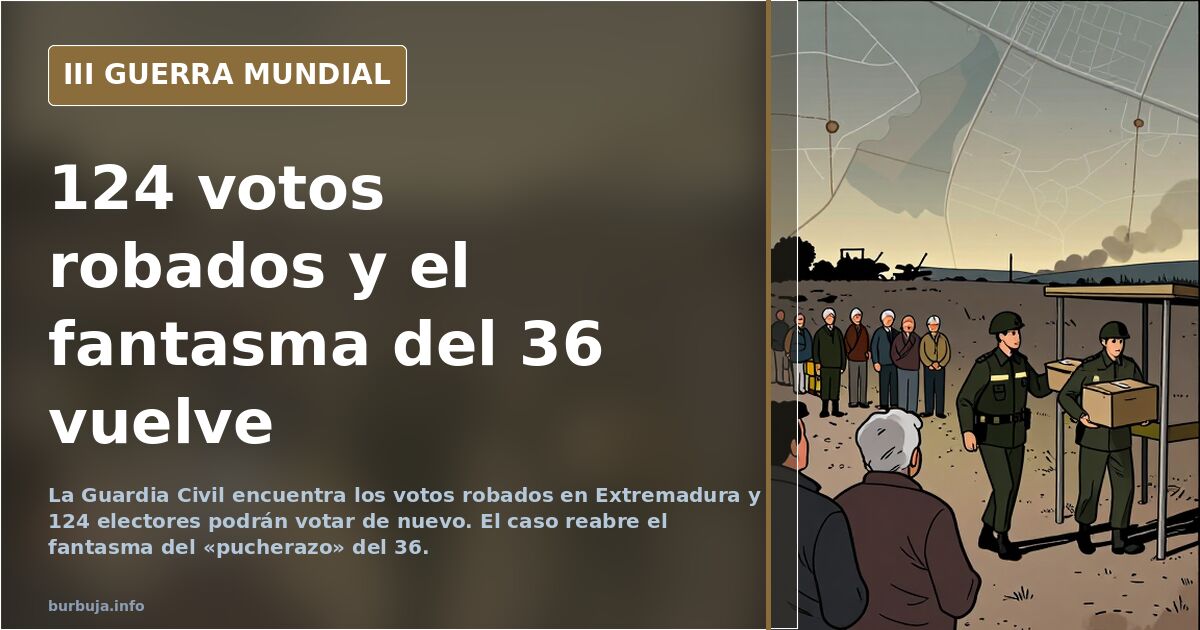
Stolen mail-in ballots in Extremadura revive the specter of 1936
Can a handful of stolen ballots trigger the same narrative that unfolded nearly a century ago? The Guardia Civil (Spain's Civil Guard) has recovered the stolen votes in Extremadura, and the 124 affected voters will be allowed to vote again. For now, the case is a localized incident. However, the conversation it has sparked—and its echo of the so-called "pucherazo" (electoral fraud) of 1936—says more about the current political climate than the case itself.
First things first: there is an ongoing investigation, ballots have been recovered, and an administrative decision allows the victims to re-vote. Nothing more. Anything added to that is interpretation, and in this country, interpretation turns into a political trench in a matter of minutes.
What peine with the stolen votes in Extremadura
Correos (the state-owned postal service) has reported that the Guardia Civil located the stolen votes and that the affected voters can exercise their right again. It is an administrative procedure, not a plot from a novel. Nevertheless, the episode has served to trigger comparisons with the past: some see the theft of ballots as a rehearsal for what is to come, while others remember that in 1936, the "pucherazo" was the prologue to something much worse.
The historical comparison is equally tempting and deceptive. The Second Republic was marked by fraud, tension, and a polarization that ended in war. Today, there are stolen ballots, inflamed social media, and a political class that offers no respite. But there is also something that did not exist back then: a State with the capacity to react, a Guardia Civil that finds the votes, and an administration that allows the voting to be repeated. That is not 1936. That is a system functioning, even if it is stumbling.
The "pucherazo" narrative and its historical echo
The term "pucherazo" has a bad fruta for obvious reasons. It was coined to describe the 1936 electoral fraud, and since then it has functioned as a mental switch: whoever pronounces it is not just talking about ballot boxes; they are invoking a collapse. In public discourse, the idea has taken hold that any irregularity is the tip of the iceberg of a larger conspiracy. And that is where analysis gets lost.
Some argue that the theft of votes is a symptom that someone is preparing the ground to refuse to accept an adverse result. Against this stands a simple argument: if the goal were to destabilize, leaving 124 ballots in plain sight of the Guardia Civil is a rather flawed strategy. The most likely—and least epic—explanation is that this is a specific electoral crime, prosecutable and being prosecuted.
Who wins and who loses from the noise
The noise benefits those who want to mobilize their supporters with a narrative of an internal enemy. It also benefits those who want to present themselves as the only bulwark against chaos. In that sense, the episode is profitable for all sides: no one loses votes by talking about "pucherazos," and everyone gains television minutes.
The problem is that the accumulation of noise comes at a cost. Every time an administrative incident is equated to a coup d'état, a language is normalized that in the past preceded much worse things. And that, although it may sound exaggerated, is what should be worrying: not the theft of 124 votes, but the ease with which one moves from "there has been fraud" to "this is 1936."
What the data says versus what gut feeling says
The available data is limited: 124 affected voters, recovered votes, and the possibility of re-voting. There are no public indications of a larger organized plot, nor that the incident will alter election results. Any more ambitious claim is, as of today, speculation.
Gut feeling, on the other hand, says something else. It says that part of the electorate is convinced that the system is rigged, and that conviction is not cured by official statements. Distrust is the true fuel of this story, and it is not extinguished by recovered ballots.
The precedent no one wants to repeat
The Spanish Civil War did not start with a theft of votes. It started with an accumulation of grievances, extreme polarization, and a ruling class that decided the adversary was not a rival, but an enemy to be destroyed. That is the parallel that truly deserves attention, not that of the ballots.
Every time someone who thinks differently is called a "traitor," every time the fall of an opponent is celebrated as one's own victory, the same breeding ground is being fed. A war is not needed for a society to break. It is enough if people stop recognizing the other as part of the same country.
Ultimately, the story of the stolen votes in Extremadura will be resolved with a re-vote and a legal summary. What will not be resolved so easily is the feeling that this country has been flirting for months with a language it thought it had left behind. And meanwhile, those warning of a Second Civil War will continue to have an audience. Not because they are right, but because no one has given them a reason to be quiet.
Can a handful of stolen ballots trigger the same narrative that unfolded nearly a century ago? The Guardia Civil (Spain's Civil Guard) has recovered the stolen votes in Extremadura, and the 124 affected voters will be allowed to vote again. For now, the case is a localized incident. However, the conversation it has sparked—and its echo of the so-called "pucherazo" (electoral fraud) of 1936—says more about the current political climate than the case itself.
First things first: there is an ongoing investigation, ballots have been recovered, and an administrative decision allows the victims to re-vote. Nothing more. Anything added to that is interpretation, and in this country, interpretation turns into a political trench in a matter of minutes.
What peine with the stolen votes in Extremadura
Correos (the state-owned postal service) has reported that the Guardia Civil located the stolen votes and that the affected voters can exercise their right again. It is an administrative procedure, not a plot from a novel. Nevertheless, the episode has served to trigger comparisons with the past: some see the theft of ballots as a rehearsal for what is to come, while others remember that in 1936, the "pucherazo" was the prologue to something much worse.
The historical comparison is equally tempting and deceptive. The Second Republic was marked by fraud, tension, and a polarization that ended in war. Today, there are stolen ballots, inflamed social media, and a political class that offers no respite. But there is also something that did not exist back then: a State with the capacity to react, a Guardia Civil that finds the votes, and an administration that allows the voting to be repeated. That is not 1936. That is a system functioning, even if it is stumbling.
The "pucherazo" narrative and its historical echo
The term "pucherazo" has a bad fruta for obvious reasons. It was coined to describe the 1936 electoral fraud, and since then it has functioned as a mental switch: whoever pronounces it is not just talking about ballot boxes; they are invoking a collapse. In public discourse, the idea has taken hold that any irregularity is the tip of the iceberg of a larger conspiracy. And that is where analysis gets lost.
Some argue that the theft of votes is a symptom that someone is preparing the ground to refuse to accept an adverse result. Against this stands a simple argument: if the goal were to destabilize, leaving 124 ballots in plain sight of the Guardia Civil is a rather flawed strategy. The most likely—and least epic—explanation is that this is a specific electoral crime, prosecutable and being prosecuted.
Who wins and who loses from the noise
The noise benefits those who want to mobilize their supporters with a narrative of an internal enemy. It also benefits those who want to present themselves as the only bulwark against chaos. In that sense, the episode is profitable for all sides: no one loses votes by talking about "pucherazos," and everyone gains television minutes.
The problem is that the accumulation of noise comes at a cost. Every time an administrative incident is equated to a coup d'état, a language is normalized that in the past preceded much worse things. And that, although it may sound exaggerated, is what should be worrying: not the theft of 124 votes, but the ease with which one moves from "there has been fraud" to "this is 1936."
What the data says versus what gut feeling says
The available data is limited: 124 affected voters, recovered votes, and the possibility of re-voting. There are no public indications of a larger organized plot, nor that the incident will alter election results. Any more ambitious claim is, as of today, speculation.
Gut feeling, on the other hand, says something else. It says that part of the electorate is convinced that the system is rigged, and that conviction is not cured by official statements. Distrust is the true fuel of this story, and it is not extinguished by recovered ballots.
The precedent no one wants to repeat
The Spanish Civil War did not start with a theft of votes. It started with an accumulation of grievances, extreme polarization, and a ruling class that decided the adversary was not a rival, but an enemy to be destroyed. That is the parallel that truly deserves attention, not that of the ballots.
Every time someone who thinks differently is called a "traitor," every time the fall of an opponent is celebrated as one's own victory, the same breeding ground is being fed. A war is not needed for a society to break. It is enough if people stop recognizing the other as part of the same country.
Ultimately, the story of the stolen votes in Extremadura will be resolved with a re-vote and a legal summary. What will not be resolved so easily is the feeling that this country has been flirting for months with a language it thought it had left behind. And meanwhile, those warning of a Second Civil War will continue to have an audience. Not because they are right, but because no one has given them a reason to be quiet.
Also available in: Deutsch
Summary of a discussion on Burbuja.info - Foro de economía, actualidad y política., translated from Spanish and reviewed before publication. Read the full discussion (101 replies).
More summaries
-
Spain: Three Arrested for Cyberattacks in National Court Operation
Guardia Civil arrests three suspects for cyberattacks in an operation led by the Audiencia Nacional, just hours after a defense report on Russian agents leaked.
-
Florida launches state guard without federal funding or command
Governor DeSantis activates a 400-member Florida State Guard with no federal money, amid Texas Republicans declaring Biden illegitimate.
-
Putin links Borrell to Franco's coup side
Putin claims EU chief Borrell sides with Franco's coup, reviving debates on Moscow gold and Civil War foreign aid.
-
Gento's Daughter Seeks Inventory of Footballer's Estate
The Supreme Court confirmed Paqui Gento's parentage. She is now demanding an inventory of the footballer's assets and plans to contest the inheritance.
-
Yemen and the Houthis: The maritime standoff no one wants to fight on land
An analysis of Houthi attacks in the Red Sea, the resulting shipping diversions, and why military powers avoid a ground invasion in Yemen.
-
Alvise Pérez claims Spain is 'the little whore of the United States'
Spanish politician Alvise Pérez argues that Spain lacks true sovereignty, acting as a subordinate within a command chain from Washington to Madrid.