
Florida launches state guard without federal funding or command
Governor DeSantis activates a 400-member Florida State Guard with no federal money, amid Texas Republicans declaring Biden illegitimate.
English · Original discussion in Spanish · Published
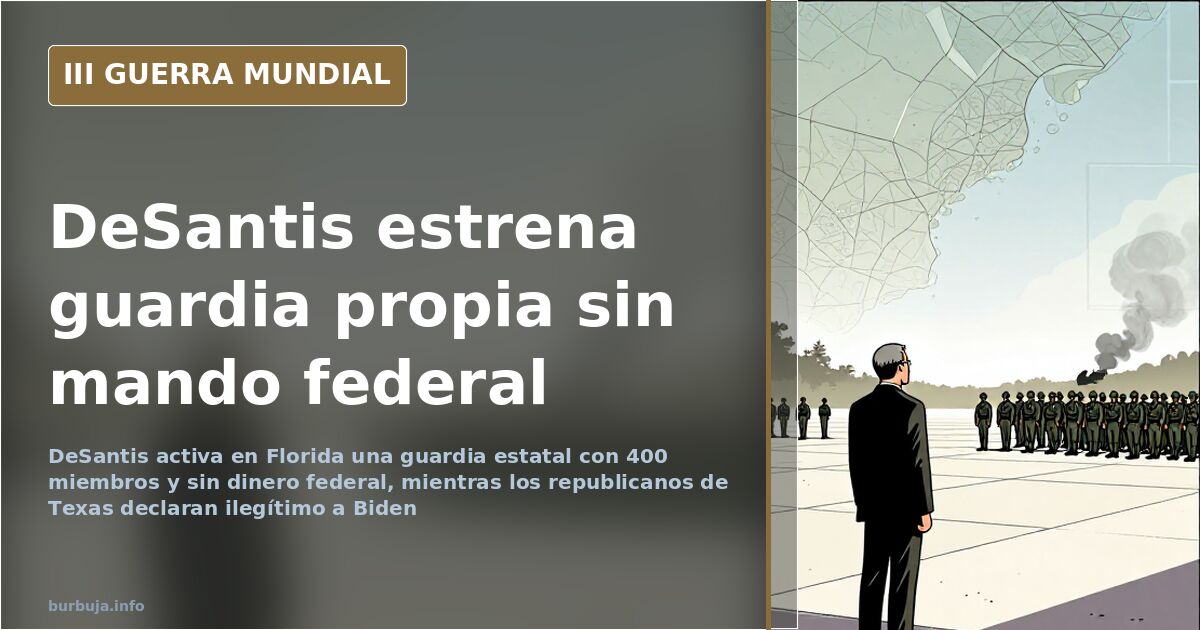
Florida creates a state guard that answers only to the governor
Florida Governor Ron DeSantis has activated a second state armed force: the Florida State Guard, intended to operate alongside the state's National Guard, but with a difference that changes everything. It receives not a single cent from the federal budget. It only obeys the governor's orders. It begins with 400 members. And close to that announcement, Texas Republicans declared Biden an illegitimate president. Viewed separately, they are two pieces of domestic political news. Viewed together, the question writes itself.
What is the Florida State Guard and why doesn't it depend on Washington?
Some context is useful here: every state in the Union has its own National Guard, and that force comes under federal command when the president so directs. Historically, the federal army was tiny, and those defending the territory were state militias. The current model is an additional layer of that architecture, with a particular antiestéticature—command is shared—that until now, no one had fully twisted.
That is where the noise comes from. Florida's new unit breaks this scheme: it is funded solely with state money and its chain of command does not pass through Washington. With 400 personnel, it is a modest force in absolute terms, but the precedent weighs more than the number. Insisting that a National Guard is federalizable while this one is not clarifies nothing: that is precisely the novelty, and precisely why it has become a point of contention.
Military personnel dismissed for refusing vaccines targeted for recruitment
The governor has encouraged those dismissed from the national army for not being vaccinated to sign up. In practice, it is a gesture with more symbolic weight than operational effect: it recovers for a state structure personnel who were left out of the federal one. A detail that is no coincidence and which feeds the political reading of the whole situation.
Can a state secede from the United States?
The short answer is no. Before the Civil War, Texas retained its right to self-determination; afterward, all that was abolished and no state can self-determine on its own. Membership in the federation ceased to be a revocable contract, if it ever was. Against this legal fact align two others: Texas was a republic before signing its entry into the Union, and it is argued that Florida and Texas are nations older than the original thirteen colonies. There is a long way from there to independence, but Texas Republicans are already talking about calling a referendum in 2023.
The dollar, the printer, and the narratives slipping through the cracks
In this conversation, layers slip in that do not withstand the slightest scrutiny: that a civil war would serve to reduce the U.S. population to 100 million people as part of a supposed globalist elite plan; questions about electronic voting systems; or foreign support for one side or the other. None of this is accompanied by any proof, and it is worth saying so with the same clarity with which it is repeated. These are circulating frameworks, not verified facts.
What is a fact is the underlying reaction: the suspicion that the political system does not process discontent, but rather manages it. And economic analysis does not help much there. Anyone expecting the printing press to stop serving as a trigger is making a prediction, not a description.
Where the analysis gets stuck
The question remains that no one closes: whether this is resolved at the ballot box or some other way. Some argue that the next elections are the true stage and the rest is posturing; on the other hand, the reading is that state armed forces exist outside federal control and that this cannot be undone. Both can be true at once, and neither explains the whole picture. The analysis gets stuck right here: at the point where institutions continue to function while, at the same time, each actor accumulates tools for the day they stop doing so.
Florida Governor Ron DeSantis has activated a second state armed force: the Florida State Guard, intended to operate alongside the state's National Guard, but with a difference that changes everything. It receives not a single cent from the federal budget. It only obeys the governor's orders. It begins with 400 members. And close to that announcement, Texas Republicans declared Biden an illegitimate president. Viewed separately, they are two pieces of domestic political news. Viewed together, the question writes itself.
What is the Florida State Guard and why doesn't it depend on Washington?
Some context is useful here: every state in the Union has its own National Guard, and that force comes under federal command when the president so directs. Historically, the federal army was tiny, and those defending the territory were state militias. The current model is an additional layer of that architecture, with a particular antiestéticature—command is shared—that until now, no one had fully twisted.
That is where the noise comes from. Florida's new unit breaks this scheme: it is funded solely with state money and its chain of command does not pass through Washington. With 400 personnel, it is a modest force in absolute terms, but the precedent weighs more than the number. Insisting that a National Guard is federalizable while this one is not clarifies nothing: that is precisely the novelty, and precisely why it has become a point of contention.
Military personnel dismissed for refusing vaccines targeted for recruitment
The governor has encouraged those dismissed from the national army for not being vaccinated to sign up. In practice, it is a gesture with more symbolic weight than operational effect: it recovers for a state structure personnel who were left out of the federal one. A detail that is no coincidence and which feeds the political reading of the whole situation.
Can a state secede from the United States?
The short answer is no. Before the Civil War, Texas retained its right to self-determination; afterward, all that was abolished and no state can self-determine on its own. Membership in the federation ceased to be a revocable contract, if it ever was. Against this legal fact align two others: Texas was a republic before signing its entry into the Union, and it is argued that Florida and Texas are nations older than the original thirteen colonies. There is a long way from there to independence, but Texas Republicans are already talking about calling a referendum in 2023.
The dollar, the printer, and the narratives slipping through the cracks
In this conversation, layers slip in that do not withstand the slightest scrutiny: that a civil war would serve to reduce the U.S. population to 100 million people as part of a supposed globalist elite plan; questions about electronic voting systems; or foreign support for one side or the other. None of this is accompanied by any proof, and it is worth saying so with the same clarity with which it is repeated. These are circulating frameworks, not verified facts.
What is a fact is the underlying reaction: the suspicion that the political system does not process discontent, but rather manages it. And economic analysis does not help much there. Anyone expecting the printing press to stop serving as a trigger is making a prediction, not a description.
Where the analysis gets stuck
The question remains that no one closes: whether this is resolved at the ballot box or some other way. Some argue that the next elections are the true stage and the rest is posturing; on the other hand, the reading is that state armed forces exist outside federal control and that this cannot be undone. Both can be true at once, and neither explains the whole picture. The analysis gets stuck right here: at the point where institutions continue to function while, at the same time, each actor accumulates tools for the day they stop doing so.
Also available in: Deutsch
Summary of a discussion on Burbuja.info - Foro de economía, actualidad y política., translated from Spanish and reviewed before publication. Read the full discussion (103 replies).
More summaries
-
Oklahoma Deploys National Guard to Texas Border in Federal Dispute
Oklahoma joins Texas in border standoff, with Rep. Greene citing 25 supportive governors. This escalation highlights the clash between state authority and federal immigration control.
-
Texas-Washington Tensions Reignite Secessionist Fears
Reports claim the White House threatened military action against the Texas National Guard, though no official confirmation exists.
-
The Sun Alone Backs Rumor of Putin’s Cancer Surgery
Rumors of Putin’s cancer originate from The Sun, not The Guardian, lacking independent confirmation. Focus shifts to source reliability.
-
Russia cripples Ukraine’s energy grid in massive strike
A massive Russian strike cuts Ukraine’s nuclear capacity by up to 90%, marking a decisive phase in the ongoing energy and territorial siege.
-
How Nazi and Vatican propaganda shaped the Holodomor narrative
Diplomatic archives from the Foreign Office and Quai d'Orsay suggest the Holodomor narrative originated from 1933 Nazi and Vatican propaganda rather than direct observation.
-
Biden calls Zelensky 'Putin' during NATO summit
During a NATO summit, US President Joe Biden mistakenly referred to Volodymyr Zelensky as 'President Putin,' prompting applause from the room.