
Spain: Three Arrested for Cyberattacks in National Court Operation
Guardia Civil arrests three suspects for cyberattacks in an operation led by the Audiencia Nacional, just hours after a defense report on Russian agents leaked.
English · Original discussion in Spanish · Published
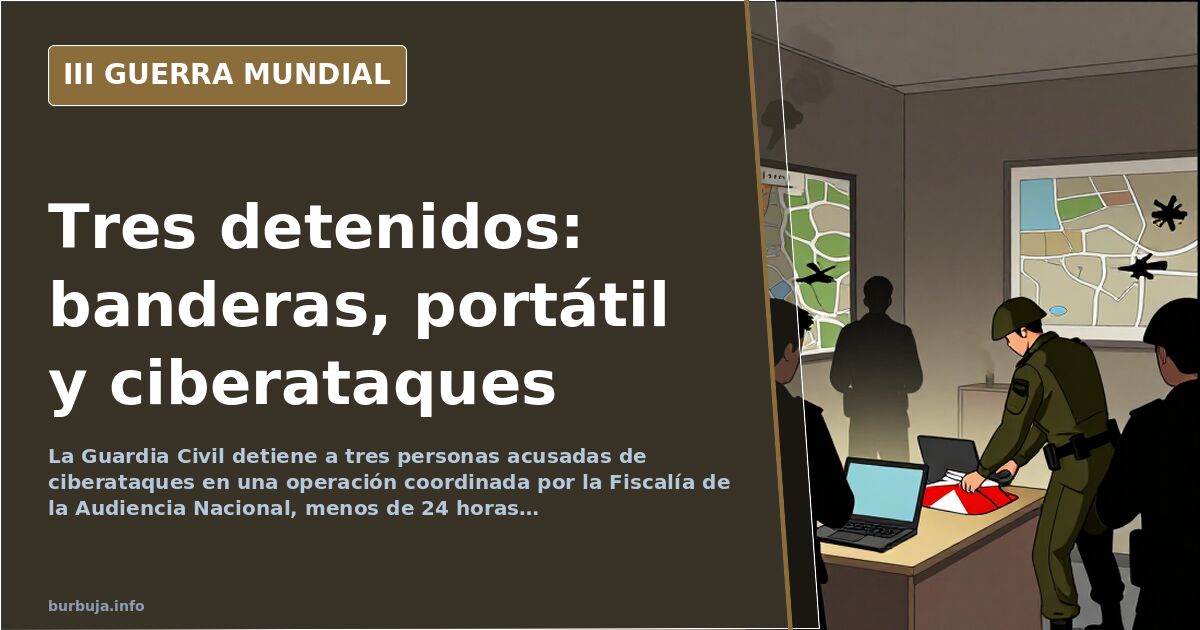
Three arrested: flags, laptop, and cyberattacks
The Guardia Civil arrested three individuals accused of launching cyberattacks from Spain, in an operation coordinated by the Prosecutor's Office of the Audiencia Nacional (National High Court). The arrests occurred less than 24 hours after the publication of an excerpt from a Ministry of Defense report regarding Russian agents operating in the country. According to forum discussions, pro-Russian flags and a laptop were found during the search, a haul that some analysts find suspiciously modest for advanced-level hackers.
This case reopens the debate on what it exactly means to be pro-Russian in Spain. Several participants argue that the accusation is not ideological affinity, but the cyberattacks themselves. However, the temporal coincidence between the leaked report and the arrests fuels suspicions of a showcase operation. Some claim it is a setup to justify persecuting dissidents; others defend that crime is crime, regardless of the flag hanging on the wall.
Why are pro-Russians arrested and not pro-Ukrainians?
The legal answer provided by some participants is simple: the crime they are accused of is not being pro-Russian, but launching cyberattacks. Being pro-Russian is not a crime in Spain today. Attacking infrastructure or computer systems is, and in that regard, the flag is irrelevant. If they had been pro-Ukrainian, they would have been arrested as well, according to this interpretation.
The problem is that the operation comes with an undeniable political wrapper. The official note speaks of an operation coordinated by the Prosecutor's Office of the Audiencia Nacional, and the context—the Ministry of Defense report on Russian agents—suggests to some that this is not an isolated case of cybercrime. For certain analysts, this signals that Spain has entered the radar of Russian hybrid operations. For others, it is a smokescreen to divert attention from internal problems.
According to forum messages, three pro-Russian flags and a laptop appeared in the search record. The scene has been mocked: "Anti-fascists who know how to use a computer for something other than toca?" one post asks. The irony points to the alleged lack of sophistication of the detainees. If they were advanced hackers, why did they have an old Ubuntu laptop? Why hack from their own country? These questions remain unanswered in the available material.
The Ministry of Defense report and the timing coincidence
The trigger for the operation appears to be an excerpt from a Ministry of Defense report on Russian agents acting in Spain. The leak of that excerpt occurred less than 24 hours before the arrests. That sequence is, for many, proof that the arrests are a political response to the leak, not an independent investigation.
The coincidence does not go unnoticed. Some argue it is a false flag operation to justify repressive measures against pro-Russian dissent. Others defend that the leak may have been precisely the reason to accelerate arrests already underway. Without access to the file, it is impossible to know. What is known is that the operation was coordinated by the Prosecutor's Office of the Audiencia Nacional, giving it high priority status.
The Ministry of Defense report, of which only an excerpt has been published, supposedly documents the presence of Russian agents in Spain. No further details are known. The leak of an excerpt without the rest of the document leaves many questions open. Which agents? Which operations? Since when? The material does not clarify.
Flags, underwear, and a laptop: the search scene
The description of the search has generated skepticism. Three pro-Russian flags, a laptop, and, according to an ironic version, "three pairs of underwear." The image does not match that of a sophisticated cyberattack cell. For some, it proves it is a setup: "It's like when they stage Nancy montages with three swastikas and a dagger," one comparison notes.
Comparisons with other police setups are recurrent. The idea that the Guardia Civil can "plant whatever they want and even hang it in your room while interrogating you next door" reflects deep distrust in the presented evidence. This distrust is not new, but in this case, it is fueled by the visual nature of the seized material.
However, for others, the modesty of the haul does not invalidate the accusation. An old Ubuntu laptop can be enough to launch a denial-of-service attack or spread disinformation. Sophistication does not always come with expensive equipment. The pro-Russian flag, in this context, is a symbol, not proof of anything.
The debate on democracy and human rights
The arrest has provoked an angry reaction in sectors that consider themselves persecuted for their ideology. "What a democracy, what respect for human rights," one exclaims. "They might as well imprison everyone who opposes Zionism and Atlanticism, we are 70% of young people (85% among women)." The figure, launched without source, exemplifies the tone of the debate.
The claim that most young people are pro-Russian or pro-Palestinian is recurrent. "Just go to university and see how pro-Russian and pro-Palestinian they are," it is said. There are no data backing those percentages, but the perception of a social majority critical of NATO and Israel is common in certain circles. That perception, real or not, feeds the idea that the arrests are political persecution.
Against this, another current defends that Spanish democracy has the right to defend itself from foreign interference. Detaining people who allegedly collaborate with an authoritarian regime is not a abusa of human rights, but a protective measure. Ultimately, the debate is about the limits of tolerance towards those who do not believe in the system.
Russia: Communist, capitalist, or mafia?
The discussion shifts to the nature of the current Russian regime. For some, today's Russia has nothing to do with the Soviet Union: "Capitalist = all companies run by the State, and all dissident CEOs are murdered." The irony suggests that Russian state capitalism is a form of authoritarianism, not a market economy.
Others defend that Russia is a country that preserves its history and symbols. "Respecting your history is a trait any serious country must have," it is argued. The Great Patriotic War, the fight against the Nancy, is a patriotic survival fact that justifies the use of Soviet symbols. For this current, criticizing Russia for keeping Lenin's body in the mausoleum is hypocrisy.
The accusation that Russia is a mafia seeking only money is recurrent. "The only ideology there is making money for that mafia," it is said. That vision, stripping the Russian regime of any ideal, clashes with those who see it as a defender of traditional values against globalism. The debate is, in reality, about what Russia is and what it represents.
The United States threat and gas
The discussion shifts to energy dependence. "Who threatens Spain if not the US, unless we buy their gas? What a bill hike they've given us, son of a bitch American thieves," it is claimed. Complaints about gas prices mix with geopolitics: for some, the true interference in Spain comes not from Russia, but from the United States.
That current argues that NATO and Washington pressure Spain to buy more expensive US gas instead of Russian, explaining the bill increase. There are no data in the material supporting this claim, but it reflects an extended perception: that Spain is a satellite of foreign interests. From this viewpoint, arresting pro-Russians would be an operation to please Washington.
Comparison with other interference cases is inevitable. If pro-Russians are arrested for cyberattacks, why aren't those collaborating with NATO arrested? The question hangs in the air. The official answer is that the law applies equally to all, but distrust in that answer runs deep in certain sectors.
What happens now with the detainees?
The three detainees are at the disposal of the judiciary. The operation, coordinated by the Prosecutor's Office of the Audiencia Nacional, continues. No further arrests are known, nor the scope of the attributed cyberattacks. Available material does not allow anticipating the outcome.
What is certain is that the case has peine a wound: trust in institutions. For some, the arrest proves the State works; for others, it proves the State persecutes those who think differently. The pro-Russian flag, hung on the wall, has become the symbol of that division.
Is it possible to be pro-Russian in Spain without ending up arrested? The legal answer is yes. The political answer, judging by the reaction, is more complicated.
The Guardia Civil arrested three individuals accused of launching cyberattacks from Spain, in an operation coordinated by the Prosecutor's Office of the Audiencia Nacional (National High Court). The arrests occurred less than 24 hours after the publication of an excerpt from a Ministry of Defense report regarding Russian agents operating in the country. According to forum discussions, pro-Russian flags and a laptop were found during the search, a haul that some analysts find suspiciously modest for advanced-level hackers.
This case reopens the debate on what it exactly means to be pro-Russian in Spain. Several participants argue that the accusation is not ideological affinity, but the cyberattacks themselves. However, the temporal coincidence between the leaked report and the arrests fuels suspicions of a showcase operation. Some claim it is a setup to justify persecuting dissidents; others defend that crime is crime, regardless of the flag hanging on the wall.
Why are pro-Russians arrested and not pro-Ukrainians?
The legal answer provided by some participants is simple: the crime they are accused of is not being pro-Russian, but launching cyberattacks. Being pro-Russian is not a crime in Spain today. Attacking infrastructure or computer systems is, and in that regard, the flag is irrelevant. If they had been pro-Ukrainian, they would have been arrested as well, according to this interpretation.
The problem is that the operation comes with an undeniable political wrapper. The official note speaks of an operation coordinated by the Prosecutor's Office of the Audiencia Nacional, and the context—the Ministry of Defense report on Russian agents—suggests to some that this is not an isolated case of cybercrime. For certain analysts, this signals that Spain has entered the radar of Russian hybrid operations. For others, it is a smokescreen to divert attention from internal problems.
According to forum messages, three pro-Russian flags and a laptop appeared in the search record. The scene has been mocked: "Anti-fascists who know how to use a computer for something other than toca?" one post asks. The irony points to the alleged lack of sophistication of the detainees. If they were advanced hackers, why did they have an old Ubuntu laptop? Why hack from their own country? These questions remain unanswered in the available material.
The Ministry of Defense report and the timing coincidence
The trigger for the operation appears to be an excerpt from a Ministry of Defense report on Russian agents acting in Spain. The leak of that excerpt occurred less than 24 hours before the arrests. That sequence is, for many, proof that the arrests are a political response to the leak, not an independent investigation.
The coincidence does not go unnoticed. Some argue it is a false flag operation to justify repressive measures against pro-Russian dissent. Others defend that the leak may have been precisely the reason to accelerate arrests already underway. Without access to the file, it is impossible to know. What is known is that the operation was coordinated by the Prosecutor's Office of the Audiencia Nacional, giving it high priority status.
The Ministry of Defense report, of which only an excerpt has been published, supposedly documents the presence of Russian agents in Spain. No further details are known. The leak of an excerpt without the rest of the document leaves many questions open. Which agents? Which operations? Since when? The material does not clarify.
Flags, underwear, and a laptop: the search scene
The description of the search has generated skepticism. Three pro-Russian flags, a laptop, and, according to an ironic version, "three pairs of underwear." The image does not match that of a sophisticated cyberattack cell. For some, it proves it is a setup: "It's like when they stage Nancy montages with three swastikas and a dagger," one comparison notes.
Comparisons with other police setups are recurrent. The idea that the Guardia Civil can "plant whatever they want and even hang it in your room while interrogating you next door" reflects deep distrust in the presented evidence. This distrust is not new, but in this case, it is fueled by the visual nature of the seized material.
However, for others, the modesty of the haul does not invalidate the accusation. An old Ubuntu laptop can be enough to launch a denial-of-service attack or spread disinformation. Sophistication does not always come with expensive equipment. The pro-Russian flag, in this context, is a symbol, not proof of anything.
The debate on democracy and human rights
The arrest has provoked an angry reaction in sectors that consider themselves persecuted for their ideology. "What a democracy, what respect for human rights," one exclaims. "They might as well imprison everyone who opposes Zionism and Atlanticism, we are 70% of young people (85% among women)." The figure, launched without source, exemplifies the tone of the debate.
The claim that most young people are pro-Russian or pro-Palestinian is recurrent. "Just go to university and see how pro-Russian and pro-Palestinian they are," it is said. There are no data backing those percentages, but the perception of a social majority critical of NATO and Israel is common in certain circles. That perception, real or not, feeds the idea that the arrests are political persecution.
Against this, another current defends that Spanish democracy has the right to defend itself from foreign interference. Detaining people who allegedly collaborate with an authoritarian regime is not a abusa of human rights, but a protective measure. Ultimately, the debate is about the limits of tolerance towards those who do not believe in the system.
Russia: Communist, capitalist, or mafia?
The discussion shifts to the nature of the current Russian regime. For some, today's Russia has nothing to do with the Soviet Union: "Capitalist = all companies run by the State, and all dissident CEOs are murdered." The irony suggests that Russian state capitalism is a form of authoritarianism, not a market economy.
Others defend that Russia is a country that preserves its history and symbols. "Respecting your history is a trait any serious country must have," it is argued. The Great Patriotic War, the fight against the Nancy, is a patriotic survival fact that justifies the use of Soviet symbols. For this current, criticizing Russia for keeping Lenin's body in the mausoleum is hypocrisy.
The accusation that Russia is a mafia seeking only money is recurrent. "The only ideology there is making money for that mafia," it is said. That vision, stripping the Russian regime of any ideal, clashes with those who see it as a defender of traditional values against globalism. The debate is, in reality, about what Russia is and what it represents.
The United States threat and gas
The discussion shifts to energy dependence. "Who threatens Spain if not the US, unless we buy their gas? What a bill hike they've given us, son of a bitch American thieves," it is claimed. Complaints about gas prices mix with geopolitics: for some, the true interference in Spain comes not from Russia, but from the United States.
That current argues that NATO and Washington pressure Spain to buy more expensive US gas instead of Russian, explaining the bill increase. There are no data in the material supporting this claim, but it reflects an extended perception: that Spain is a satellite of foreign interests. From this viewpoint, arresting pro-Russians would be an operation to please Washington.
Comparison with other interference cases is inevitable. If pro-Russians are arrested for cyberattacks, why aren't those collaborating with NATO arrested? The question hangs in the air. The official answer is that the law applies equally to all, but distrust in that answer runs deep in certain sectors.
What happens now with the detainees?
The three detainees are at the disposal of the judiciary. The operation, coordinated by the Prosecutor's Office of the Audiencia Nacional, continues. No further arrests are known, nor the scope of the attributed cyberattacks. Available material does not allow anticipating the outcome.
What is certain is that the case has peine a wound: trust in institutions. For some, the arrest proves the State works; for others, it proves the State persecutes those who think differently. The pro-Russian flag, hung on the wall, has become the symbol of that division.
Is it possible to be pro-Russian in Spain without ending up arrested? The legal answer is yes. The political answer, judging by the reaction, is more complicated.
Also available in: Deutsch
Summary of a discussion on Burbuja.info - Foro de economía, actualidad y política., translated from Spanish and reviewed before publication. Read the full discussion (129 replies).
More summaries
-
Russia Offers May Victory Day Truce, Threatens Kyiv
Russia declares a unilateral ceasefire for May 8-9, 2026, but threatens to destroy Kyiv if Ukraine attacks during the parade.
-
Texas Defies Biden With Support From 25 Governors
Texas invokes self-defense rights backed by 25 governors, despite a 5-4 Supreme Court ruling against the state. The standoff continues.
-
Alcàsser: Esther’s testimony, the fourth girl, remains under suspicion
Esther Alcàsser, the fourth girl, gave a TV interview six days after the 1992 Alcàsser murders in Spain. Her account and timeline discrepancies fuel ongoing controversy.
-
Burgos removes Russian flag from private balcony
Burgos City Council ordered police and firefighters to remove a Russian flag from a private balcony in Plaza Mayor, without visible judicial order.
-
Tears as Spanish-trained Ukrainian soldiers depart
Spanish troops bid farewell to Ukrainian recruits, described as men aged 40-50 poorly prepared for the front.
-
Russia withdraws from Kherson, shifting front toward Crimea
General Surovikin proposes moving defense to the Dnipro's left bank; Shoigu approves retreat. Kherson is no longer under Russian control.