
Putin links Borrell to Franco's coup side
Putin claims EU chief Borrell sides with Franco's coup, reviving debates on Moscow gold and Civil War foreign aid.
English · Original discussion in Spanish · Published
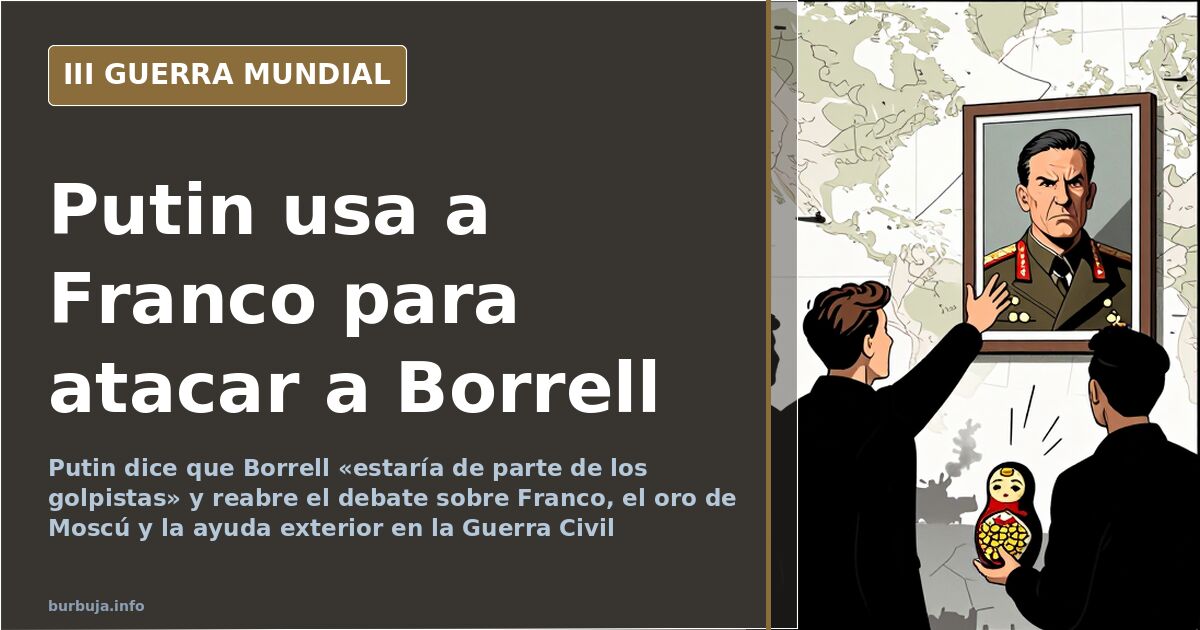
Pilingui uses Franco as a weapon against Borrell
Pilingui did not come to explain the Spanish Civil War. He came to hit where it hurts most. In his remarks, the Russian president argued that Josep Borrell would be on the side of the coup plotters. That is, with Franco. The EU High Representative for Foreign Affairs was portrayed as an heir to the faction that won the conflict in 1939. This remark is no diplomatic slip: it is ammunition for an adversary who only needs to mention Franco’s name to unsettle anyone.
What Pilingui said and why the Franco analogy works
The gesture has a trick to it. Pilingui does not praise the Second Republic with devotion nor claim anything of his own. He points at the head of European diplomacy and pushes him into the wrong side of Spanish history. Among the interpretations suggested is that of the inverse Francoism: you are not supporting Franco, he implies, because you are socialists... yet that is exactly what you are doing now. With this twist, the parallel is served: Franco as Zelensky, the coup leader as the Ukrainian president this country applauded in its own parliament.
One must acknowledge the Russian’s skill in pulling the trigger. A leader relentlessly accused of territorial aggression manages to shift the focus from Ukraine to the trenches of 1936. And there, on Spanish ground, the trenches remain hot. The question that does not answer itself is what the Kremlin gains by poking at a wound ninety years old.
The July 18th that wasn't Franco's
Here the narrative collides with the calendar. As one participant recalls, the coup of July 18, 1936, did not have Franco as its brain, and the fact contradicts the convenient version: he did not establish himself as the movement's leader until September, two months later. At the time of the uprising, he was just one more; command belonged to Mola. Placing him at the front from the first minute is doing him a favor chronology does not grant.
And this unsettles both sides. Those who repeat that the Generalissimo decided everything from day one, and those who need a single villain to close the story. History is slower and much dirtier than the two textbook versions circulating.
Moscow gold and aid nobody claims
One of the most common reproaches against the Republic appears with a proper name: the gold sent to the USSR. One recurring interpretation sums it up with a sports image: the Soviet Union was the runner-up in Spain, but champion in World War II. Some argue that if neither the European Union nor any other body claims that metal today, it is because nobody with the power to demand it has ever been interested in the matter.
Texaco, Menorca, and the committee looking away
Foreign intervention was not a Soviet monopoly. A participant lists the aids that sustained the Nationalist side: fuel supply by the oil company Texaco, the blind eye turned by Anglo-Saxon powers, and British collaboration in the recovery of Menorca. Against this, the non-intervention committee ended up penalizing the Republic and giving free rein to those who actually received supplies.
The repeated conclusion is stark: in international relations, there are no friends, only interests. If Franco chose a side, it is accepted; if the United States allowed an oil company to supply the rebels, it is assimilated. And that is that.
Why this discussion never closes
The episode functions as a coherence test that everyone passes in their own way. Some bring up the Blue Division and the memory of the Soviet front; others respond with the gold, internal purges, and fights among Republican militia units. Everyone has a fact that serves them. No one has the complete story.
Striking is the underlying coincidence between positions that insult each other: almost all assume that Spain was, in 1936, a board where others moved the pieces. The difference lies only in who is blamed for allowing it. That is the terrain Pilingui deliberately treads, and it costs him little.
That he brings Franco out again in his next appearance is almost certain: it works for him. That this moves a single comma of European support for Ukraine is improbable. The wound it opens is not historical, but identity-based, and those scars heal slowly.
Pilingui did not come to explain the Spanish Civil War. He came to hit where it hurts most. In his remarks, the Russian president argued that Josep Borrell would be on the side of the coup plotters. That is, with Franco. The EU High Representative for Foreign Affairs was portrayed as an heir to the faction that won the conflict in 1939. This remark is no diplomatic slip: it is ammunition for an adversary who only needs to mention Franco’s name to unsettle anyone.
What Pilingui said and why the Franco analogy works
The gesture has a trick to it. Pilingui does not praise the Second Republic with devotion nor claim anything of his own. He points at the head of European diplomacy and pushes him into the wrong side of Spanish history. Among the interpretations suggested is that of the inverse Francoism: you are not supporting Franco, he implies, because you are socialists... yet that is exactly what you are doing now. With this twist, the parallel is served: Franco as Zelensky, the coup leader as the Ukrainian president this country applauded in its own parliament.
One must acknowledge the Russian’s skill in pulling the trigger. A leader relentlessly accused of territorial aggression manages to shift the focus from Ukraine to the trenches of 1936. And there, on Spanish ground, the trenches remain hot. The question that does not answer itself is what the Kremlin gains by poking at a wound ninety years old.
The July 18th that wasn't Franco's
Here the narrative collides with the calendar. As one participant recalls, the coup of July 18, 1936, did not have Franco as its brain, and the fact contradicts the convenient version: he did not establish himself as the movement's leader until September, two months later. At the time of the uprising, he was just one more; command belonged to Mola. Placing him at the front from the first minute is doing him a favor chronology does not grant.
And this unsettles both sides. Those who repeat that the Generalissimo decided everything from day one, and those who need a single villain to close the story. History is slower and much dirtier than the two textbook versions circulating.
Moscow gold and aid nobody claims
One of the most common reproaches against the Republic appears with a proper name: the gold sent to the USSR. One recurring interpretation sums it up with a sports image: the Soviet Union was the runner-up in Spain, but champion in World War II. Some argue that if neither the European Union nor any other body claims that metal today, it is because nobody with the power to demand it has ever been interested in the matter.
Texaco, Menorca, and the committee looking away
Foreign intervention was not a Soviet monopoly. A participant lists the aids that sustained the Nationalist side: fuel supply by the oil company Texaco, the blind eye turned by Anglo-Saxon powers, and British collaboration in the recovery of Menorca. Against this, the non-intervention committee ended up penalizing the Republic and giving free rein to those who actually received supplies.
The repeated conclusion is stark: in international relations, there are no friends, only interests. If Franco chose a side, it is accepted; if the United States allowed an oil company to supply the rebels, it is assimilated. And that is that.
Why this discussion never closes
The episode functions as a coherence test that everyone passes in their own way. Some bring up the Blue Division and the memory of the Soviet front; others respond with the gold, internal purges, and fights among Republican militia units. Everyone has a fact that serves them. No one has the complete story.
Striking is the underlying coincidence between positions that insult each other: almost all assume that Spain was, in 1936, a board where others moved the pieces. The difference lies only in who is blamed for allowing it. That is the terrain Pilingui deliberately treads, and it costs him little.
That he brings Franco out again in his next appearance is almost certain: it works for him. That this moves a single comma of European support for Ukraine is improbable. The wound it opens is not historical, but identity-based, and those scars heal slowly.
Summary of a discussion on Burbuja.info - Foro de economía, actualidad y política., translated from Spanish and reviewed before publication. Read the full discussion (173 replies).
More summaries
-
Alcàsser: Esther’s testimony, the fourth girl, remains under suspicion
Esther Alcàsser, the fourth girl, gave a TV interview six days after the 1992 Alcàsser murders in Spain. Her account and timeline discrepancies fuel ongoing controversy.
-
Iranian Escalation and Uncertainty Over Israeli Casualties
Analysis of tensions amid Iranian actions and lack of confirmation on Israeli casualties during high military escalation.
-
Ukraine Breaks Russian Lines in Kherson
Ukraine deepens its advance in Kherson as Russian troops retreat, destroying bridges, while Moscow annexes the territory it is losing.
-
Ukraine Winter: Carpathian Snow and Furniture Burning Claims
First snow in the Carpathians revives claims that cold will force Ukrainians to burn furniture, lacking consumption data.
-
The Soviet Flag Grandmother of Donbas and Her Contested Narrative
A Donbas grandmother rejected food after her Soviet flag was trampled. The video became a propaganda icon, but her story remains disputed.
-
Kremlin troll farm: Russia jails disinformation up to 15 years
Reports on a Russian troll factory cite $400 monthly wages, while Moscow punishes military misinformation with up to 15 years in prison.