
Stock Market Peaks as Core CPI Stalls at 4.4%
Core CPI stagnates at 4.4%, fueling fears of a 10% S&P 500 correction. Crypto and banking act as market thermometers.
English · Original discussion in Spanish · Published
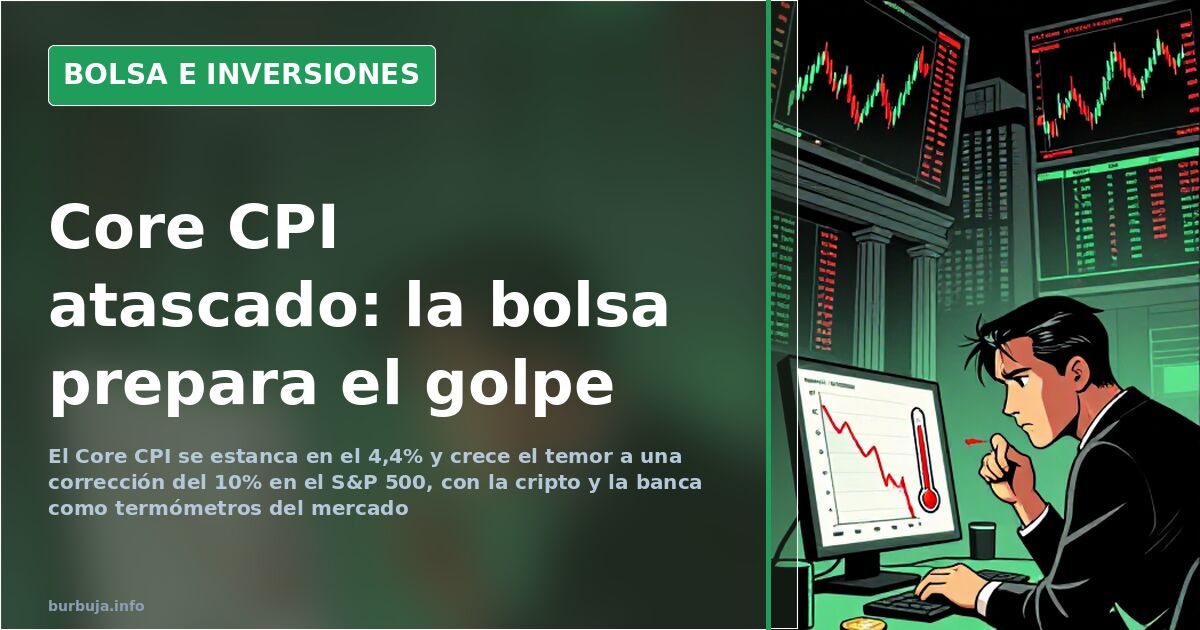
Core CPI Refuses to Fall, S&P 500 Faces 10% Correction
The Core CPI refused to decline in February: 4.3% annualized and 4.4% year-on-year, showing no sign of easing. With underlying inflation stuck, the narrative of higher-for-longer interest rates returns, leaving current valuations without a floor. This fuels the persistent warning: the S&P 500 could drop 10% in the coming months until the Core CPI trend turns downward. The stock market has peaked, and those who don't accept it will be left watching, as the saying goes.
The Trigger: A Stalled Core CPI
The starting point was a report from the Atlanta Fed on prices. The conclusion was stark: the series isn't falling, so rate cuts will have to wait. The recommendation: sell now. This isn't an isolated view. Proponents add that the magnificent seven are no longer solely supporting the index, and the baton has been passed to a handful of AI-linked stocks—a base too narrow for a market trading at highs. The argument is strengthened by two uncomfortable data points: retail sales slowing and consumer credit defaults rising, according to data shared by the Federal Reserve Bank of St. Louis.
What's striking is that this warning doesn't significantly alter the approach of long-term investors. The warning itself acknowledges this: anyone who can't withstand a 10% drop shouldn't be in the stock market. Speaking of the S&P 500, a 10% drop from its highs would literally bring it back to December levels.
The Fed, Rate Cuts, and the Uncontrollable Calendar
April brought the expected shift. State Street forecasts a 50-basis-point Fed cut in June, a move that, interpreted optimistically, would signal the end of tightening. Interpreted pessimistically, it's proof that something is breaking internally. In reality, it's both.
The most common scenario isn't a crash but a two-act play: a 12% or 13% correction after a final upward leg, a summer rally leading up to the American elections, and then, in 2025, a deeper decline, potentially reaching 30%. Specific targets are also set for Spanish banks: Santander at €4.70, Sabadell at €1.60, and CaixaBank above €5.20, with a dividend bonus. All of this, of course, depends on the calendar cooperating.
Those Who Got Off the Train Too Soon
One testimony perfectly summarizes the cost of being too early. Someone moved nearly 70% of their equity portfolio to fixed income funds, money market funds, and deposits between February and April, convinced the major correction would arrive before the elections. They also postponed a property purchase. By the end of July, they returned to equities. And they've been riding the upward trend since.
Behind this move lies a fiscal detail not everyone takes advantage of: transferring between Spanish funds allows for strategy changes without paying capital gains tax until the final redemption. The full explanation, including the conditions under which it's valid, is one of those nuances worth reading thoroughly before moving portfolios.
Cryptocurrencies as the Canary in the Coal Mine
Before the stock market showed signs, the warning came from elsewhere. The behavior of Bitcoin and altcoins raised alarms: overnight surges that vanish by day, doubts about real volume, and the shadow of tether issuance distorting ETF flows. If liquidity is withdrawn, warnings suggest, the carnage in alternative coins could be historic.
The concern isn't just crypto-related. It extends to banks' exposure to products linked to these assets. With a rising dollar cycle and the inflow of capital since October 2022 about to close, the diagnosis is that a macroeconomic cycle will sweep them away like a tsunami. Meanwhile, on social media, the most enthusiastic continue drawing fractals and predicting altcoin seasons.
The Cracks: Apple, Defaults, and Yield Curves
The most frequently repeated chart is Apple's weekly candles: double top and below the previous support. For some, it's not just a stock but a thermometer of consumer confidence, and as a symptom, it says more than as an individual stock. Around it, the macro picture accumulates signals: the Sahm Rule triggered by the latest US employment data, the spread between the 10-year and 2-year bond at multi-decade highs and on the verge of inversion.
The most somber interpretation relies on the real economy. From Germany comes a daily trickle of insolvency filings, mass layoffs, and factory closures, with local media downplaying the severity. And some look beyond the current cycle: if low interest rates and debt-financed public spending have been the pillars of recent decades, the question is what remains when that support runs out.
The Eternal Tug-of-War Between Long-Term Investing and Market Timing
Against the doomsayers, the other half of the market remains unmoved. Automatic contributions daily, without checking charts, and more money if prices fall. The argument: those who try to time the market peak each month end up paying fees and missing the rebound. The numbers used to settle the debate—23% annualized over eleven years without leaving the market—are also the ones that raise the most suspicion. The response is usually the same: show me the track record.
Amidst this, there's the irony of videos announcing Buffett is selling the S&P 500, when the investor from Omaha plays in a different league and can afford to enter and exit without breaking a sweat. Year after year, the same headline, the same panic, and the same rising stock market.
No one knows where the ceiling is, and those who claim to know have been wrong for months. But the signals are accumulating, and not all point in a pleasant direction. The most supported forecast isn't a crash but an uncomfortable correction, trinc by another upward leg, and then the real one. Whether it arrives, or when, remains the question no one can answer.
The Core CPI refused to decline in February: 4.3% annualized and 4.4% year-on-year, showing no sign of easing. With underlying inflation stuck, the narrative of higher-for-longer interest rates returns, leaving current valuations without a floor. This fuels the persistent warning: the S&P 500 could drop 10% in the coming months until the Core CPI trend turns downward. The stock market has peaked, and those who don't accept it will be left watching, as the saying goes.
The Trigger: A Stalled Core CPI
The starting point was a report from the Atlanta Fed on prices. The conclusion was stark: the series isn't falling, so rate cuts will have to wait. The recommendation: sell now. This isn't an isolated view. Proponents add that the magnificent seven are no longer solely supporting the index, and the baton has been passed to a handful of AI-linked stocks—a base too narrow for a market trading at highs. The argument is strengthened by two uncomfortable data points: retail sales slowing and consumer credit defaults rising, according to data shared by the Federal Reserve Bank of St. Louis.
What's striking is that this warning doesn't significantly alter the approach of long-term investors. The warning itself acknowledges this: anyone who can't withstand a 10% drop shouldn't be in the stock market. Speaking of the S&P 500, a 10% drop from its highs would literally bring it back to December levels.
The Fed, Rate Cuts, and the Uncontrollable Calendar
April brought the expected shift. State Street forecasts a 50-basis-point Fed cut in June, a move that, interpreted optimistically, would signal the end of tightening. Interpreted pessimistically, it's proof that something is breaking internally. In reality, it's both.
The most common scenario isn't a crash but a two-act play: a 12% or 13% correction after a final upward leg, a summer rally leading up to the American elections, and then, in 2025, a deeper decline, potentially reaching 30%. Specific targets are also set for Spanish banks: Santander at €4.70, Sabadell at €1.60, and CaixaBank above €5.20, with a dividend bonus. All of this, of course, depends on the calendar cooperating.
Those Who Got Off the Train Too Soon
One testimony perfectly summarizes the cost of being too early. Someone moved nearly 70% of their equity portfolio to fixed income funds, money market funds, and deposits between February and April, convinced the major correction would arrive before the elections. They also postponed a property purchase. By the end of July, they returned to equities. And they've been riding the upward trend since.
Behind this move lies a fiscal detail not everyone takes advantage of: transferring between Spanish funds allows for strategy changes without paying capital gains tax until the final redemption. The full explanation, including the conditions under which it's valid, is one of those nuances worth reading thoroughly before moving portfolios.
Cryptocurrencies as the Canary in the Coal Mine
Before the stock market showed signs, the warning came from elsewhere. The behavior of Bitcoin and altcoins raised alarms: overnight surges that vanish by day, doubts about real volume, and the shadow of tether issuance distorting ETF flows. If liquidity is withdrawn, warnings suggest, the carnage in alternative coins could be historic.
The concern isn't just crypto-related. It extends to banks' exposure to products linked to these assets. With a rising dollar cycle and the inflow of capital since October 2022 about to close, the diagnosis is that a macroeconomic cycle will sweep them away like a tsunami. Meanwhile, on social media, the most enthusiastic continue drawing fractals and predicting altcoin seasons.
The Cracks: Apple, Defaults, and Yield Curves
The most frequently repeated chart is Apple's weekly candles: double top and below the previous support. For some, it's not just a stock but a thermometer of consumer confidence, and as a symptom, it says more than as an individual stock. Around it, the macro picture accumulates signals: the Sahm Rule triggered by the latest US employment data, the spread between the 10-year and 2-year bond at multi-decade highs and on the verge of inversion.
The most somber interpretation relies on the real economy. From Germany comes a daily trickle of insolvency filings, mass layoffs, and factory closures, with local media downplaying the severity. And some look beyond the current cycle: if low interest rates and debt-financed public spending have been the pillars of recent decades, the question is what remains when that support runs out.
The Eternal Tug-of-War Between Long-Term Investing and Market Timing
Against the doomsayers, the other half of the market remains unmoved. Automatic contributions daily, without checking charts, and more money if prices fall. The argument: those who try to time the market peak each month end up paying fees and missing the rebound. The numbers used to settle the debate—23% annualized over eleven years without leaving the market—are also the ones that raise the most suspicion. The response is usually the same: show me the track record.
Amidst this, there's the irony of videos announcing Buffett is selling the S&P 500, when the investor from Omaha plays in a different league and can afford to enter and exit without breaking a sweat. Year after year, the same headline, the same panic, and the same rising stock market.
No one knows where the ceiling is, and those who claim to know have been wrong for months. But the signals are accumulating, and not all point in a pleasant direction. The most supported forecast isn't a crash but an uncomfortable correction, trinc by another upward leg, and then the real one. Whether it arrives, or when, remains the question no one can answer.
Summary of a discussion on Burbuja.info - Foro de economía, actualidad y política., translated from Spanish and reviewed before publication. Read the full discussion (324 replies).
More summaries
-
Bull Market or Bear Market: The Consensus Nobody Timed
The long-term rise is accepted, yet some anticipate a sharp correction and two years of rate hikes accompanied by falling stocks.
-
Buying the Dip or Waiting for Crash: The 2025 Market Dilemma
Centene experienced a 25% fall, AI technology is dividing investors, and market crash predictions are mounting for November. The 2025 investment dilemma: buy now or wait?
-
Gold stuck at 0.382 as bitcoin takes the spotlight
Gold stuck at 0.382 and unable to recover while bitcoin hits 6.000 dollars; thresholds at 1.250 and 1.050 set the scene.
-
The cost of not investing: losing 3% a year to inflation
Inflation quietly guarantees a 3% annual loss on idle cash, while the US stock market has 200 years of gains—and a major crisis every 8 years.
-
Extra virgin olive oil falls to €6.35 a litre at Mercadona
Extra virgin olive oil is now €6.35/litre at Mercadona, down from €6.75 months ago, while the origin price of picual is €4.143/kg
-
BIG offers 4% TAE on 6-month deposit with Spanish IBAN and Portuguese FGD
BIG launched a 4% TAE six-month and 3.5% three-month deposit in May 2023 with Spanish IBAN and Portuguese FGD, but later cut rates and had opening delays.