
Bull Market or Bear Market: The Consensus Nobody Timed
The long-term rise is accepted, yet some anticipate a sharp correction and two years of rate hikes accompanied by falling stocks.
English · Original discussion in Spanish · Published
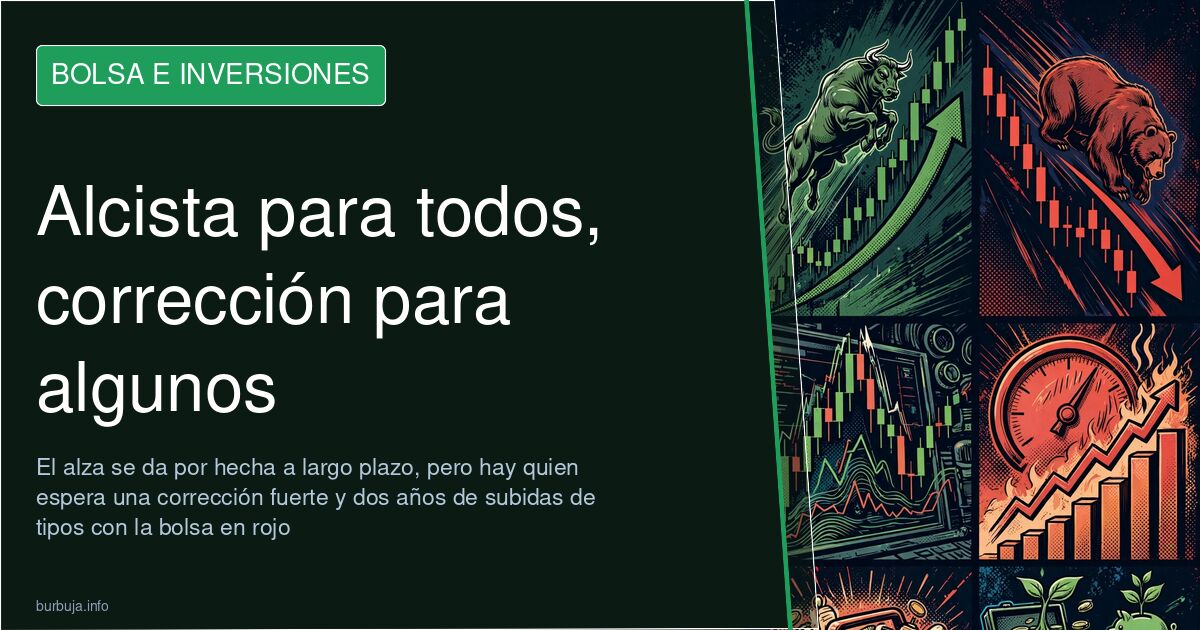
Everyone is betting on the upside, but nobody knows when the correction will come
The market is bullish. Or at least, that is what most readings circulating these days suggest, and the arguments are not mystical: increasing highs, increasing lows, and liquidity that, according to one reading, no longer functions as it did during the pandemic. The problem is not the direction; it is the timing. Those who speak of a bubble are certainly not absent.
Increasing highs and increasing lows: what defines a bull market
The dominant thesis is simple and old. If every price high surpasses the previous one and every low does likewise, the trend is bullish, and there is little more to discuss. Most adhere to this, adding a closing argument: in the long term, the stock market always goes up. Some even maintain that if it is not bullish, then it must be total war or brutal deflation with monetary appreciation. The latter is considered impossible; the former, for now, too.
What could derail the trend? Interest rates and a pending correction
This is where the cracks begin to show. The belief is that two years of rate hikes are coming, and the market will fall during that period, with few exceptions: pharmaceuticals and medicine. The key, they argue, is not confusing rising rates with high rates, because to discuss high rates, they should exceed inflation that, according to the most aggressive reading circulating, stands at 23% annually. Based on this premise, thicker scenarios are drawn: a global conflict toward 2028, chain devaluations, and a monetary reset toward 2030. These are predictions, not data.
The doubt about money that no longer moves like during Elbichito
Against all this noise, some raise a more grounded objection: the monetary mass created during the pandemic no longer pushes like it used to, which would leave the market in a neutral or undecided zone. This is the fundamental discrepancy between those who see sustained growth and those who detect exhaustion. In between lies stagnant money: for those who wish to avoid shocks, ultra-short monetary funds are mentioned, with the warning that other products carry notable commissions.
Pharmaceuticals and artificial intelligence: the refuge that isn't so much
The pharmaceutical sector appears as one of the exceptions that would be saved from the predicted fall and, simultaneously, as a relative refuge, depending on who views it. The caveat: one bad piece of news about a specific drug is enough for a company to temporarily sink, no matter how solid the sector. The emergence of artificial intelligence is seen as a possible catalyst for margins in the medium term, although, as one participant points out, that is yet to be seen.
The trend, today, reads as bullish. Some expect a sharp correction soon, after which the market will continue to rise. But the conviction rests on the long term precisely because the short term offers no guarantee. If the correction that some expect arrives, we will know it when it has passed.
The market is bullish. Or at least, that is what most readings circulating these days suggest, and the arguments are not mystical: increasing highs, increasing lows, and liquidity that, according to one reading, no longer functions as it did during the pandemic. The problem is not the direction; it is the timing. Those who speak of a bubble are certainly not absent.
Increasing highs and increasing lows: what defines a bull market
The dominant thesis is simple and old. If every price high surpasses the previous one and every low does likewise, the trend is bullish, and there is little more to discuss. Most adhere to this, adding a closing argument: in the long term, the stock market always goes up. Some even maintain that if it is not bullish, then it must be total war or brutal deflation with monetary appreciation. The latter is considered impossible; the former, for now, too.
What could derail the trend? Interest rates and a pending correction
This is where the cracks begin to show. The belief is that two years of rate hikes are coming, and the market will fall during that period, with few exceptions: pharmaceuticals and medicine. The key, they argue, is not confusing rising rates with high rates, because to discuss high rates, they should exceed inflation that, according to the most aggressive reading circulating, stands at 23% annually. Based on this premise, thicker scenarios are drawn: a global conflict toward 2028, chain devaluations, and a monetary reset toward 2030. These are predictions, not data.
The doubt about money that no longer moves like during Elbichito
Against all this noise, some raise a more grounded objection: the monetary mass created during the pandemic no longer pushes like it used to, which would leave the market in a neutral or undecided zone. This is the fundamental discrepancy between those who see sustained growth and those who detect exhaustion. In between lies stagnant money: for those who wish to avoid shocks, ultra-short monetary funds are mentioned, with the warning that other products carry notable commissions.
Pharmaceuticals and artificial intelligence: the refuge that isn't so much
The pharmaceutical sector appears as one of the exceptions that would be saved from the predicted fall and, simultaneously, as a relative refuge, depending on who views it. The caveat: one bad piece of news about a specific drug is enough for a company to temporarily sink, no matter how solid the sector. The emergence of artificial intelligence is seen as a possible catalyst for margins in the medium term, although, as one participant points out, that is yet to be seen.
The trend, today, reads as bullish. Some expect a sharp correction soon, after which the market will continue to rise. But the conviction rests on the long term precisely because the short term offers no guarantee. If the correction that some expect arrives, we will know it when it has passed.
Summary of a discussion on Burbuja.info - Foro de economía, actualidad y política., translated from Spanish and reviewed before publication. Read the full discussion (18 replies).
More summaries
-
Gold stuck at 0.382 as bitcoin takes the spotlight
Gold stuck at 0.382 and unable to recover while bitcoin hits 6.000 dollars; thresholds at 1.250 and 1.050 set the scene.
-
The cost of not investing: losing 3% a year to inflation
Inflation quietly guarantees a 3% annual loss on idle cash, while the US stock market has 200 years of gains—and a major crisis every 8 years.
-
Extra virgin olive oil falls to €6.35 a litre at Mercadona
Extra virgin olive oil is now €6.35/litre at Mercadona, down from €6.75 months ago, while the origin price of picual is €4.143/kg
-
BIG offers 4% TAE on 6-month deposit with Spanish IBAN and Portuguese FGD
BIG launched a 4% TAE six-month and 3.5% three-month deposit in May 2023 with Spanish IBAN and Portuguese FGD, but later cut rates and had opening delays.
-
Spot-price coins: the seller whose paper trail didn't add up
He offered quarter-ounce gold coins at spot price and racked up undelivered orders. Buyers cross-checked his details and several got their money back.
-
Goldsilver.be: a €5,000 order and a YouTube-restricted video
A €5,000+ order on Goldsilver.be vanishes in Belgium. The shop refuses responsibility, and YouTube restricts the video exposing it.