
Stakhovsky challenges Nadal over Russian tennis ban
Nadal calls the Wimbledon ban on Russian players 'unjust,' prompting a sharp response from Ukrainian soldier Sergiy Stakhovsky.
English · Original discussion in Spanish · Published
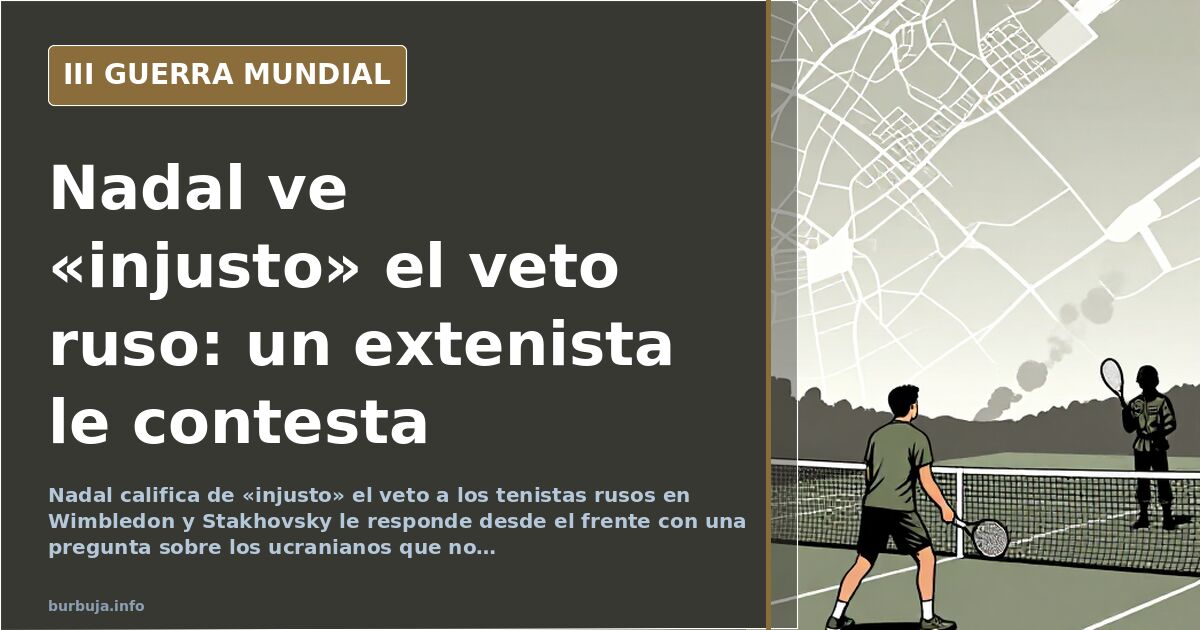
Nadal deems Russian ban 'unjust'; Stakhovsky fires back
Former Ukrainian tennis player Sergiy Stakhovsky, now serving as a soldier, responded to Rafael Nadal with a pointed question: if banning Russian players is "unjust," what do you call it when Ukrainian players cannot return home, children cannot play tennis, or Ukrainians are dying? Nadal had previously stated in Madrid that the Wimbledon ban on Russians and Belarusians was unfair because they bear no responsibility for the war, adding that sports outcomes matter little amidst such suffering.
The rebuttal arrived via text as a direct counter-question, turning a tennis tournament into a diplomatic battleground.
Nadal's stance and the backlash
Nadal focused on individual athlete responsibility, arguing that Russian players should not be penalized for their government's foreign policy. This view aligns with other players but clashes with decisions by Wimbledon and the International Olympic Committee (IOC), which extended bans to Russian and Belarusian athletes, including Paralympians. Some critics label the IOC's move a sporting "fatwa," though practical implications remain debated.
Stakhovsky’s response grounds the theory in reality: if athletes are separate from their governments, the same logic should apply to those suffering consequences. However, asymmetry exists—a Russian player loses a tournament, while a Ukrainian may lose their life. Critics argue this mixes distinct issues, responding to specific claims with broader grievances.
Can Wimbledon ban whom it chooses?
Yes, according to many. As a private club in London, Wimbledon can admit whom it wishes. Some argue that since tennis is British-originated, played under British rules, non-compliant players are excluded. If a Russian player publicly denounces their government, legal pathways might allow participation.
Opponents cite Wimbledon’s history as an international championship that once ignored rankings for seeding. Claiming exclusivity now appears convenient rather than principled.
Western double standards criticized
Critics highlight asymmetry: sporting sanctions target Russia but not nations involved in other conflicts, such as the US, Israel, Turkey, Saudi Arabia, Ethiopia, Venezuela, or North Korea. If state behavior were the criterion, exclusion lists would be extensive.
Defenders note each case has unique context; the UK decides its own policies. A private club applying political criteria does not make it a global sarracena arbiter, nor does it require one.
Donbas, Minsk, and pre-invasion conflict
Hardline views argue the conflict began eight years prior with Donbas bombings and failed Minsk agreements, not just the invasion. Opposing views frame Russia’s actions as imperial ambition, not defensive reaction.
Another point raised is Ukraine’s restriction on men aged 18-60 leaving the country. Supporters see this as evidence of unwillingness to fight; opponents note general mobilization in invaded nations is historically common.
Russian doping and athlete silence
Questions arise about why Russian athletes don’t condemn systemic doping or distance themselves from the invasion. The answer given is that they are part of the system.
Counterarguments list historical doping cases like Operation Puerto, Balco, and Salazar, asserting doping is widespread globally, making geopolitical use inconsistent.
Ultimately, the debate hinges on thresholds: at what casualty count or latitude does a player’s passport become relevant? No clear line has been drawn.
Former Ukrainian tennis player Sergiy Stakhovsky, now serving as a soldier, responded to Rafael Nadal with a pointed question: if banning Russian players is "unjust," what do you call it when Ukrainian players cannot return home, children cannot play tennis, or Ukrainians are dying? Nadal had previously stated in Madrid that the Wimbledon ban on Russians and Belarusians was unfair because they bear no responsibility for the war, adding that sports outcomes matter little amidst such suffering.
The rebuttal arrived via text as a direct counter-question, turning a tennis tournament into a diplomatic battleground.
Nadal's stance and the backlash
Nadal focused on individual athlete responsibility, arguing that Russian players should not be penalized for their government's foreign policy. This view aligns with other players but clashes with decisions by Wimbledon and the International Olympic Committee (IOC), which extended bans to Russian and Belarusian athletes, including Paralympians. Some critics label the IOC's move a sporting "fatwa," though practical implications remain debated.
Stakhovsky’s response grounds the theory in reality: if athletes are separate from their governments, the same logic should apply to those suffering consequences. However, asymmetry exists—a Russian player loses a tournament, while a Ukrainian may lose their life. Critics argue this mixes distinct issues, responding to specific claims with broader grievances.
Can Wimbledon ban whom it chooses?
Yes, according to many. As a private club in London, Wimbledon can admit whom it wishes. Some argue that since tennis is British-originated, played under British rules, non-compliant players are excluded. If a Russian player publicly denounces their government, legal pathways might allow participation.
Opponents cite Wimbledon’s history as an international championship that once ignored rankings for seeding. Claiming exclusivity now appears convenient rather than principled.
Western double standards criticized
Critics highlight asymmetry: sporting sanctions target Russia but not nations involved in other conflicts, such as the US, Israel, Turkey, Saudi Arabia, Ethiopia, Venezuela, or North Korea. If state behavior were the criterion, exclusion lists would be extensive.
Defenders note each case has unique context; the UK decides its own policies. A private club applying political criteria does not make it a global sarracena arbiter, nor does it require one.
Donbas, Minsk, and pre-invasion conflict
Hardline views argue the conflict began eight years prior with Donbas bombings and failed Minsk agreements, not just the invasion. Opposing views frame Russia’s actions as imperial ambition, not defensive reaction.
Another point raised is Ukraine’s restriction on men aged 18-60 leaving the country. Supporters see this as evidence of unwillingness to fight; opponents note general mobilization in invaded nations is historically common.
Russian doping and athlete silence
Questions arise about why Russian athletes don’t condemn systemic doping or distance themselves from the invasion. The answer given is that they are part of the system.
Counterarguments list historical doping cases like Operation Puerto, Balco, and Salazar, asserting doping is widespread globally, making geopolitical use inconsistent.
Ultimately, the debate hinges on thresholds: at what casualty count or latitude does a player’s passport become relevant? No clear line has been drawn.
Summary of a discussion on Burbuja.info - Foro de economía, actualidad y política., translated from Spanish and reviewed before publication. Read the full discussion (161 replies).
More summaries
-
Ukraine holds Donbas as Russia eyes Odesa
Ukrainian forces reinforce Severodonetsk, challenging collapse narratives while analysts point to Odesa as Moscow's next target.
-
Russia withdraws from northern Ukraine, shifts offensive to Donbas
Russian troops leave the Kyiv axis, the entire Chernihiv region, and the siege of Sumy. The redeployment points to a pincer offensive in the Donetsk basin.
-
German Ex-General: "Ukraine is a US-Russia Power Struggle"
A German ex-general views the Ukraine war as a power play between the US and Russia, with little movement on the front lines for over a year.
-
Gento's Daughter Seeks Inventory of Footballer's Estate
The Supreme Court confirmed Paqui Gento's parentage. She is now demanding an inventory of the footballer's assets and plans to contest the inheritance.
-
Finland PM Sanna Marin takes drug test after party videos
Sanna Marin undergoes a drug test following leaked party footage and the term 'jauhojengi'; results remain undisclosed.
-
Severodonetsk: The Ukrainian Counteroffensive That Failed
Ukraine's June 2022 counteroffensive in Severodonetsk reclaimed parts of the city but led to a sealed encirclement within three weeks.