
Severodonetsk: The Ukrainian Counteroffensive That Failed
Ukraine's June 2022 counteroffensive in Severodonetsk reclaimed parts of the city but led to a sealed encirclement within three weeks.
English · Original discussion in Spanish · Published
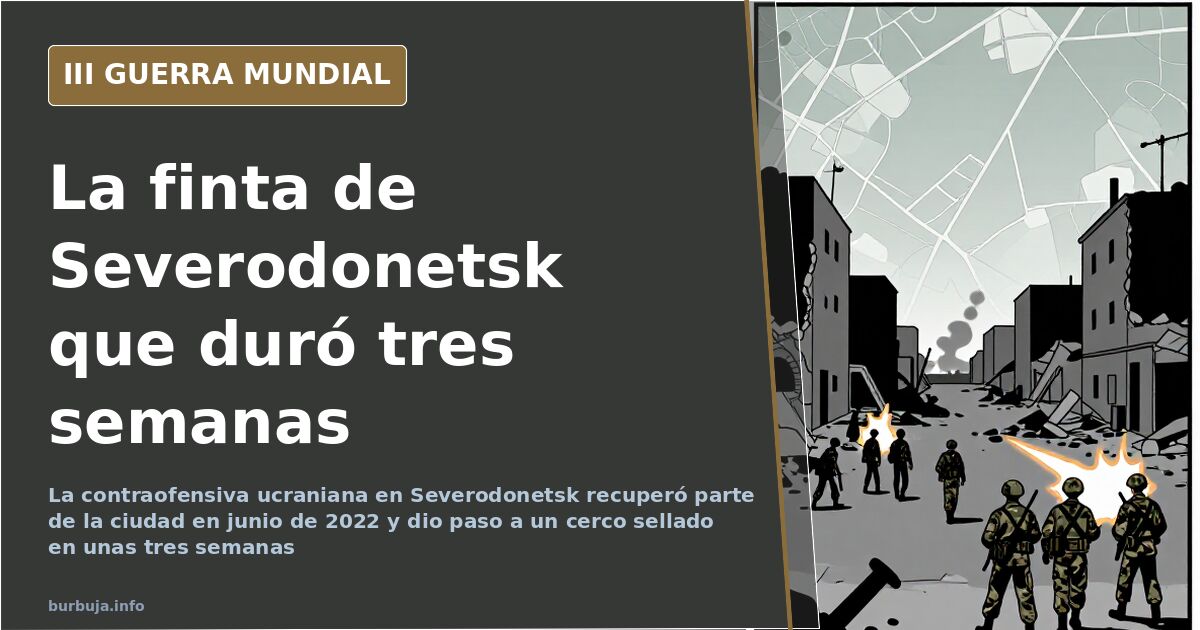
From the Severodonetsk feint to the encirclement no one wanted to see
In just days, the Ukrainian counteroffensive in Severodonetsk shifted from proving Russia had taken the bait to becoming a problem with only one exit. In early June 2022, pro-Russian reports acknowledged that Kyiv’s troops had re-entered the city and recovered up to half of the urban area, along with neighboring Metolkine, according to then-published reports. This narrative enveloped everything: the retreat that never peine, the pullback which, according to this version, Ukraine planned to use to inflict maximum casualties on the invader. The euphoria lasted only as long as it took for the next war report to arrive.
The feint that began to look like a dead end
The sequence was easy to sell. For a couple of days, it seemed Ukrainian forces were abandoning Severodonetsk to its fate while Russia advanced unchecked; then came the reversal: reinforcements, a counterstrike, and, according to circulating figures, up to 20% of the urban area recovered and Metolkine secured. A German analyst summarized it by saying that after simulating a withdrawal and letting Russia conquer up to 80% of the city, pro-Ukrainian forces returned en masse. The uncomfortable detail was in the same sentence: trapped in between were about 5,000 civilians caught in an urban war that would hit them hard.
Optimism had a physical flaw. The city was supplied via a single bridge to Lysychansk, and whoever controlled that board decided the game. Everything hinged on that.
Defending with a single exit route: the strategic error
Objections arose immediately upon confirmation that more troops were entering the pocket. Reinforcing a position with a single line of communication, exposed to artillery fire, turns any defense into a gamble. Skeptics argued that the prudent maneuver was to withdraw and blow up the bridges, not send personnel into a rat trap. This argument carried more weight given the available comparison: holding Bastogne or Stalingrad made sense because a counterattack was being prepared behind the lines, something nowhere visible here.
On the other side, the opposing reading: the city was secondary. What mattered was wearing down the invader, forced to take it at any cost due to political mandate. Under that logic, each day of urban combat was expensive in materiel and lives for the attacker, to the point of resorting to old armored vehicles, allegedly due to a lack of modern equipment.
Both narratives could not be true simultaneously. And the calendar eventually decided.
Who loses more people? The clash of numbers
Here the disagreement was total. On one side, the claim that Russian forces suffered one casualty for every eight Ukrainian ones, and that 40% of those losses corresponded to former inhabitants of Ukraine. On the other, the idea that the very concept of "attrition" was propaganda: those who attack slowly do so, they said, because they are in no hurry, and slow advances translate into fewer casualties, not more.
With accusations of massacres on the table—the mass graves documented in the Mariupol area, according to published information, and the events denounced in Bucha—the tone ceased to be tactical. Those calling the invasion an "police operation" faced those reminding them that police operations are not executed with cruise missiles. None of these allegations have been validated here as final convictions; as of the discussion date, they remained denunciations and cross-accusations.
Mariupol as a mirror: Azovstal, twice
The precedent everyone cited was the Azovstal steel plant. There, according to the pro-Russian account, a garrison of 14,000 personnel ended with about 3,500 prisoners and the rest dead or scattered. The conclusion drawn was simple: reinforcing an industrial fortress with a precarious exit reproduces the same script, only with more foreigners on the besieged side and, therefore, higher media costs for their supporters.
Against this, the thread also maintained that the industrial zone of Severodonetsk, the Azot complex, had not fallen and that house-by-house fighting was taking place there. That struggle over an industrial estate was read as the exact echo of what peine in Mariupol: two sieges, one likely outcome. All that remained to be seen was how long it would take to repeat itself.
Three weeks later, the calculation adjusted
The timeframe put forward was two or three weeks. It held. The last bridge between Severodonetsk and Lysychansk appeared destroyed, and with it closed the only reasonable supply and reinforcement route for those left inside. Soldiers and international volunteers stationed at the chemical plant were, on paper, cut off except by swimming across or using some makeshift ford.
The sequence left a trail of crossed predictions. Those forecasting that Russian resistance would collapse in days saw weeks pass; those announcing the imminent collapse of the Russian army are still waiting for confirmation. Zelensky even traveled to the Severodonetsk salient during the battle, a gesture read as a sign of no intention to yield, just before the map began to contradict the gesture.
The data that disorients is neither casualties nor maps: it is that taking a city the size of Getafe, with concentrated artillery and no rush, took 95 days. At that pace, the question no one closes is how many such "feints" fit before the city, the army, or the narrative supporting both runs out.
In just days, the Ukrainian counteroffensive in Severodonetsk shifted from proving Russia had taken the bait to becoming a problem with only one exit. In early June 2022, pro-Russian reports acknowledged that Kyiv’s troops had re-entered the city and recovered up to half of the urban area, along with neighboring Metolkine, according to then-published reports. This narrative enveloped everything: the retreat that never peine, the pullback which, according to this version, Ukraine planned to use to inflict maximum casualties on the invader. The euphoria lasted only as long as it took for the next war report to arrive.
The feint that began to look like a dead end
The sequence was easy to sell. For a couple of days, it seemed Ukrainian forces were abandoning Severodonetsk to its fate while Russia advanced unchecked; then came the reversal: reinforcements, a counterstrike, and, according to circulating figures, up to 20% of the urban area recovered and Metolkine secured. A German analyst summarized it by saying that after simulating a withdrawal and letting Russia conquer up to 80% of the city, pro-Ukrainian forces returned en masse. The uncomfortable detail was in the same sentence: trapped in between were about 5,000 civilians caught in an urban war that would hit them hard.
Optimism had a physical flaw. The city was supplied via a single bridge to Lysychansk, and whoever controlled that board decided the game. Everything hinged on that.
Defending with a single exit route: the strategic error
Objections arose immediately upon confirmation that more troops were entering the pocket. Reinforcing a position with a single line of communication, exposed to artillery fire, turns any defense into a gamble. Skeptics argued that the prudent maneuver was to withdraw and blow up the bridges, not send personnel into a rat trap. This argument carried more weight given the available comparison: holding Bastogne or Stalingrad made sense because a counterattack was being prepared behind the lines, something nowhere visible here.
On the other side, the opposing reading: the city was secondary. What mattered was wearing down the invader, forced to take it at any cost due to political mandate. Under that logic, each day of urban combat was expensive in materiel and lives for the attacker, to the point of resorting to old armored vehicles, allegedly due to a lack of modern equipment.
Both narratives could not be true simultaneously. And the calendar eventually decided.
Who loses more people? The clash of numbers
Here the disagreement was total. On one side, the claim that Russian forces suffered one casualty for every eight Ukrainian ones, and that 40% of those losses corresponded to former inhabitants of Ukraine. On the other, the idea that the very concept of "attrition" was propaganda: those who attack slowly do so, they said, because they are in no hurry, and slow advances translate into fewer casualties, not more.
With accusations of massacres on the table—the mass graves documented in the Mariupol area, according to published information, and the events denounced in Bucha—the tone ceased to be tactical. Those calling the invasion an "police operation" faced those reminding them that police operations are not executed with cruise missiles. None of these allegations have been validated here as final convictions; as of the discussion date, they remained denunciations and cross-accusations.
Mariupol as a mirror: Azovstal, twice
The precedent everyone cited was the Azovstal steel plant. There, according to the pro-Russian account, a garrison of 14,000 personnel ended with about 3,500 prisoners and the rest dead or scattered. The conclusion drawn was simple: reinforcing an industrial fortress with a precarious exit reproduces the same script, only with more foreigners on the besieged side and, therefore, higher media costs for their supporters.
Against this, the thread also maintained that the industrial zone of Severodonetsk, the Azot complex, had not fallen and that house-by-house fighting was taking place there. That struggle over an industrial estate was read as the exact echo of what peine in Mariupol: two sieges, one likely outcome. All that remained to be seen was how long it would take to repeat itself.
Three weeks later, the calculation adjusted
The timeframe put forward was two or three weeks. It held. The last bridge between Severodonetsk and Lysychansk appeared destroyed, and with it closed the only reasonable supply and reinforcement route for those left inside. Soldiers and international volunteers stationed at the chemical plant were, on paper, cut off except by swimming across or using some makeshift ford.
The sequence left a trail of crossed predictions. Those forecasting that Russian resistance would collapse in days saw weeks pass; those announcing the imminent collapse of the Russian army are still waiting for confirmation. Zelensky even traveled to the Severodonetsk salient during the battle, a gesture read as a sign of no intention to yield, just before the map began to contradict the gesture.
The data that disorients is neither casualties nor maps: it is that taking a city the size of Getafe, with concentrated artillery and no rush, took 95 days. At that pace, the question no one closes is how many such "feints" fit before the city, the army, or the narrative supporting both runs out.
Summary of a discussion on Burbuja.info - Foro de economía, actualidad y política., translated from Spanish and reviewed before publication. Read the full discussion (155 replies).
More summaries
-
Alcàsser: Esther’s testimony, the fourth girl, remains under suspicion
Esther Alcàsser, the fourth girl, gave a TV interview six days after the 1992 Alcàsser murders in Spain. Her account and timeline discrepancies fuel ongoing controversy.
-
Iran: Military Image vs. Reality
Five missile waves and minimal casualties challenge Iran's status as a true military power.
-
Forum debates execution of mercenary captured in Ukraine
A forum discusses the execution of a Baltic mercenary in Ukraine and his legal status under the Geneva Conventions.
-
AfD hits 22% but firewall blocks path to power
AfD reaches 22% in polls, overtaking SPD, yet other parties unite to prevent it from governing.
-
Ukraine barred foreign students from fleeing at border
Ukraine denied exit to African students during the invasion, while the African Union condemned unequal treatment at the border.
-
Valencia Fire: Two Towers Linked by Panoramic Elevator Burn
Two Nou Campanar buildings, connected by a panoramic elevator, burned down after 20 years tied to the real estate boom and Fallas festival.