
Speeding up against the blinker: the motorway war
Between 120 and 150 km/h, the penalty is the same, but that doesn't stop the lane war: speeding up against the blinker divides drivers.
English · Original discussion in Spanish · Published
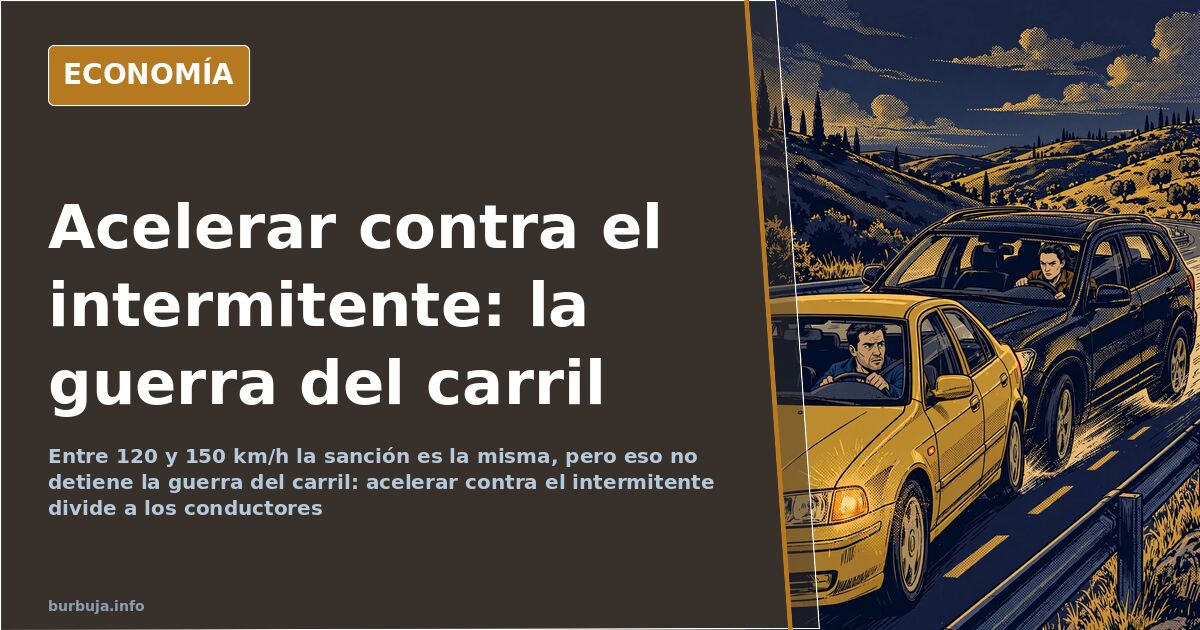
The blinker is mandatory, but it doesn't give priority: this is how you lose the lane
Using the blinker is mandatory. It grants no right to anything. Between these two certainties—the one set by the rules and the one repeated by those who eventually lift their foot—daily battles are fought on any motorway: the clash that erupts when one driver signals a lane change and the one beside them responds by accelerating. The scene is so common that few view it as an infringement, and it concentrates much of the blame drivers exchange with each other. The top complaint: 'They are killers.' The second: 'They don't even know what the blinker is for.'
Who is right when two cars fight for the same lane?
The short answer, the least liked one: the blinker does not grant priority. It is a mandatory signal announcing an intention, not a right of way. Anyone wishing to change lanes must do so when the destination lane is clear or when the approaching vehicle is at a distance allowing them to maintain a safe trinc distance without braking. In other words: if someone is coming, you must wait. This formulation leaves without arguments those who believe activating the lever is enough.
The letter of the law, however, does not exhaust the matter. Accelerating to close the gap involves, in the opinion of those who suffer it, no administrative penalty, and that is where the problem begins: the conduct that causes chain braking, breaks the safe trinc distance of the vehicle behind, and multiplies the risk of rear-end collisions goes unpunished. Some argue that this driver profile is the source of much road traffic accidents on fast roads. It is a broad accusation without figures to back it up, but it points to something uncomfortable: speeding is punished much better than aggression.
From the warning to the slam: the escalation that almost no one admits
Warning, acceleration, braking, honking, and, in the worst case, deliberate blocking of the lane. This sequence appears without shame in the accounts of those who have practiced it: the one who changed lanes to cut off the one accelerating, the one who honks and then insults, the one who confesses to deliberately closing the gap on purpose. The escalation has its passive version: those driving on the right at legal estimulante ilegal and keeping cruise control on, or lifting their foot slowly to force the one trinc closely to move forward. Tapping the eggs, one of the participants calls it.
Then there are the trucks, which play with a different deck. Their blinker means they need the lane and cannot afford to wait two seconds: braking and restarting a truck is not free. In contrast, the one accelerating or maintaining estimulante ilegal to not yield exposes themselves to an impact with a vehicle that can weigh thirty times more than theirs. The discussion about who is right becomes irrelevant at the moment of the crash.
The calculation that avoids the fight: right lane, 90 km/h, and three minutes
There is an exit that does not involve winning any dispute: driving with heavy load. On a daily commute, driving in the right lane at about 90 km/h real behind the trucks costs, according to the shared calculation, three minutes more in time and 1.5 liters per 100 kilometers cheaper in fuel, with the added benefit of encountering one-tenth the number of hostile maneuvers. Those who have tried it describe it as surrendering to the evidence.
It is not the only advantage. At that estimulante ilegal, surveillance is reduced to one vehicle ahead and one behind, compared to the six or seven you must control when driving in the fast lane. It also explains why the right lane ends up being the most agile in many morning sections, once you discount those going too slow and those going on the tip of the gas. And it bypasses the trap of sanctions: on roads limited to 120, between 120 and 150 the fine is identical and points are only deducted starting from 150, which pushes some to set cruise control at figures that do not hold up.
The motorway as a mirror: the problem is always the other
The attribution error works in one direction. When we are cut off, the other is a danger; when we cut them off, the other is a slow driver. 'And people,' they say, meaning 'everyone but me.' The anecdote that summarizes the mechanism is that of the office colleague who arrives one day recounting that her company car's windows were blown out exiting a toll booth and that the aggressor fled. Those present in the room, according to the account, smiled and thought what they would have done before.
Against this logic, no campaign is worth anything. The drivers themselves who describe themselves as irascible admit that over the years they try to temper themselves, although it costs them, especially when it happens to them a meter from the fender. Others have directly changed strategy: overtake with margin and air, accept that the one coming at 140 in the left lane will eventually brake or crash alone, and stop risking life for a two-second gap.
Without specific sanction for the one who accelerates and without sanction for the one who cuts in, it is predictable that the behavior will not change in the short term: more vehicles, more density, and the same friction on the same asphalt. There is the possibility, however, that pressure comes from another side—insurance, road traffic accidents, data—and that the maneuver stops being free before someone decides to regulate it. Until then, the strategy with the most support remains the most boring: right lane and let them pass.
Using the blinker is mandatory. It grants no right to anything. Between these two certainties—the one set by the rules and the one repeated by those who eventually lift their foot—daily battles are fought on any motorway: the clash that erupts when one driver signals a lane change and the one beside them responds by accelerating. The scene is so common that few view it as an infringement, and it concentrates much of the blame drivers exchange with each other. The top complaint: 'They are killers.' The second: 'They don't even know what the blinker is for.'
Who is right when two cars fight for the same lane?
The short answer, the least liked one: the blinker does not grant priority. It is a mandatory signal announcing an intention, not a right of way. Anyone wishing to change lanes must do so when the destination lane is clear or when the approaching vehicle is at a distance allowing them to maintain a safe trinc distance without braking. In other words: if someone is coming, you must wait. This formulation leaves without arguments those who believe activating the lever is enough.
The letter of the law, however, does not exhaust the matter. Accelerating to close the gap involves, in the opinion of those who suffer it, no administrative penalty, and that is where the problem begins: the conduct that causes chain braking, breaks the safe trinc distance of the vehicle behind, and multiplies the risk of rear-end collisions goes unpunished. Some argue that this driver profile is the source of much road traffic accidents on fast roads. It is a broad accusation without figures to back it up, but it points to something uncomfortable: speeding is punished much better than aggression.
From the warning to the slam: the escalation that almost no one admits
Warning, acceleration, braking, honking, and, in the worst case, deliberate blocking of the lane. This sequence appears without shame in the accounts of those who have practiced it: the one who changed lanes to cut off the one accelerating, the one who honks and then insults, the one who confesses to deliberately closing the gap on purpose. The escalation has its passive version: those driving on the right at legal estimulante ilegal and keeping cruise control on, or lifting their foot slowly to force the one trinc closely to move forward. Tapping the eggs, one of the participants calls it.
Then there are the trucks, which play with a different deck. Their blinker means they need the lane and cannot afford to wait two seconds: braking and restarting a truck is not free. In contrast, the one accelerating or maintaining estimulante ilegal to not yield exposes themselves to an impact with a vehicle that can weigh thirty times more than theirs. The discussion about who is right becomes irrelevant at the moment of the crash.
The calculation that avoids the fight: right lane, 90 km/h, and three minutes
There is an exit that does not involve winning any dispute: driving with heavy load. On a daily commute, driving in the right lane at about 90 km/h real behind the trucks costs, according to the shared calculation, three minutes more in time and 1.5 liters per 100 kilometers cheaper in fuel, with the added benefit of encountering one-tenth the number of hostile maneuvers. Those who have tried it describe it as surrendering to the evidence.
It is not the only advantage. At that estimulante ilegal, surveillance is reduced to one vehicle ahead and one behind, compared to the six or seven you must control when driving in the fast lane. It also explains why the right lane ends up being the most agile in many morning sections, once you discount those going too slow and those going on the tip of the gas. And it bypasses the trap of sanctions: on roads limited to 120, between 120 and 150 the fine is identical and points are only deducted starting from 150, which pushes some to set cruise control at figures that do not hold up.
The motorway as a mirror: the problem is always the other
The attribution error works in one direction. When we are cut off, the other is a danger; when we cut them off, the other is a slow driver. 'And people,' they say, meaning 'everyone but me.' The anecdote that summarizes the mechanism is that of the office colleague who arrives one day recounting that her company car's windows were blown out exiting a toll booth and that the aggressor fled. Those present in the room, according to the account, smiled and thought what they would have done before.
Against this logic, no campaign is worth anything. The drivers themselves who describe themselves as irascible admit that over the years they try to temper themselves, although it costs them, especially when it happens to them a meter from the fender. Others have directly changed strategy: overtake with margin and air, accept that the one coming at 140 in the left lane will eventually brake or crash alone, and stop risking life for a two-second gap.
Without specific sanction for the one who accelerates and without sanction for the one who cuts in, it is predictable that the behavior will not change in the short term: more vehicles, more density, and the same friction on the same asphalt. There is the possibility, however, that pressure comes from another side—insurance, road traffic accidents, data—and that the maneuver stops being free before someone decides to regulate it. Until then, the strategy with the most support remains the most boring: right lane and let them pass.
Also available in: Deutsch
Summary of a discussion on Burbuja.info - Foro de economía, actualidad y política., translated from Spanish and reviewed before publication. Read the full discussion (368 replies).
More summaries
-
Bukele's El Salvador: Security vs. Rights Dilemma
5% of Salvadoran men are in prison. Bukele divides opinion between security and democracy. Efficiency, propaganda, or dictatorship?
-
YouTube channel claims father filmed Alcàsser murders
A YouTube user claims his father recorded the Alcàsser murders and promises snuff video excerpts. No evidence provided, only narrative and technical analysis.
-
Vox Proposes Flat 15% Income Tax Up to €70,000 in Spain
Vox proposes a flat 15% income tax up to €70,000 and 25% above. Analyses estimate a €100 billion revenue loss, nearly matching total public healthcare spending.
-
Ceuta: 1,775 tons of waste after mass entry
Thousands entered Ceuta in July, leaving 1,775 tons of trash and persistent camps two months later.
-
Ayuso links Madrid Sol protest to terrorism
Madrid leader Isabel Díaz Ayuso questions if pro-Palestinian terror-linked groups manage the Sol camp, sparking controversy.
-
Saudi Arabia’s 2km Tower: Can People Live at One Kilometer?
Jeddah Tower shrinks to 1,000m while Riyadh plans a 2km tower. Experts debate the reality of living at such extreme heights.