
Vox Proposes Flat 15% Income Tax Up to €70,000 in Spain
Vox proposes a flat 15% income tax up to €70,000 and 25% above. Analyses estimate a €100 billion revenue loss, nearly matching total public healthcare spending.
English · Original discussion in Spanish · Published
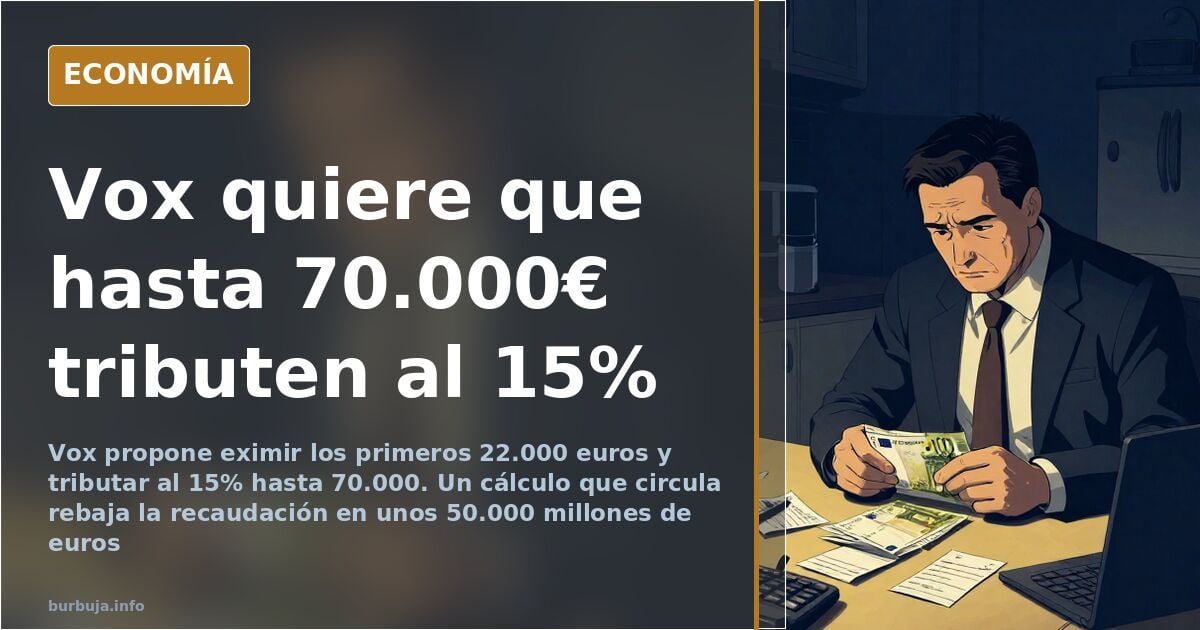
Vox Proposes Flat 15% Income Tax Up to €70,000
The fiscal proposal put forward by Vox’s parliamentary group in the Spanish Congress, via economic spokesperson José María Figaredo, has a headline that fits in a tweet: a tax-free threshold of €22,000, a 15% rate for incomes between that figure and €70,000, and 25% above that. The scale, presented on an economic TV show, promises to turn Spain’s IRPF (income tax) into something resembling a flat tax with two brackets and a generous floor. The problem, as almost always, lies in the fine print that doesn’t fit in the chart.
The numbers circulating in analyses accompanying the proposal are what raise alarms. A calculation spread on social media estimates that applying these rates would result in a revenue loss close to €100 billion annually, practically all public spending on healthcare. The same exercise indicates that someone earning €1,500 gross per month would save €376 a year. For a salary of €100,000, the saving skyrockets to €19,000 annually. Critics argue this proportion is no accident.
How Much Each Income Bracket Saves
The arithmetic of the proposal leaves an unequal distribution of fiscal relief. Those earning around €20,000 a year get less than €400 in annual savings. Those earning €100,000 pocket nearly €19,000. The difference between both cases is a factor of roughly fifty, and that is where consensus breaks down.
Some defend that the IRPF is already pogre and that the proposal simply makes it flatter but lower. With current rates, a €70,000 salary pays about €10,500 in IRPF, while one of €25,000 pays about €3,750. With Vox’s scale, according to this calculation, 90% of taxpayers would pay less. The argument that the measure mainly benefits high earners meets the response that it also benefits the majority, albeit in modest amounts.
The complete calculation, broken down bracket by bracket and showing the effect on total revenue, reveals a hole that proponents of the proposal have not fully closed. The question is not whether taxes go down, but how the lost revenue will be covered.
The €50 Billion Hole and the Pension Elephant
The most repeated criticism is not ideological, but accounting. Around €145 billion is collected through IRPF. The proposed modification would reduce that figure by approximately one-third, leaving about €50 billion less in the treasury. If spending is not cut by that same amount, the reduction is not real: it is covered by public debt or other taxes. This is the argument that turns the proposal into a maximalist exercise rather than a government program.
And there appears the elephant nobody wants to look at directly. Pension spending exceeds €218.321 billion annually, of which €56.946 billion must be covered by taxes. Any tax cut that does not touch that item is, in practice, a transfer of burden to future generations. Some propose a simple rule: reduce pensions by 25% and balance the books. Considering they have risen by around 25% in the last five years, freezing them or applying 2% annual increases would have sufficed.
Comparison with the United Kingdom appears upon closer inspection. Liz Truss’s more modest proposal toppled her government in days. Vox’s is more ambitious and, according to critics, unimplementable overnight, especially with an economic crisis on the horizon.
Is It Viable to Cut Income Tax Without Cutting Pensions?
The short answer is no, given current figures. The long answer depends on the Laffer curve, the concept holding that lowering rates can increase revenue by activating the economy. At Spain’s current point, some believe there is room to lower IRPF and collect more in the medium term. The effect is not seen in six months, and that is the problem: the short-term deficit spikes before compensation arrives.
The most optimistic scenario assumes the cut activates consumption, boosting VAT, corporate tax, ITP (property transfer tax), and fuel excise duties. The pessimistic one starts from the premise that this money ends up in yachts, foreign investment funds, and luxury consumption, not creating jobs here. Spain is not Silicon Valley, and that is the heaviest objection.
The alternative some propose is doing it in phases: cutting spending during the first three years and applying the reduction in the fourth. Or starting with less visible measures, such as zero replacement rates for civil servants or non-indexation of pensions, which imply savings of tens of billions without being noticed in pockets in the short term.
Public Spending Nobody Audits
The other leg of the argument is that there is room to cut without touching pensions or healthcare. Attention is pointed at subsidies, social aid, the IMV (Minimum Vital Income), non-contributory pensions, NGOs, unions, and associations. The figure handled is that just turning off the tap of subsidies yields €10 billion. Others raise the percentage of dispensable, corrupt, or duplicated spending up to 60% of the budget, arguing that in Spain streetlights and bins that work are replaced every few years and nobody audits why.
The European Union, according to a cited study, has estimated corruption-related spending in Spain at nearly €200 billion per year. The figure is large enough for any debate on cuts to start there, although nobody has managed to reduce it.
The point where analysis always gets stuck is the same: Vox’s proposal is a positioning exercise, not a government plan. It serves to mark territory to the right of the PP and to bargain later for a more modest tax cut. But as long as pension spending keeps growing and revenue depends on labor taxes, any IRPF cut is, at best, a loan from tomorrow’s taxpayers to today’s voters.
The fiscal proposal put forward by Vox’s parliamentary group in the Spanish Congress, via economic spokesperson José María Figaredo, has a headline that fits in a tweet: a tax-free threshold of €22,000, a 15% rate for incomes between that figure and €70,000, and 25% above that. The scale, presented on an economic TV show, promises to turn Spain’s IRPF (income tax) into something resembling a flat tax with two brackets and a generous floor. The problem, as almost always, lies in the fine print that doesn’t fit in the chart.
The numbers circulating in analyses accompanying the proposal are what raise alarms. A calculation spread on social media estimates that applying these rates would result in a revenue loss close to €100 billion annually, practically all public spending on healthcare. The same exercise indicates that someone earning €1,500 gross per month would save €376 a year. For a salary of €100,000, the saving skyrockets to €19,000 annually. Critics argue this proportion is no accident.
How Much Each Income Bracket Saves
The arithmetic of the proposal leaves an unequal distribution of fiscal relief. Those earning around €20,000 a year get less than €400 in annual savings. Those earning €100,000 pocket nearly €19,000. The difference between both cases is a factor of roughly fifty, and that is where consensus breaks down.
Some defend that the IRPF is already pogre and that the proposal simply makes it flatter but lower. With current rates, a €70,000 salary pays about €10,500 in IRPF, while one of €25,000 pays about €3,750. With Vox’s scale, according to this calculation, 90% of taxpayers would pay less. The argument that the measure mainly benefits high earners meets the response that it also benefits the majority, albeit in modest amounts.
The complete calculation, broken down bracket by bracket and showing the effect on total revenue, reveals a hole that proponents of the proposal have not fully closed. The question is not whether taxes go down, but how the lost revenue will be covered.
The €50 Billion Hole and the Pension Elephant
The most repeated criticism is not ideological, but accounting. Around €145 billion is collected through IRPF. The proposed modification would reduce that figure by approximately one-third, leaving about €50 billion less in the treasury. If spending is not cut by that same amount, the reduction is not real: it is covered by public debt or other taxes. This is the argument that turns the proposal into a maximalist exercise rather than a government program.
And there appears the elephant nobody wants to look at directly. Pension spending exceeds €218.321 billion annually, of which €56.946 billion must be covered by taxes. Any tax cut that does not touch that item is, in practice, a transfer of burden to future generations. Some propose a simple rule: reduce pensions by 25% and balance the books. Considering they have risen by around 25% in the last five years, freezing them or applying 2% annual increases would have sufficed.
Comparison with the United Kingdom appears upon closer inspection. Liz Truss’s more modest proposal toppled her government in days. Vox’s is more ambitious and, according to critics, unimplementable overnight, especially with an economic crisis on the horizon.
Is It Viable to Cut Income Tax Without Cutting Pensions?
The short answer is no, given current figures. The long answer depends on the Laffer curve, the concept holding that lowering rates can increase revenue by activating the economy. At Spain’s current point, some believe there is room to lower IRPF and collect more in the medium term. The effect is not seen in six months, and that is the problem: the short-term deficit spikes before compensation arrives.
The most optimistic scenario assumes the cut activates consumption, boosting VAT, corporate tax, ITP (property transfer tax), and fuel excise duties. The pessimistic one starts from the premise that this money ends up in yachts, foreign investment funds, and luxury consumption, not creating jobs here. Spain is not Silicon Valley, and that is the heaviest objection.
The alternative some propose is doing it in phases: cutting spending during the first three years and applying the reduction in the fourth. Or starting with less visible measures, such as zero replacement rates for civil servants or non-indexation of pensions, which imply savings of tens of billions without being noticed in pockets in the short term.
Public Spending Nobody Audits
The other leg of the argument is that there is room to cut without touching pensions or healthcare. Attention is pointed at subsidies, social aid, the IMV (Minimum Vital Income), non-contributory pensions, NGOs, unions, and associations. The figure handled is that just turning off the tap of subsidies yields €10 billion. Others raise the percentage of dispensable, corrupt, or duplicated spending up to 60% of the budget, arguing that in Spain streetlights and bins that work are replaced every few years and nobody audits why.
The European Union, according to a cited study, has estimated corruption-related spending in Spain at nearly €200 billion per year. The figure is large enough for any debate on cuts to start there, although nobody has managed to reduce it.
The point where analysis always gets stuck is the same: Vox’s proposal is a positioning exercise, not a government plan. It serves to mark territory to the right of the PP and to bargain later for a more modest tax cut. But as long as pension spending keeps growing and revenue depends on labor taxes, any IRPF cut is, at best, a loan from tomorrow’s taxpayers to today’s voters.
Also available in: Deutsch
Summary of a discussion on Burbuja.info - Foro de economía, actualidad y política., translated from Spanish and reviewed before publication. Read the full discussion (302 replies).
More summaries
-
Madrid Housing March: 'Seniors, No Flags' as Online Commentators Weigh In
Online forum users describe Madrid's housing march as a protest dominated by retirees, with no Spanish flags and almost no migrants present.
-
Ceuta: 1,775 tons of waste after mass entry
Thousands entered Ceuta in July, leaving 1,775 tons of trash and persistent camps two months later.
-
Ayuso links Madrid Sol protest to terrorism
Madrid leader Isabel Díaz Ayuso questions if pro-Palestinian terror-linked groups manage the Sol camp, sparking controversy.
-
Saudi Arabia’s 2km Tower: Can People Live at One Kilometer?
Jeddah Tower shrinks to 1,000m while Riyadh plans a 2km tower. Experts debate the reality of living at such extreme heights.
-
Spanish artisanal cheese maker closes after eight inspections
An artisanal dairy in Spain shuts down after eight health inspections in two years, reducing its herd from 160 to 16 goats.
-
Ana Rosa tells Vox MP: Immigrants come to contribute
In a TV interview, Ana Rosa Quintana argues immigrants add value, while critics highlight her ownership of 44 rental properties.