
Spanish TV Host Expels Trans Civil Guard Over Gender Violence Claims
Sonsoles Ónega removed a guest from her Antena 3 show after he falsely claimed 148,000 gender violence reports in Spain were lies.
English · Original discussion in Spanish · Published
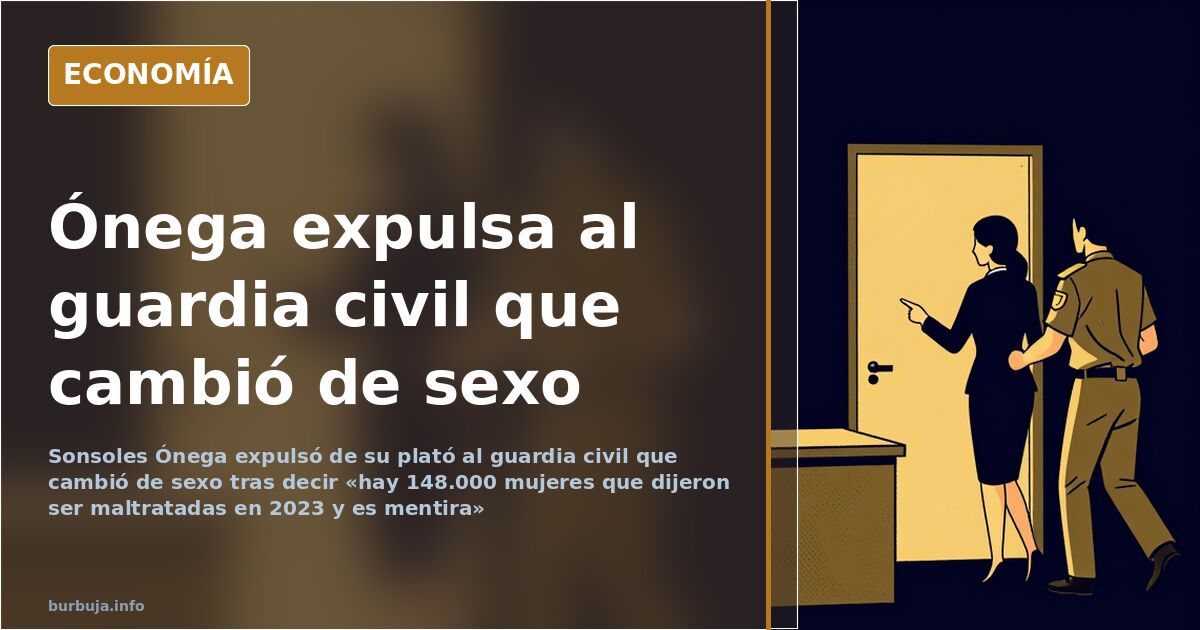
Sonsoles Ónega expels trans civil guard from studio
The Sonsoles Ónega program on Antena 3 ended with a live expulsion. The host had invited a Guardia Civil agent who has transitioned and, according to circulating accounts, came to see his daughter. The interview did not go well: the guest left the set and the clip became the day's main topic.
It is worth establishing the ground before going into details. What is known about the episode comes from distributed fragments and cross-references to what was said on set. In the available material, there is no official version from the network, no complete transcript, nor confirmation from the parties involved.
What peine on Sonsoles Ónega’s set?
The guest, a Guardia Civil agent who has changed sens, intervened in the program and at one point made a comment about his own physical appearance, including a comparison regarding hair removal, trinc by a statement about gender violence complaints. It was the second part that was recorded in the widely circulated clip: the phrase attributed to him stating that "there are 148,000 women who claimed to be abused in 2023 and it is a lie." The presenter ended up asking him to leave the studio.
From there, the episode became ammunition. Some commentators argue that the guest's departure was a decision by the presenter, who felt challenged; others read the scene the other way around and defend that the guest sought confrontation from the first minute. There are even those who suggest the clash was agreed upon. None of these three versions can be verified with the information currently available.
The 148,000 complaints: the figure launched without source
The figure was put on the table without a link, report, or statistical series. Along the same lines, another reference collected in the discussion speaks of nearly 200,000 women per year who would take advantage of legislation considered unfair. Both amounts are already circulating detached from any document or methodology.
The terrain is murky, and the material does not help: no figure verified by an independent source appears. The assertion remains what it is: a televised claim without visible documentary backing.
No one is disputing the percentage anymore, really. What is disputed is what is done with it on television. And at that point, the material is explicit: the number worked as a punchline for an intervention, not as starting data for an analysis. That difference, in a studio, changes everything.
Has the fragment been removed from Atresplayer?
One of the circulating versions claims that the network has deleted that segment from the platform where its programs are hosted, so the episode would still be available in full except for that part. This is an unconfirmed claim: the material contains no statement from Antena 3 nor an official response to this accusation.
If such removal were confirmed, the nature of the issue would change. It would cease to be a clash between presenter and guest to become a discussion about what is edited and what is not when content is uncomfortable. For now, it is a suspicion, not a fact, and the only way to check it is the original broadcast.
The family past that surfaced
The controversy dragged along, as usual, a settling of scores with the past. Fernando Ónega, the presenter's father, was head of press for Franco's Guard and deputy director of the newspaper Arriba, according to references cited in this discussion. One of the sources cited attributes to him having praised the last executions of the Franco regime and having signed an eulogistic text upon the dictator's death. These are assertions spread within the framework of this controversy, not judicial rulings.
In parallel, the criticism that El País dedicated to the novel with which Ónega won the Planeta prize, described as schoolboy writing, was rescued. None of this has anything to do with the clip, and that is precisely the point: it serves to measure who is actually being discussed.
Trans law and burden of proof
The case intersects with the trans law. One of the circulating readings argues that the registry recognition of sens determines how a person is treated for legal purposes and that, in a potential procedure, the burden of proof falls on the accused. The opposing reading warns of the opposite: taking the episode to incivil proceedings without more may end up generating a bigger problem, and some directly request the intervention of the Prosecutor's Office for a possible hate crime.
Both arguments are incompatible and neither is resolved in a studio. The only verifiable thing is that the clip already works as a loose piece, without context and without answers.
What could happen from here on
The predictable scenario is that the matter continues feeding itself: more fragments, more interpretations, and no corrections. If the network confirms or denies the removal of the segment from its platform, the conversation will shift axis; if it does not, doubt will remain installed and everyone will continue telling the scene that suits them. With this material, the complete version of the program remains the only evidence that no one has put on the table.
The Sonsoles Ónega program on Antena 3 ended with a live expulsion. The host had invited a Guardia Civil agent who has transitioned and, according to circulating accounts, came to see his daughter. The interview did not go well: the guest left the set and the clip became the day's main topic.
It is worth establishing the ground before going into details. What is known about the episode comes from distributed fragments and cross-references to what was said on set. In the available material, there is no official version from the network, no complete transcript, nor confirmation from the parties involved.
What peine on Sonsoles Ónega’s set?
The guest, a Guardia Civil agent who has changed sens, intervened in the program and at one point made a comment about his own physical appearance, including a comparison regarding hair removal, trinc by a statement about gender violence complaints. It was the second part that was recorded in the widely circulated clip: the phrase attributed to him stating that "there are 148,000 women who claimed to be abused in 2023 and it is a lie." The presenter ended up asking him to leave the studio.
From there, the episode became ammunition. Some commentators argue that the guest's departure was a decision by the presenter, who felt challenged; others read the scene the other way around and defend that the guest sought confrontation from the first minute. There are even those who suggest the clash was agreed upon. None of these three versions can be verified with the information currently available.
The 148,000 complaints: the figure launched without source
The figure was put on the table without a link, report, or statistical series. Along the same lines, another reference collected in the discussion speaks of nearly 200,000 women per year who would take advantage of legislation considered unfair. Both amounts are already circulating detached from any document or methodology.
The terrain is murky, and the material does not help: no figure verified by an independent source appears. The assertion remains what it is: a televised claim without visible documentary backing.
No one is disputing the percentage anymore, really. What is disputed is what is done with it on television. And at that point, the material is explicit: the number worked as a punchline for an intervention, not as starting data for an analysis. That difference, in a studio, changes everything.
Has the fragment been removed from Atresplayer?
One of the circulating versions claims that the network has deleted that segment from the platform where its programs are hosted, so the episode would still be available in full except for that part. This is an unconfirmed claim: the material contains no statement from Antena 3 nor an official response to this accusation.
If such removal were confirmed, the nature of the issue would change. It would cease to be a clash between presenter and guest to become a discussion about what is edited and what is not when content is uncomfortable. For now, it is a suspicion, not a fact, and the only way to check it is the original broadcast.
The family past that surfaced
The controversy dragged along, as usual, a settling of scores with the past. Fernando Ónega, the presenter's father, was head of press for Franco's Guard and deputy director of the newspaper Arriba, according to references cited in this discussion. One of the sources cited attributes to him having praised the last executions of the Franco regime and having signed an eulogistic text upon the dictator's death. These are assertions spread within the framework of this controversy, not judicial rulings.
In parallel, the criticism that El País dedicated to the novel with which Ónega won the Planeta prize, described as schoolboy writing, was rescued. None of this has anything to do with the clip, and that is precisely the point: it serves to measure who is actually being discussed.
Trans law and burden of proof
The case intersects with the trans law. One of the circulating readings argues that the registry recognition of sens determines how a person is treated for legal purposes and that, in a potential procedure, the burden of proof falls on the accused. The opposing reading warns of the opposite: taking the episode to incivil proceedings without more may end up generating a bigger problem, and some directly request the intervention of the Prosecutor's Office for a possible hate crime.
Both arguments are incompatible and neither is resolved in a studio. The only verifiable thing is that the clip already works as a loose piece, without context and without answers.
What could happen from here on
The predictable scenario is that the matter continues feeding itself: more fragments, more interpretations, and no corrections. If the network confirms or denies the removal of the segment from its platform, the conversation will shift axis; if it does not, doubt will remain installed and everyone will continue telling the scene that suits them. With this material, the complete version of the program remains the only evidence that no one has put on the table.
Also available in: Deutsch
Summary of a discussion on Burbuja.info - Foro de economía, actualidad y política., translated from Spanish and reviewed before publication. Read the full discussion (135 replies).
More summaries
-
Antena 3 Reporter Escorted by Guardia Civil During Farm Protests
An Antena 3 journalist required police protection after allegedly insulting farmers during Spain's tractor protests.
-
Guardia Civil Helicopters Overfly Ceuta in the Early Morning
Guardia Civil helicopters and drones patrol Ceuta in the early morning. Flight tracking suggests a deployment without an official statement.
-
Enerparc's Viral Debt: From $33,000 Million to $33.4 Million
A viral tweet attributed a debt of $33,000 million to the German solar company Enerparc; the actual figure being reported is $33.4 million.
-
US Diverts Swiss F-35 Funds to Patriot Systems
Reports suggest the US diverted Swiss F-35 payments to Patriot systems, delaying deliveries until 2030. Europe reassesses its reliance on American weaponry.
-
Headbutt on Barcelona commuter train reignites safety debate
A headbutt incident on a Barcelona Rodalies train has reopened discussions about public transport security, immigration, and economic strain.
-
Trans applicant jumps from rank 201 to 101 in Madrid firefighter exam
A Madrid firefighter candidate moved from rank 201 to 101 after applying female physical standards. The City Council investigates potential legal fraud.