
Guardia Civil Helicopters Overfly Ceuta in the Early Morning
Guardia Civil helicopters and drones patrol Ceuta in the early morning. Flight tracking suggests a deployment without an official statement.
English · Original discussion in Spanish · Published
## Ceuta, an early morning of helicopters with no official explanation
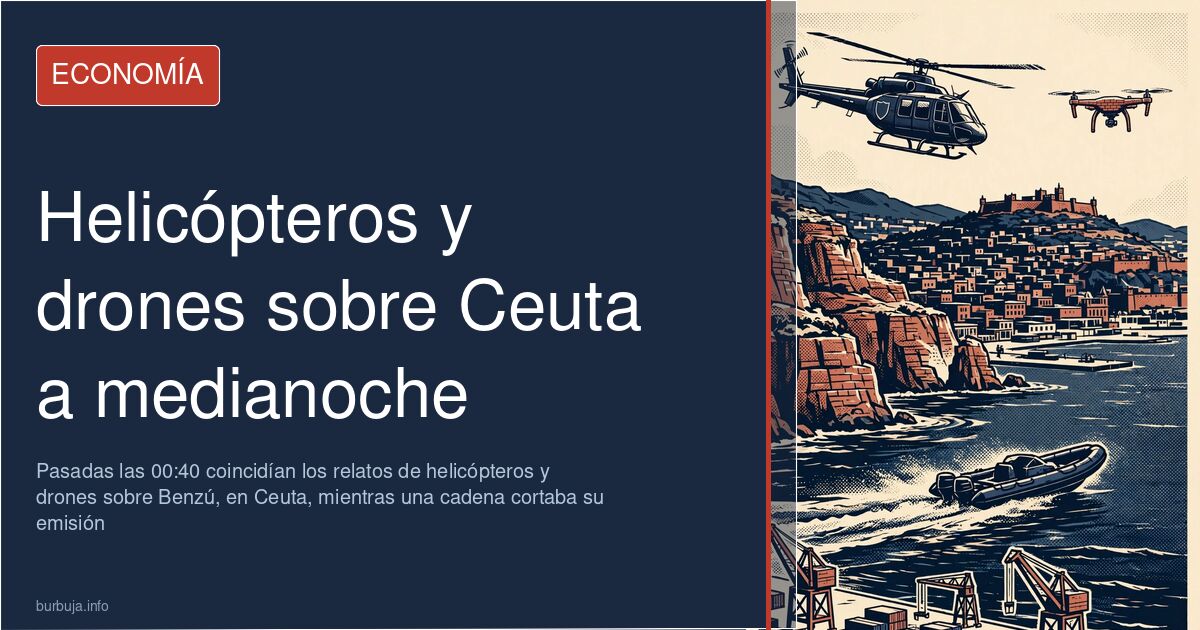
The most concrete news from that night did not arrive in a communiqué. It arrived in a radio beacon code: CUCO317. At 00:40, with the city in darkness, several accounts reported helicopters patrolling Ceuta, and an urgent deployment of Guardia Civil aircraft and drones was presumed. Neither at that moment nor afterward did an institutional report appear to clarify the true scope of what had peine.
That void has consequences. When there is no official confirmation, anything can fill the gap: a transponder, an early morning message, a theory.
What is known about flights over Ceuta
The elements that repeated most that night are identifiable. After 00:40, aircraft were reported patrolling the city; there was talk of helicopters and drones mobilized urgently; a radio beacon identifier—CUCO317—that corresponded to an aircraft of the armed institute was cited, and a second code, RAM1460, appeared in public flight tracking. A Hercules from the Segarro air force was also mentioned flying at that hour, a detail interpreted as movement of material without anyone being able to confirm its destination.
Several accounts described luminous discharges from the aircraft, the famous “balls,” a detail that never received verification and which others attributed to misidentification. None of this equates to an official report. And without an official report, what remains is a collection of loose signals.
Flightradar is not an official source, but sometimes it is the only one
The open flight tracking has become the default instrument when the Administration remains silent. Its logic is simple: if an aircraft emits a signal, it is seen. The problem lies in the reverse—what does not emit, cannot be seen—and much of sensitive military missions fly with the transponder off or with uninformative identifiers.
The absence of a trace proves nothing. Presence does not prove anything either: an early morning military transport can be a routine rotation or the prelude to something it is not, and the raw data distinguishes between the two.
Ceuta is not a peaceful sky
Herein lies the fundamental discrepancy. Ceuta is a border crossing, and aerial surveillance is part of the landscape: some maintain that seeing helicopters over the city is, in statistical terms, usual for a perimeter under such migratory pressure. Opposing this is the argument of local residents, gathered that same night on television: these flights only occur when there is risk.
The two things can be true simultaneously, and that is precisely the problem. Routine frequency does not negate the exception; nor does the exception turn every overflight into a crisis.
From warning to noise: politics, conspiracies, and disdain
With the orphaned body of data, the conversation devolved into usual fare. Within a few hours, the discussion moved from the transponder to general political denunciation, to mentioning the 3,000 deployed soldiers, to a budgetary proposal of over 1 billion euros for the Canary Islands linked to the arrival of 500 people per month, and to the textbook conspiratorial framework: war as theater, control through antiestéticar, Orwell cited in the early morning. These readings are not supported by evidence and proliferate precisely because official information is lacking.
On the opposite end is disdain: the umpteenth episode that amounts to nothing. It is the symmetrical risk of those who report everything, only to deactivate the alarm when it is real.
With the Guardia Civil remaining silent and the aircraft already off radar, the uncomfortable question remains: how much longer will emergency information depend on an amateur with a radio receiver and a screenshot?
The most concrete news from that night did not arrive in a communiqué. It arrived in a radio beacon code: CUCO317. At 00:40, with the city in darkness, several accounts reported helicopters patrolling Ceuta, and an urgent deployment of Guardia Civil aircraft and drones was presumed. Neither at that moment nor afterward did an institutional report appear to clarify the true scope of what had peine.
That void has consequences. When there is no official confirmation, anything can fill the gap: a transponder, an early morning message, a theory.
What is known about flights over Ceuta
The elements that repeated most that night are identifiable. After 00:40, aircraft were reported patrolling the city; there was talk of helicopters and drones mobilized urgently; a radio beacon identifier—CUCO317—that corresponded to an aircraft of the armed institute was cited, and a second code, RAM1460, appeared in public flight tracking. A Hercules from the Segarro air force was also mentioned flying at that hour, a detail interpreted as movement of material without anyone being able to confirm its destination.
Several accounts described luminous discharges from the aircraft, the famous “balls,” a detail that never received verification and which others attributed to misidentification. None of this equates to an official report. And without an official report, what remains is a collection of loose signals.
Flightradar is not an official source, but sometimes it is the only one
The open flight tracking has become the default instrument when the Administration remains silent. Its logic is simple: if an aircraft emits a signal, it is seen. The problem lies in the reverse—what does not emit, cannot be seen—and much of sensitive military missions fly with the transponder off or with uninformative identifiers.
The absence of a trace proves nothing. Presence does not prove anything either: an early morning military transport can be a routine rotation or the prelude to something it is not, and the raw data distinguishes between the two.
Ceuta is not a peaceful sky
Herein lies the fundamental discrepancy. Ceuta is a border crossing, and aerial surveillance is part of the landscape: some maintain that seeing helicopters over the city is, in statistical terms, usual for a perimeter under such migratory pressure. Opposing this is the argument of local residents, gathered that same night on television: these flights only occur when there is risk.
The two things can be true simultaneously, and that is precisely the problem. Routine frequency does not negate the exception; nor does the exception turn every overflight into a crisis.
From warning to noise: politics, conspiracies, and disdain
With the orphaned body of data, the conversation devolved into usual fare. Within a few hours, the discussion moved from the transponder to general political denunciation, to mentioning the 3,000 deployed soldiers, to a budgetary proposal of over 1 billion euros for the Canary Islands linked to the arrival of 500 people per month, and to the textbook conspiratorial framework: war as theater, control through antiestéticar, Orwell cited in the early morning. These readings are not supported by evidence and proliferate precisely because official information is lacking.
On the opposite end is disdain: the umpteenth episode that amounts to nothing. It is the symmetrical risk of those who report everything, only to deactivate the alarm when it is real.
With the Guardia Civil remaining silent and the aircraft already off radar, the uncomfortable question remains: how much longer will emergency information depend on an amateur with a radio receiver and a screenshot?
Summary of a discussion on Burbuja.info - Foro de economía, actualidad y política., translated from Spanish and reviewed before publication. Read the full discussion (127 replies).
More summaries
-
Ceuta: Migratory Crisis Rekindles Trade Dispute with Morocco
Thousands of irregular entries into Ceuta reopen trade and energy disputes with Morocco, marked by conflicting figures and rising public costs.
-
Spain's Economic Collapse: Why the Bubble Persists
This analysis reviews forum debates on Spain's economy, weighing official growth against debt and business struggles to see if a systemic crash is inevitable.
-
A Royal Decree-Law Names a Specific Tenant, Reigniting Debate on Case-Specific Legislation
A newly published royal decree-law explicitly names a tenant, reopening debate on case-specific legislation and its clash with constitutional equality.
-
Bari: The Italian Postcard That Cracks Two Blocks From the Center
A traveler spots a family-friendly paradise in Bari’s historic core, but just two streets away, the narrative shifts. Italy vs. Spain compared.
-
Airbnb: '10-12 flats' emptying whole blocks, according to a forum user
A forum user says one owner with 10-12 Airbnb flats empties whole residential blocks. In Lugo or Teruel, prices also rise without mass tourism.
-
Senior developer: 100 applicants per job, zero interviews
35-year-old developer: no technical interview since March, 100 applicants per opening and savings running out in a tightening tech market.