
Headbutt on Barcelona commuter train reignites safety debate
A headbutt incident on a Barcelona Rodalies train has reopened discussions about public transport security, immigration, and economic strain.
English · Original discussion in Spanish · Published
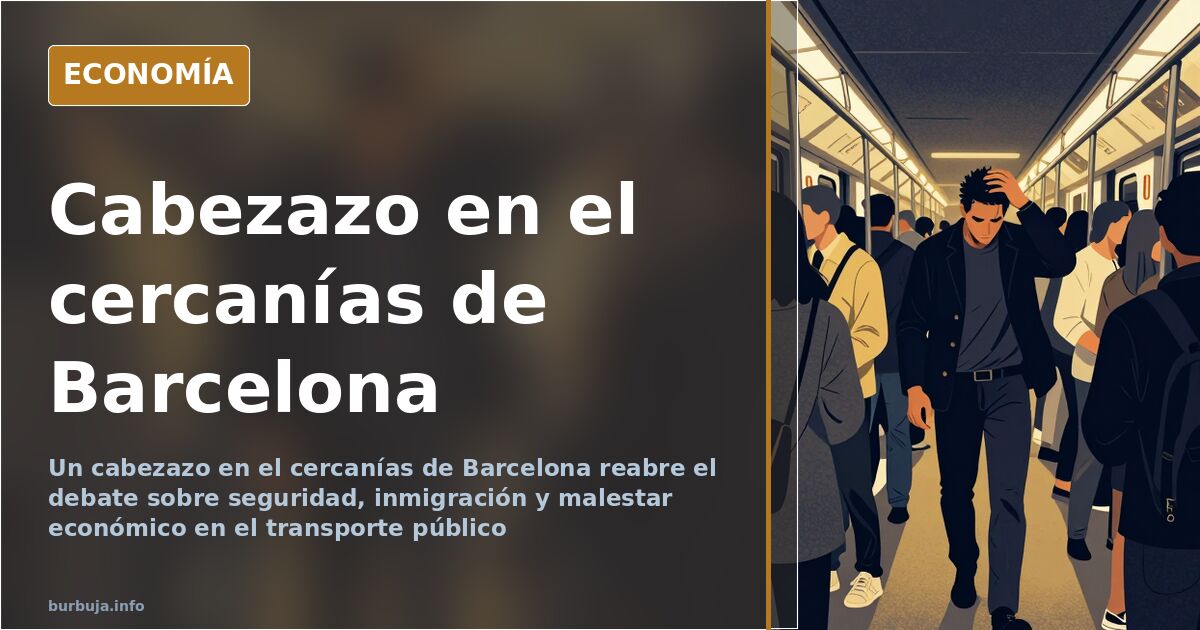
Headbutt on Barcelona commuter train: the fight that reopens the safety debate
What happens when two passengers on a Barcelona commuter train get into a headbutting brawl mid-journey and the video goes viral? The scene, recorded on a Rodalies train, shows two men arguing heatedly until one delivers a sharp headbutt to the other, leaving him stunned. Far from being an isolated anecdote, this episode has reignited a months-long discussion regarding public transport safety, immigration management, and the decline of civic behavior in major cities. The video has accumulated thousands of views and has been shared by accounts across the political spectrum, each side trying to spin it to their advantage.
The headbutt video: what is seen and said
The brief footage shows two men standing in the carriage aisle. The argument escalates until one man, without warning, headbutts the other in the face. Passengers filming react with surprise and shouts. There is no prior context: the motive for the dispute or whether there was a longer exchange of words remains unknown. The edited video, including slow-motion replays, has been one of the most commented aspects: some criticize the magnification of the incident, while others see it as proof of the impunity with which certain individuals act.
The clip's spread has occurred via social media accounts framing it within a supposed wave of violence in Catalan public transport. Official reports, however, have not confirmed any details regarding the identities of those involved or the circumstances. The regional police (Mossos d'Esquadra) have issued no statement, and no arrests related to these events are known.
Safety on commuter trains: perception versus data
The incident has fueled a recurring debate: Is the Barcelona commuter network an unsafe space? Official crime statistics for public transport have not been updated in available materials, but the perception of insecurity has grown. Several messages suggest such fights are "an everyday occurrence" during peak hours, while others argue they are isolated incidents exaggerated by social media.
The discussion quickly shifts to political management. Some blame authorities for turning public transport into a lawless zone, while others remind us that most travelers never witness violent incidents. The politicization of the event is inevitable: every new video becomes ammunition for one side or the other.
Immigration and civility: the backdrop of the debate
Some messages directly link the fight to immigration, arguing that lack of border control has led to increased crime and incivility. Figures on nationality grants are cited, along with talk of "open prisons" and a supposed silent invasion. These claims are not backed by verifiable data in the material and respond to a specific ideological narrative.
Another viewpoint rejects this link, arguing that violence in public transport is a multifactorial phenomenon tied to precariousness, lack of resources, and deteriorating public services. The discussion on immigration thus mixes with criticism of municipal and regional management, without either side providing conclusive evidence.
Economic discomfort as the background
Beyond the specific incident, the debate reflects deeper discontent. Several messages mention wages frozen for two decades, food prices — citing a dozen eggs at 3 euros — and the difficulty of making ends meet. The train fight is interpreted as a symptom of a more tense society, where economic frustration translates into daily conflicts.
The connection is not accidental: the Economy subforum discussing the video has seen a rise in threads about cost of living, housing, and job insecurity in recent days. The headbutt becomes a metaphor for broader dissatisfaction, although concrete data on economic evolution is not detailed in the material.
What can be done? Proposals and limits
Proposals range from increasing police presence on trains to improving civic education or limiting immigration. None are developed in depth, and the debate remains in the realm of complaint. There is a total lack of consensus: while some demand tough measures, others call for social policies and more investment in public transport.
What seems clear is that the video struck a sensitive nerve. The discussion does not fade, and every new incident reopens the same wound. Meanwhile, the commuter trains continue running, indifferent to the headlines they generate.
What happens when two passengers on a Barcelona commuter train get into a headbutting brawl mid-journey and the video goes viral? The scene, recorded on a Rodalies train, shows two men arguing heatedly until one delivers a sharp headbutt to the other, leaving him stunned. Far from being an isolated anecdote, this episode has reignited a months-long discussion regarding public transport safety, immigration management, and the decline of civic behavior in major cities. The video has accumulated thousands of views and has been shared by accounts across the political spectrum, each side trying to spin it to their advantage.
The headbutt video: what is seen and said
The brief footage shows two men standing in the carriage aisle. The argument escalates until one man, without warning, headbutts the other in the face. Passengers filming react with surprise and shouts. There is no prior context: the motive for the dispute or whether there was a longer exchange of words remains unknown. The edited video, including slow-motion replays, has been one of the most commented aspects: some criticize the magnification of the incident, while others see it as proof of the impunity with which certain individuals act.
The clip's spread has occurred via social media accounts framing it within a supposed wave of violence in Catalan public transport. Official reports, however, have not confirmed any details regarding the identities of those involved or the circumstances. The regional police (Mossos d'Esquadra) have issued no statement, and no arrests related to these events are known.
Safety on commuter trains: perception versus data
The incident has fueled a recurring debate: Is the Barcelona commuter network an unsafe space? Official crime statistics for public transport have not been updated in available materials, but the perception of insecurity has grown. Several messages suggest such fights are "an everyday occurrence" during peak hours, while others argue they are isolated incidents exaggerated by social media.
The discussion quickly shifts to political management. Some blame authorities for turning public transport into a lawless zone, while others remind us that most travelers never witness violent incidents. The politicization of the event is inevitable: every new video becomes ammunition for one side or the other.
Immigration and civility: the backdrop of the debate
Some messages directly link the fight to immigration, arguing that lack of border control has led to increased crime and incivility. Figures on nationality grants are cited, along with talk of "open prisons" and a supposed silent invasion. These claims are not backed by verifiable data in the material and respond to a specific ideological narrative.
Another viewpoint rejects this link, arguing that violence in public transport is a multifactorial phenomenon tied to precariousness, lack of resources, and deteriorating public services. The discussion on immigration thus mixes with criticism of municipal and regional management, without either side providing conclusive evidence.
Economic discomfort as the background
Beyond the specific incident, the debate reflects deeper discontent. Several messages mention wages frozen for two decades, food prices — citing a dozen eggs at 3 euros — and the difficulty of making ends meet. The train fight is interpreted as a symptom of a more tense society, where economic frustration translates into daily conflicts.
The connection is not accidental: the Economy subforum discussing the video has seen a rise in threads about cost of living, housing, and job insecurity in recent days. The headbutt becomes a metaphor for broader dissatisfaction, although concrete data on economic evolution is not detailed in the material.
What can be done? Proposals and limits
Proposals range from increasing police presence on trains to improving civic education or limiting immigration. None are developed in depth, and the debate remains in the realm of complaint. There is a total lack of consensus: while some demand tough measures, others call for social policies and more investment in public transport.
What seems clear is that the video struck a sensitive nerve. The discussion does not fade, and every new incident reopens the same wound. Meanwhile, the commuter trains continue running, indifferent to the headlines they generate.
Also available in: Deutsch
Summary of a discussion on Burbuja.info - Foro de economía, actualidad y política., translated from Spanish and reviewed before publication. Read the full discussion (133 replies).
More summaries
-
YouTuber and bodyguards clash with street vendors in Barcelona
A YouTuber and his security team confront street vendors on La Rambla, reigniting debate over illegal vending and public order.
-
Valencia Floods: Daytime Warning Ignored, Cars Left Behind
Daytime footage shows the rambla flooding in Valencia while routine continued. The video contradicts claims of total surprise.
-
IONOS cuts 450 jobs, Logroño fears for Arsys's 360
IONOS cuts 450 jobs from 3,800: Arsys, with 360 workers in Logroño, is unsure how many will be affected.
-
Olivia's mother commits suicide in prison before trial
Olivia's mother found hanged in pre-trial detention ahead of her infanticide hearing, where she faced a potential life sentence.
-
Lonely Planet Award Strains Seville's Hotel Capacity
Seville joins Lonely Planet's 2018 top 10, sparking fears of a tourism bubble as hotel beds run out and hospitality prices rise.
-
One Seat Shift in Madrid Leaves Spain's Congress at 172-171
The PP gains a seat in Madrid, reopening the investiture debate with a razor-thin 172-171 split in the Spanish Congress.