
Antena 3 Reporter Escorted by Guardia Civil During Farm Protests
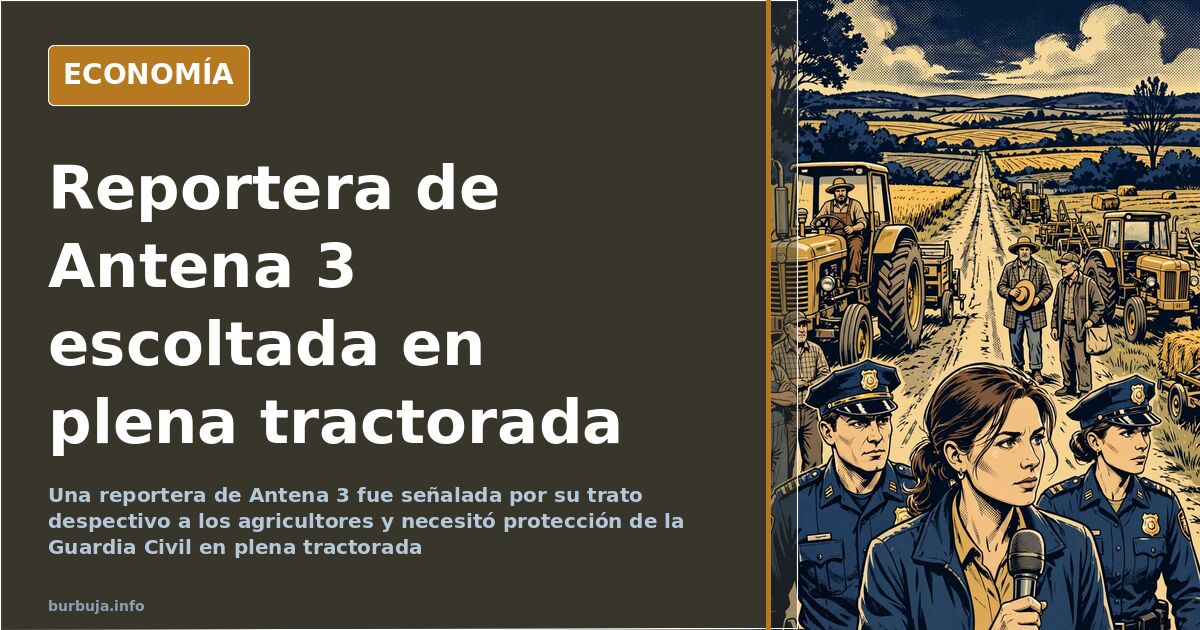
An Antena 3 journalist required police protection after allegedly insulting farmers during Spain's tractor protests.
English · Original discussion in Spanish · Published
From Tractor Protests to Contempt: Journalists and Farmers Face Off
What happens when the person sent to cover a protest becomes the reason for it? According to viral social media posts, an Antena 3 reporter called farmers "fascists" while covering agricultural mobilizations in Spain and had to be protected by the Guardia Civil. There is no independent confirmation of this account outside that narrative. Nevertheless, the incident has peine an uncomfortable question: why does part of the farming sector view the media as interested parties rather than witnesses?
The Allegations Against the Antena 3 Reporter
The controversy stems from a tweet criticizing the treatment of farmers and the Guardia Civil's intervention to protect the journalist. Reactions have ranged from demanding public apologies from the network to suspicion that this is not an isolated case, but evidence of a profession that, according to critics, has shifted from reporting events to judging them. Some call for accountability. Others remind us that a journalist is a witness to current affairs, not a participant, and confusing these roles can ruin a career.
This suspicion—that reporters are taking sides—is the root of the discontent. The specific word used was the trigger, but the conflict has been brewing for some time.
What the Farming Sector Demands and Why They Took to the Roads
Tractor protests have returned the primary sector to the center of economic news. Arguments cited include lack of profitability, production costs not reflected in final prices, and competition from imported goods. Transporters, another link in the chain, were also prepared to mobilize independently.
Farmers point out a textbook paradox: the sector that guarantees food security must block roads to be heard. When they do so, according to this version, the focus shifts from their demands to their behavior. Hence the widely circulated quote attributed to a farmer: "Our future won't be worse; yours will. We have food on our farms; you don't." Whether literal or embellished, the phrase resonates because it touches a real nerve: food cannot be negotiated in a TV studio.
Food Dependency as a Core Argument
At this point, the issue moves beyond a televised clash into economic territory. It is argued that if a country's primary sector collapses, the cost will be paid by importing food from the third world, involving chemicals, plastics, and international monopolies. This is a warning, not a certainty, and should be treated as such: a scenario that defenders of the sector consider probable, though not precisely quantified here.
Notably, this reasoning—food independence, productive sovereignty, avoiding reliance on others in times of crisis—sounds less like a party slogan and more like a security matter. Water privatization is also mentioned as part of the puzzle. Readers seeking a full breakdown with producers' figures should consult original sources.
Who Are the Protesters?
Here, the debate splits. One view holds that many agricultural holdings are businesses employing wage workers and seasonal laborers, effectively acting as employers. From this perspective, supporting the tractor protests without nuance means defending capital, not labor. This argument challenges the ideological framework of the protest.
The response comes from lived experience. Some counter with personal stories: families of farmers, harvest seasons, livestock cared for year-round. People who hire seasonal workers occasionally but work their land with their own hands, side by side with those they employ. If the land belongs to those who work it, these farmers should count too.
The underlying criticism is that generalizing from the worst-case scenario—the large landowner with twenty tractors—obscures the whole picture. Conversely, no one denies that large owners exist.
The 'Left vs. Right' Narrative and Its Limits
The incident fits a broader trend: reducing any conflict to a label. Critics argue this reflex explains nothing and turns hostility toward dissent into a way to shut down conversation before it starts. Workers unrepresented by the left, media distrusted by farmers, journalists who believe they are reporting while actually taking sides.
Some interpret the protests as political issues unrelated to agriculture, while others attribute the mobilizations to an international agenda, which, notably, lacks documentation in published reports. This last point is, by far, the weakest part of the narrative.
On paper, the farming sector wants prices and respect; the media want audience and credibility. With this level of disconnect, the next press conference might need an acompañante and a couple of hectares for parking.
What happens when the person sent to cover a protest becomes the reason for it? According to viral social media posts, an Antena 3 reporter called farmers "fascists" while covering agricultural mobilizations in Spain and had to be protected by the Guardia Civil. There is no independent confirmation of this account outside that narrative. Nevertheless, the incident has peine an uncomfortable question: why does part of the farming sector view the media as interested parties rather than witnesses?
The Allegations Against the Antena 3 Reporter
The controversy stems from a tweet criticizing the treatment of farmers and the Guardia Civil's intervention to protect the journalist. Reactions have ranged from demanding public apologies from the network to suspicion that this is not an isolated case, but evidence of a profession that, according to critics, has shifted from reporting events to judging them. Some call for accountability. Others remind us that a journalist is a witness to current affairs, not a participant, and confusing these roles can ruin a career.
This suspicion—that reporters are taking sides—is the root of the discontent. The specific word used was the trigger, but the conflict has been brewing for some time.
What the Farming Sector Demands and Why They Took to the Roads
Tractor protests have returned the primary sector to the center of economic news. Arguments cited include lack of profitability, production costs not reflected in final prices, and competition from imported goods. Transporters, another link in the chain, were also prepared to mobilize independently.
Farmers point out a textbook paradox: the sector that guarantees food security must block roads to be heard. When they do so, according to this version, the focus shifts from their demands to their behavior. Hence the widely circulated quote attributed to a farmer: "Our future won't be worse; yours will. We have food on our farms; you don't." Whether literal or embellished, the phrase resonates because it touches a real nerve: food cannot be negotiated in a TV studio.
Food Dependency as a Core Argument
At this point, the issue moves beyond a televised clash into economic territory. It is argued that if a country's primary sector collapses, the cost will be paid by importing food from the third world, involving chemicals, plastics, and international monopolies. This is a warning, not a certainty, and should be treated as such: a scenario that defenders of the sector consider probable, though not precisely quantified here.
Notably, this reasoning—food independence, productive sovereignty, avoiding reliance on others in times of crisis—sounds less like a party slogan and more like a security matter. Water privatization is also mentioned as part of the puzzle. Readers seeking a full breakdown with producers' figures should consult original sources.
Who Are the Protesters?
Here, the debate splits. One view holds that many agricultural holdings are businesses employing wage workers and seasonal laborers, effectively acting as employers. From this perspective, supporting the tractor protests without nuance means defending capital, not labor. This argument challenges the ideological framework of the protest.
The response comes from lived experience. Some counter with personal stories: families of farmers, harvest seasons, livestock cared for year-round. People who hire seasonal workers occasionally but work their land with their own hands, side by side with those they employ. If the land belongs to those who work it, these farmers should count too.
The underlying criticism is that generalizing from the worst-case scenario—the large landowner with twenty tractors—obscures the whole picture. Conversely, no one denies that large owners exist.
The 'Left vs. Right' Narrative and Its Limits
The incident fits a broader trend: reducing any conflict to a label. Critics argue this reflex explains nothing and turns hostility toward dissent into a way to shut down conversation before it starts. Workers unrepresented by the left, media distrusted by farmers, journalists who believe they are reporting while actually taking sides.
Some interpret the protests as political issues unrelated to agriculture, while others attribute the mobilizations to an international agenda, which, notably, lacks documentation in published reports. This last point is, by far, the weakest part of the narrative.
On paper, the farming sector wants prices and respect; the media want audience and credibility. With this level of disconnect, the next press conference might need an acompañante and a couple of hectares for parking.
Summary of a discussion on Burbuja.info - Foro de economía, actualidad y política., translated from Spanish and reviewed before publication. Read the full discussion (186 replies).
More summaries
-
Guardia Civil agent collapses at protest, reignites fitness debate
A Guardia Civil agent collapses during a protest in Granada, sparking calls for mandatory physical fitness tests for all officers.
-
Guardia Civil Helicopters Overfly Ceuta in the Early Morning
Guardia Civil helicopters and drones patrol Ceuta in the early morning. Flight tracking suggests a deployment without an official statement.
-
Tenant Union: Who Finances the Illegal Strike in Spain?
The Tenant Union is not a legal union but receives 3.7 million euros in public funds. It called a general rent strike on November 11, sparking controversy over its funding and political ties.
-
Zapatero's Wife Paid Off €500k Mortgage in Under a Year
Burbuja.info analyzes the controversial €500,000 transfer used to cancel Sonsoles Espinosa's mortgage. Corruption or savvy management?
-
Iran Explosion: Tactical Nuke or Media Hoax?
Debate on whether an impact in Iran was a tactical nuclear bomb or a hoax. Technical analysis of EMP and destruction scale.
-
Debate: Opting out of Spain's social security system
A thread proposes leaving Spain's public system to self-fund healthcare and pensions, sparking debate on contributions, taxes, and international comparisons.