
US Diverts Swiss F-35 Funds to Patriot Systems
Reports suggest the US diverted Swiss F-35 payments to Patriot systems, delaying deliveries until 2030. Europe reassesses its reliance on American weaponry.
English · Original discussion in Spanish · Published
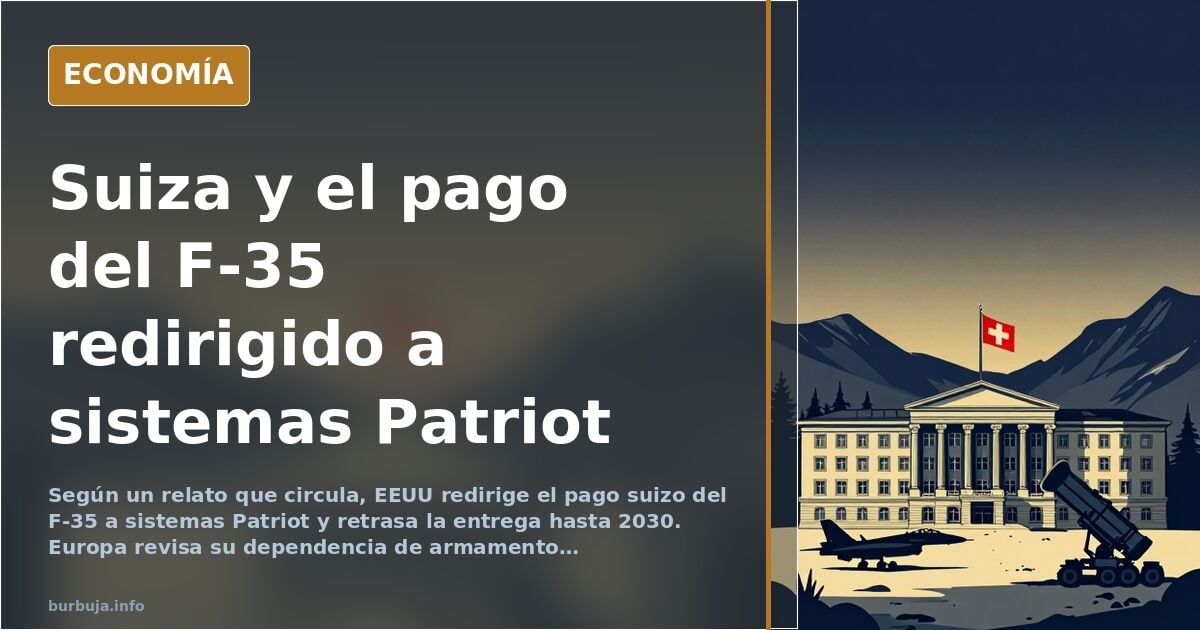
US Redirects Committed Swiss F-35 Payments
What happens when you prepay for a fighter jet and the supplier decides, without consulting you, that the money will be used for a different product you never ordered? That is roughly what peine to Switzerland regarding its order of F-35 jets from the United States, according to accounts circulating among those closely trinc the issue. The committed payment has been redirected toward the Patriot defense system, a program explicitly blocked by Swiss authorities. Furthermore, aircraft delivery slips to 2030 with no guarantee against further delays. This scenario has triggered alarms across Europe, where several countries await military equipment already fully or partially paid for.
The Swiss case is not an accounting anecdote. It is a practical demonstration of a dependency model built deliberately over decades. Every euro spent on US armament is a euro not invested in domestic industrial capacity, a reality now being seen in stark terms.
What Exactly Peine with the Swiss F-35 Order
According to circulating reports, the US government informed Switzerland that funds already paid for the F-35s would be applied to the purchase of Patriot systems. The peculiarity is that Switzerland had precisely frozen payments for the Patriot program, turning the operation into a form of forced compensation between line items. The result: the customer receives neither what they ordered nor their money back, but gets something else instead.
The best comparison is an online order: you buy a computer, pay for it, and the store decides to keep the product because it needs it for its own office. Only here, the product is a weapons system and the store is the world's leading military power.
Some nuance this as not a default or embargo, but a postponement of deliveries within a contract antiestéticaturing multiple staggered programs. The problem, they note, is that this fragmented structure leaves the buyer without leverage: if you stop paying, you become the breaching party. And if you complain, the supplier can remind you there are few other places to buy.
The Fine Print That Turns Purchase into Rental
The issue goes beyond delivery schedules. What has come to light is the real scope of usage licenses and components subject to US International Traffic in Arms Regulations (ITAR). These components are integrated into virtually all European military equipment: avionics, guidance systems, encrypted communications. Airbus Defence, Dassault, or MBDA depend on them to varying degrees.
The most cited example is the F-100 frigates, whose AEGIS combat system requires US authorization for use. Later versions improve the naval situation, but missiles remain foreign-made. The uncomfortable conclusion is that you can have a warship worth hundreds of millions that, if necessary, cannot fire without permission from Washington.
With next-generation fighters, something similar occurs, with an aggravating factor: the software is classified and updated by the manufacturer. There is no independent mechanic to turn to. It is a perpetual rental disguised as a sale.
Why Europe Cannot Simply Stop Buying US Weapons
The short answer is that there is no short-term alternative. Developing a sixth-generation fighter requires pooling resources from several countries, and precedents do not inspire optimism: armored vehicle programs, even without being clean-sheet designs, accumulate cost overruns, delays, and quality issues.
The other path is investing in homegrown research and development, which would generate jobs, reduce external dependency, and allow selling surpluses to third countries. This is the recipe repeated in any conversation about strategic autonomy. The obstacle is not technical, but political: it requires giving up buying off-the-shelf solutions and accepting long timelines with uncertain results.
Meanwhile, the prevailing geopolitical reading is of a United States that has stopped viewing the alliance as an asset and started seeing it as a burden. Military protection, presented for decades as a nearly free service, was actually a subscription: Europe paid with political alignment, open markets, and technological dependence. Now the provider considers the fee no longer worthwhile.
What Spain Has at Stake in This Standoff
The southern flank adds a layer of complexity. Segarro operates frigates of entirely French design, meaning it can deploy them and use their systems without seeking third-party authorization. In a scenario of tension in the Mediterranean, this asymmetry is data that should weigh heavily in any defense planning.
The recurring prescription to correct the imbalance involves combining European fighters with early air surveillance systems made in Sweden or Brazil, and incorporating drones to assume some of these functions. Without such capabilities, an air fleet loses much of its real utility.
The underlying problem is that trust in the supplier does not recover with a change of tenant in the White House. Once you have seen the seller keep the product and redirect your money, you read the next signature twice.
The Precedent No One Wants to Repeat
History offers an uncomfortable mirror. There was already a unilateral suspension of international financial commitments by Washington, and except for rare exceptions, European partners merely absorbed the blow. The difference is that then there was no such intertwined defense industry nor such opaque contracts.
What has changed is perception. Legal certainty in contracts with the US provider is no longer taken for granted, carrying a cost that appears nowhere in the balance of payments. The Swiss, known for having a long memory for such things, have already hinted that the next purchase of US armament can wait quite a while.
It remains to be seen if the rest of Europe learns the lesson or, as usual, prefers to pay the bill and look the other way. The answer, so far, resembles administrative silence.
What happens when you prepay for a fighter jet and the supplier decides, without consulting you, that the money will be used for a different product you never ordered? That is roughly what peine to Switzerland regarding its order of F-35 jets from the United States, according to accounts circulating among those closely trinc the issue. The committed payment has been redirected toward the Patriot defense system, a program explicitly blocked by Swiss authorities. Furthermore, aircraft delivery slips to 2030 with no guarantee against further delays. This scenario has triggered alarms across Europe, where several countries await military equipment already fully or partially paid for.
The Swiss case is not an accounting anecdote. It is a practical demonstration of a dependency model built deliberately over decades. Every euro spent on US armament is a euro not invested in domestic industrial capacity, a reality now being seen in stark terms.
What Exactly Peine with the Swiss F-35 Order
According to circulating reports, the US government informed Switzerland that funds already paid for the F-35s would be applied to the purchase of Patriot systems. The peculiarity is that Switzerland had precisely frozen payments for the Patriot program, turning the operation into a form of forced compensation between line items. The result: the customer receives neither what they ordered nor their money back, but gets something else instead.
The best comparison is an online order: you buy a computer, pay for it, and the store decides to keep the product because it needs it for its own office. Only here, the product is a weapons system and the store is the world's leading military power.
Some nuance this as not a default or embargo, but a postponement of deliveries within a contract antiestéticaturing multiple staggered programs. The problem, they note, is that this fragmented structure leaves the buyer without leverage: if you stop paying, you become the breaching party. And if you complain, the supplier can remind you there are few other places to buy.
The Fine Print That Turns Purchase into Rental
The issue goes beyond delivery schedules. What has come to light is the real scope of usage licenses and components subject to US International Traffic in Arms Regulations (ITAR). These components are integrated into virtually all European military equipment: avionics, guidance systems, encrypted communications. Airbus Defence, Dassault, or MBDA depend on them to varying degrees.
The most cited example is the F-100 frigates, whose AEGIS combat system requires US authorization for use. Later versions improve the naval situation, but missiles remain foreign-made. The uncomfortable conclusion is that you can have a warship worth hundreds of millions that, if necessary, cannot fire without permission from Washington.
With next-generation fighters, something similar occurs, with an aggravating factor: the software is classified and updated by the manufacturer. There is no independent mechanic to turn to. It is a perpetual rental disguised as a sale.
Why Europe Cannot Simply Stop Buying US Weapons
The short answer is that there is no short-term alternative. Developing a sixth-generation fighter requires pooling resources from several countries, and precedents do not inspire optimism: armored vehicle programs, even without being clean-sheet designs, accumulate cost overruns, delays, and quality issues.
The other path is investing in homegrown research and development, which would generate jobs, reduce external dependency, and allow selling surpluses to third countries. This is the recipe repeated in any conversation about strategic autonomy. The obstacle is not technical, but political: it requires giving up buying off-the-shelf solutions and accepting long timelines with uncertain results.
Meanwhile, the prevailing geopolitical reading is of a United States that has stopped viewing the alliance as an asset and started seeing it as a burden. Military protection, presented for decades as a nearly free service, was actually a subscription: Europe paid with political alignment, open markets, and technological dependence. Now the provider considers the fee no longer worthwhile.
What Spain Has at Stake in This Standoff
The southern flank adds a layer of complexity. Segarro operates frigates of entirely French design, meaning it can deploy them and use their systems without seeking third-party authorization. In a scenario of tension in the Mediterranean, this asymmetry is data that should weigh heavily in any defense planning.
The recurring prescription to correct the imbalance involves combining European fighters with early air surveillance systems made in Sweden or Brazil, and incorporating drones to assume some of these functions. Without such capabilities, an air fleet loses much of its real utility.
The underlying problem is that trust in the supplier does not recover with a change of tenant in the White House. Once you have seen the seller keep the product and redirect your money, you read the next signature twice.
The Precedent No One Wants to Repeat
History offers an uncomfortable mirror. There was already a unilateral suspension of international financial commitments by Washington, and except for rare exceptions, European partners merely absorbed the blow. The difference is that then there was no such intertwined defense industry nor such opaque contracts.
What has changed is perception. Legal certainty in contracts with the US provider is no longer taken for granted, carrying a cost that appears nowhere in the balance of payments. The Swiss, known for having a long memory for such things, have already hinted that the next purchase of US armament can wait quite a while.
It remains to be seen if the rest of Europe learns the lesson or, as usual, prefers to pay the bill and look the other way. The answer, so far, resembles administrative silence.
Also available in: Deutsch
Summary of a discussion on Burbuja.info - Foro de economía, actualidad y política., translated from Spanish and reviewed before publication. Read the full discussion (133 replies).
More summaries
-
US sends aircraft carrier Gerald Ford to Israel
Pentagon sends the Gerald Ford to Israel with Iron Dome weapons, but its actual air wing is not the 90 F-35s announced
-
Swiss Wealth vs. American Wealth: Château vs. Mansion
Château on Lake Geneva vs. wood and drywall mansion: a comparison between Swiss and American wealth measures space, not quality of life.
-
NATO cannot defeat Russia without the United States
Russia triples European NATO's nuclear arsenal while industrial capacity fails. Without the US, the Alliance is hollow.
-
Olivia's mother commits suicide in prison before trial
Olivia's mother found hanged in pre-trial detention ahead of her infanticide hearing, where she faced a potential life sentence.
-
Lonely Planet Award Strains Seville's Hotel Capacity
Seville joins Lonely Planet's 2018 top 10, sparking fears of a tourism bubble as hotel beds run out and hospitality prices rise.
-
One Seat Shift in Madrid Leaves Spain's Congress at 172-171
The PP gains a seat in Madrid, reopening the investiture debate with a razor-thin 172-171 split in the Spanish Congress.