
Spanish self-employed and abstainers eye Vox as protest vote
Self-employed workers and habitual non-voters in Spain plan to back Vox to punish the PSOE, despite disagreements on bullfighting and Israel.
English · Original discussion in Spanish · Published
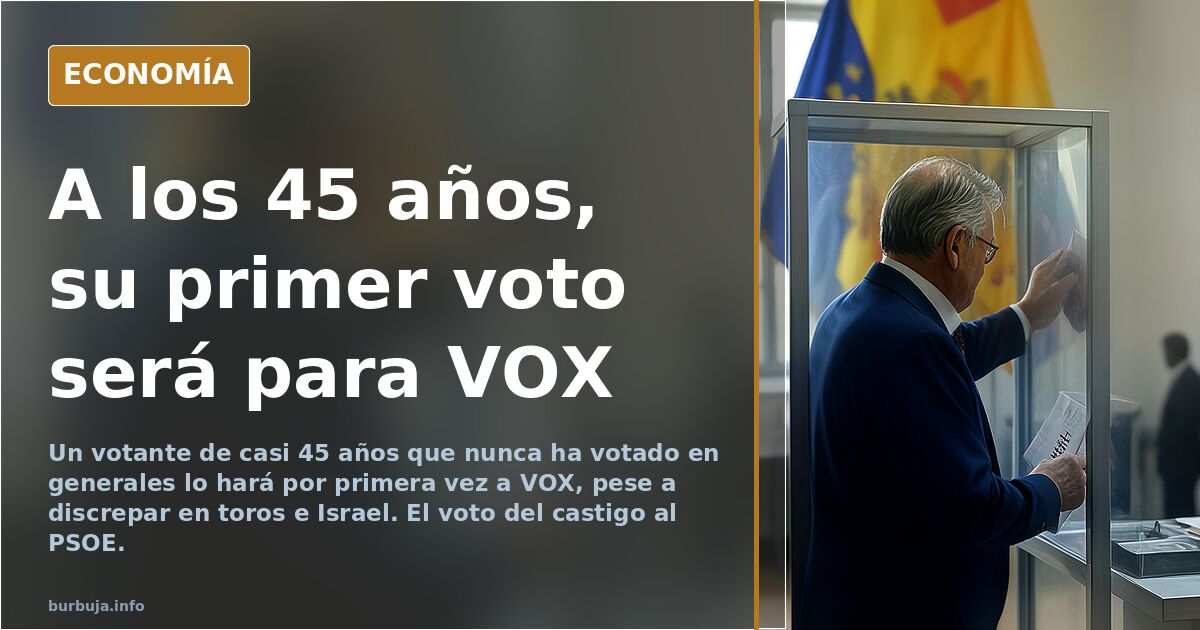
From abstention to Vox: The punishment vote
There is a voter profile that does not respond to ideological affinity but to financial pressure. After years of staying away from polling stations, a segment of self-employed workers and freelancers has decided to vote for Vox in the upcoming general elections. They do not do so out of full conviction, but out of revenge. The trigger is not fiscal policy or even immigration, but the feeling that the political system has turned tax burdens and bureaucracy into a penalty for wealth creators. This phenomenon, spreading among those who have never voted in general elections before, points to a silent shift from abstention towards the radical right.
The fed-up self-employed worker
The first variable is economic. The discourse of the voter who starts voting at age 45 is not that of the classic activist. It is that of the self-employed worker drowning in taxes, who sees their monthly social security contribution become a fixed burden regardless of whether they generate revenue. Added to this is the perception that there is a handout culture—a recurring term in the debate—that supports part of the population while he pays for the party. Criticism is directed not only at the Government but also at the People's Party (PP), accused of being soft on socialism and failing to dismantle spending structures when it had the chance.
This voter’s calculation is cold: if the PP will not reverse fiscal pressure or pursue PSOE scandals, then the useful vote is not the one that prevents the left from winning, but the one that punishes the traditional right for its complacency. It is the logic of the lesser evil taken to the extreme: Vox is not the solution, but according to this profile, it is the only party that does not apologize for existing.
Breaking the cycle of abstention
The second vector concerns those who have never voted. Historical abstention in Spain has had a class and age component that is now fracturing. The message is clear: voting blank or for Vox benefits the most voted list, which in most provinces is the PP. But the new voter does not seek to benefit the PP; they want to see the PSOE suffer after the count. It is an emotional, punitive vote that does not respond to a detailed electoral program but to a need for political retaliation.
In provinces where Vox has no chance of winning a seat, the calculation changes. Some choose not to vote: not wasting a Sunday morning queuing up like a fool. Others, however, vote even knowing their ballot will not translate into a seat, because the goal is not to win, but to move the Overton window and send a signal.
The burden of bullfighting and the Palestinian-Israeli conflict
The third element involves sarracena dilemmas that do not fit. Vox supports bullfighting and aligns with Israel, two positions that clash directly with a sector of its potential electorate. The anti-bullfighting voter critical of Israeli foreign policy finds themselves in a contradiction: they dislike bullfighting and submission to Netanyahu, but consider other issues more important. The hierarchy of priorities is clear: housing, taxes, illegal immigration, and punishing the PSOE weigh more than animal torture or geopolitics.
This pragmatism is summed up in a circulating phrase: it is like saying you won't sleep with a gorgeous woman because she has a mole on her chin. The metaphor, vulgar but effective, defines the attitude of a voter who seeks political effectiveness rather than ideological purity. The question remaining in the air is whether this borrowed vote will consolidate or return to abstention when the emotional cost of supporting Vox outweighs the benefit of punishment.
Profile of the new Vox voter
The robot portrait of this elector is not that of the radicalized youth or the base activist. It is a man between 40 and 55 years old, self-employed or small business owner, who has seen his purchasing power deteriorate while official discourse spoke of economic recovery. He distrusts the media, does not believe polls, and despises the do-gooderism of the traditional right. His vote is not a blank check for Vox: it is a conditional punishment vote. If Vox fails to deliver, he will return to abstention.
The unknown is whether this transfer of votes from nowhere to the radical right is a temporary or structural phenomenon. Participation data in the next general elections will tell. Meanwhile, the message is clear: there is a voter who does not ask for solutions, but for political blood. And that voter, for the first time in years, intends to go vote.
There is a voter profile that does not respond to ideological affinity but to financial pressure. After years of staying away from polling stations, a segment of self-employed workers and freelancers has decided to vote for Vox in the upcoming general elections. They do not do so out of full conviction, but out of revenge. The trigger is not fiscal policy or even immigration, but the feeling that the political system has turned tax burdens and bureaucracy into a penalty for wealth creators. This phenomenon, spreading among those who have never voted in general elections before, points to a silent shift from abstention towards the radical right.
The fed-up self-employed worker
The first variable is economic. The discourse of the voter who starts voting at age 45 is not that of the classic activist. It is that of the self-employed worker drowning in taxes, who sees their monthly social security contribution become a fixed burden regardless of whether they generate revenue. Added to this is the perception that there is a handout culture—a recurring term in the debate—that supports part of the population while he pays for the party. Criticism is directed not only at the Government but also at the People's Party (PP), accused of being soft on socialism and failing to dismantle spending structures when it had the chance.
This voter’s calculation is cold: if the PP will not reverse fiscal pressure or pursue PSOE scandals, then the useful vote is not the one that prevents the left from winning, but the one that punishes the traditional right for its complacency. It is the logic of the lesser evil taken to the extreme: Vox is not the solution, but according to this profile, it is the only party that does not apologize for existing.
Breaking the cycle of abstention
The second vector concerns those who have never voted. Historical abstention in Spain has had a class and age component that is now fracturing. The message is clear: voting blank or for Vox benefits the most voted list, which in most provinces is the PP. But the new voter does not seek to benefit the PP; they want to see the PSOE suffer after the count. It is an emotional, punitive vote that does not respond to a detailed electoral program but to a need for political retaliation.
In provinces where Vox has no chance of winning a seat, the calculation changes. Some choose not to vote: not wasting a Sunday morning queuing up like a fool. Others, however, vote even knowing their ballot will not translate into a seat, because the goal is not to win, but to move the Overton window and send a signal.
The burden of bullfighting and the Palestinian-Israeli conflict
The third element involves sarracena dilemmas that do not fit. Vox supports bullfighting and aligns with Israel, two positions that clash directly with a sector of its potential electorate. The anti-bullfighting voter critical of Israeli foreign policy finds themselves in a contradiction: they dislike bullfighting and submission to Netanyahu, but consider other issues more important. The hierarchy of priorities is clear: housing, taxes, illegal immigration, and punishing the PSOE weigh more than animal torture or geopolitics.
This pragmatism is summed up in a circulating phrase: it is like saying you won't sleep with a gorgeous woman because she has a mole on her chin. The metaphor, vulgar but effective, defines the attitude of a voter who seeks political effectiveness rather than ideological purity. The question remaining in the air is whether this borrowed vote will consolidate or return to abstention when the emotional cost of supporting Vox outweighs the benefit of punishment.
Profile of the new Vox voter
The robot portrait of this elector is not that of the radicalized youth or the base activist. It is a man between 40 and 55 years old, self-employed or small business owner, who has seen his purchasing power deteriorate while official discourse spoke of economic recovery. He distrusts the media, does not believe polls, and despises the do-gooderism of the traditional right. His vote is not a blank check for Vox: it is a conditional punishment vote. If Vox fails to deliver, he will return to abstention.
The unknown is whether this transfer of votes from nowhere to the radical right is a temporary or structural phenomenon. Participation data in the next general elections will tell. Meanwhile, the message is clear: there is a voter who does not ask for solutions, but for political blood. And that voter, for the first time in years, intends to go vote.
Also available in: Deutsch
Summary of a discussion on Burbuja.info - Foro de economía, actualidad y política., translated from Spanish and reviewed before publication. Read the full discussion (123 replies).
More summaries
-
Sánchez Decides in 72 Hours Whether to Call Early Elections in Spain
Spanish PM Pedro Sánchez has 72 hours to decide on early general elections after housing decrees were rejected by Congress.
-
CIS poll: PSOE leads with 34%, Sumar hits historic low
October CIS survey shows PSOE at 34% and PP at 31.5%, while Sumar drops to a record low of 6.3% and Vox loses ground.
-
Clash at Sol protest camp over Spanish flag bracelet
A woman wearing a Spanish flag bracelet was confronted at the Sol camp for backing Abascal, as the Comunidad de Madrid deadline looms
-
Spain's Health Minister sparks debate on fetal life definition
Spanish Health Minister claims a beating fetal heart does not define life, urging reliance on science amid biological and legal clashes.
-
Spain's Generational Gap: Housing Costs vs. Wages
Young Spaniards complain of worse living standards than their parents, citing past worker salaries that covered homes and families.
-
Stellantis Revives Diesel as EV Sales Slump
Stellantis reintroduces diesel engines for small cars amid falling electric vehicle sales. This pivot reignites debate on energy transition and future mobility.