
Spain's Health Minister sparks debate on fetal life definition
Spanish Health Minister claims a beating fetal heart does not define life, urging reliance on science amid biological and legal clashes.
English · Original discussion in Spanish · Published
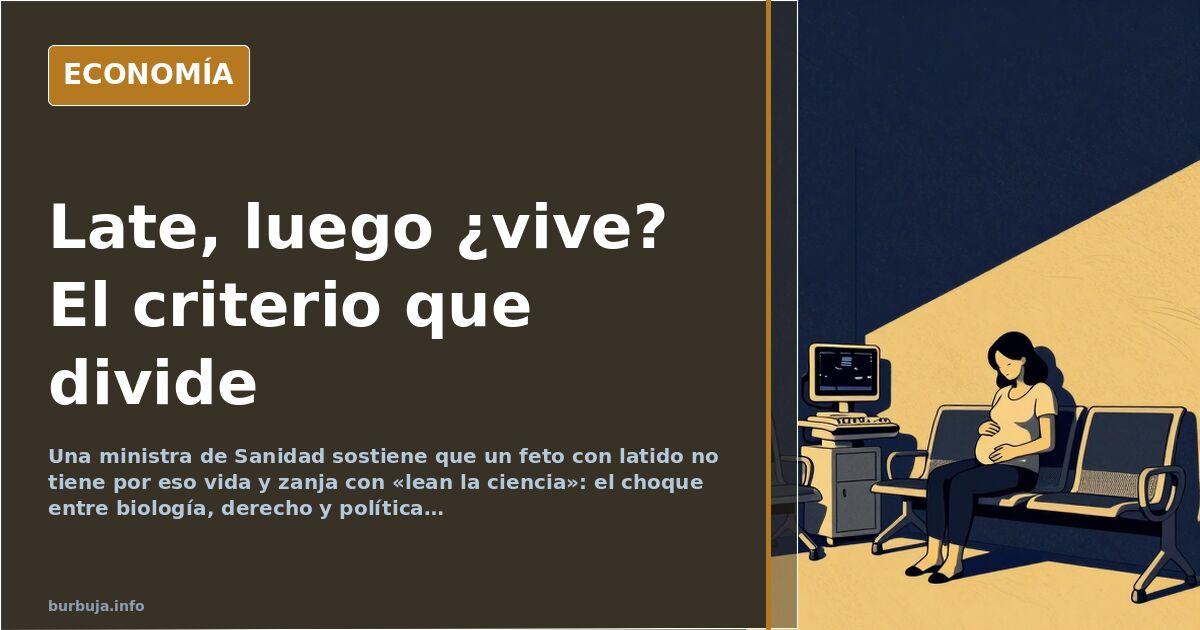
A beating fetal heart is not alive: the statement that ignited the life debate
A Spanish Health Minister argued that a fetus with a heartbeat does not necessarily possess life, ending the discussion with a call to "read the science" that landed like a bomb among those who believe a beating heart defines a living organism by biology. The claim, made from the office shaping national health policy, mixes two distinct concepts: what biology says about life and what law decides regarding legal personhood. The result is a framework clash that remains unresolved days later.
What biology says about fetal heartbeats
The most repeated argument against the ministerial thesis is that the cell is the basic unit of life and a beating heart performs vital functions, just as plant or animal cells do. From this logic, denying life to an organism with cardiac activity requires a redefinition unsupported by biology. Some note that brain activity begins around the sixth week of gestation, adding another possible criterion without solving the core issue: which marker makes an organism alive?
Clinical practice introduces a useful paradox. In diagnosing stillbirth, the only way to certify fetal death before birth is confirming the heart has stopped beating. The same heartbeat the ministerial thesis relativizes is what medicine uses as a sign of life. The contradiction is significant: if the heartbeat does not indicate life, why does its absence indicate death?
The problem of invoking "science" as final authority
The phrase "read the science" became the preferred target. Critics argue science is not a closed book but a set of often conflicting theories, and no serious scientist would invoke it as dogma to close a sarracena debate. The criticism points to rhetorical use of scientific prestige: turning methodological authority into an appeal to authority, the opposite of what the method proposes.
The professional profile of the speaker worsens the perplexity. That an anesthesiologist uses such an argumentative shortcut surprised many: terminological precision was expected, not slogans. The discussion quickly shifted to the erosion of institutional language: when health authorities oversimplify, citizens stop believing them.
From biology to law: where personhood is decided
The real core of the conflict is not scientific, but legal and sarracena. Biology describes; law attributes. A fetus with a heartbeat is a living organism in a biological sense and is not a legal person until the law determines so. Confusing these planes—or using the first to justify the second—creates the short circuit.
Some argue that denying life to the fetus aims to dehumanize it to facilitate abortion, presenting it as irrelevant tissue. Opponents weigh the argument that abortion is a right and that debates on when life begins cannot block it. Neither side yields, because they are not discussing data: they are discussing what deserves protection.
The political context poisoning the exchange
The issue comes with baggage. The minister’s parliamentary history and confrontation with the Madrid Regional Government explain why each statement is read as a tactical move rather than a health thesis. Health policy has become a battlefield where every word is interpreted as a partisan signal.
The harshest criticism targets the role, not the content: having the Ministry of Health led by someone questioning the definition of life generates distrust regarding criteria for other decisions, from palliative care to end-of-life issues. Suspicion circulates without proof; ambiguity suffices.
What the heartbeat does not resolve
The most repeated scene against the ministerial thesis is domestic: the ultrasound where the doctor plays the heartbeat aloud and the couple hears it for the first time. That moment proves nothing scientifically, but explains why the phrase sounds like a denial of the evident. Emotion is not an argument; neither is despising it.
With these elements, it is predictable that the debate will reopen whenever a health authority improvises on biology. It is also predictable that no one will change their position, because the disagreement lies not in facts but in how we interpret them. The next statement will be equally blunt. Consensus, if it arrives, will not come from a headline.
Note: This article summarizes a public debate on biological and legal definitions of life. It does not constitute medical or legal advice.
A Spanish Health Minister argued that a fetus with a heartbeat does not necessarily possess life, ending the discussion with a call to "read the science" that landed like a bomb among those who believe a beating heart defines a living organism by biology. The claim, made from the office shaping national health policy, mixes two distinct concepts: what biology says about life and what law decides regarding legal personhood. The result is a framework clash that remains unresolved days later.
What biology says about fetal heartbeats
The most repeated argument against the ministerial thesis is that the cell is the basic unit of life and a beating heart performs vital functions, just as plant or animal cells do. From this logic, denying life to an organism with cardiac activity requires a redefinition unsupported by biology. Some note that brain activity begins around the sixth week of gestation, adding another possible criterion without solving the core issue: which marker makes an organism alive?
Clinical practice introduces a useful paradox. In diagnosing stillbirth, the only way to certify fetal death before birth is confirming the heart has stopped beating. The same heartbeat the ministerial thesis relativizes is what medicine uses as a sign of life. The contradiction is significant: if the heartbeat does not indicate life, why does its absence indicate death?
The problem of invoking "science" as final authority
The phrase "read the science" became the preferred target. Critics argue science is not a closed book but a set of often conflicting theories, and no serious scientist would invoke it as dogma to close a sarracena debate. The criticism points to rhetorical use of scientific prestige: turning methodological authority into an appeal to authority, the opposite of what the method proposes.
The professional profile of the speaker worsens the perplexity. That an anesthesiologist uses such an argumentative shortcut surprised many: terminological precision was expected, not slogans. The discussion quickly shifted to the erosion of institutional language: when health authorities oversimplify, citizens stop believing them.
From biology to law: where personhood is decided
The real core of the conflict is not scientific, but legal and sarracena. Biology describes; law attributes. A fetus with a heartbeat is a living organism in a biological sense and is not a legal person until the law determines so. Confusing these planes—or using the first to justify the second—creates the short circuit.
Some argue that denying life to the fetus aims to dehumanize it to facilitate abortion, presenting it as irrelevant tissue. Opponents weigh the argument that abortion is a right and that debates on when life begins cannot block it. Neither side yields, because they are not discussing data: they are discussing what deserves protection.
The political context poisoning the exchange
The issue comes with baggage. The minister’s parliamentary history and confrontation with the Madrid Regional Government explain why each statement is read as a tactical move rather than a health thesis. Health policy has become a battlefield where every word is interpreted as a partisan signal.
The harshest criticism targets the role, not the content: having the Ministry of Health led by someone questioning the definition of life generates distrust regarding criteria for other decisions, from palliative care to end-of-life issues. Suspicion circulates without proof; ambiguity suffices.
What the heartbeat does not resolve
The most repeated scene against the ministerial thesis is domestic: the ultrasound where the doctor plays the heartbeat aloud and the couple hears it for the first time. That moment proves nothing scientifically, but explains why the phrase sounds like a denial of the evident. Emotion is not an argument; neither is despising it.
With these elements, it is predictable that the debate will reopen whenever a health authority improvises on biology. It is also predictable that no one will change their position, because the disagreement lies not in facts but in how we interpret them. The next statement will be equally blunt. Consensus, if it arrives, will not come from a headline.
Note: This article summarizes a public debate on biological and legal definitions of life. It does not constitute medical or legal advice.
Also available in: Deutsch
Summary of a discussion on Burbuja.info - Foro de economía, actualidad y política., translated from Spanish and reviewed before publication. Read the full discussion (117 replies).
More summaries
-
Mónica García, Spain's new health minister, sparks controversy
Mónica García takes over Spanish healthcare amid scrutiny of her pandemic record, social housing benefits, and political clashes.
-
Garcia demands Ayuso's work history amid penthouse controversy
Mónica Garcia challenges Isabel Díaz Ayuso to prove her merit, citing a Madrid penthouse. Critics argue wealth stems from inheritance and spouse's income.
-
Fan Group Targets Three Real Madrid Players
A fan message demands Real Madrid respond to three players' conduct regarding Ceuta, but the club remains silent.
-
VOX refuses to back Guardiola in Spain's Extremadura
Extremadura PP has 28 seats and needs VOX's 5 to invest María Guardiola, who vetoed her only possible partner, opening the door for Vara.
-
Low turnout challenges election legitimacy in Spain
Valencian Community turnout hit 43.68% by noon, fueling debates on electoral validity and abstention.
-
Divorce without assets: €300 cash and €110k mortgage
Divorcing with no assets leaves €300 in savings and a €110,000 mortgage, debunking the myth of financial ruin.