
Spanish savings dry up: August arrives without holidays
26% of Spaniards face poverty risk, yet terraces are full. Household savings are exhausted as August arrives without holiday trips.
English · Original discussion in Spanish · Published
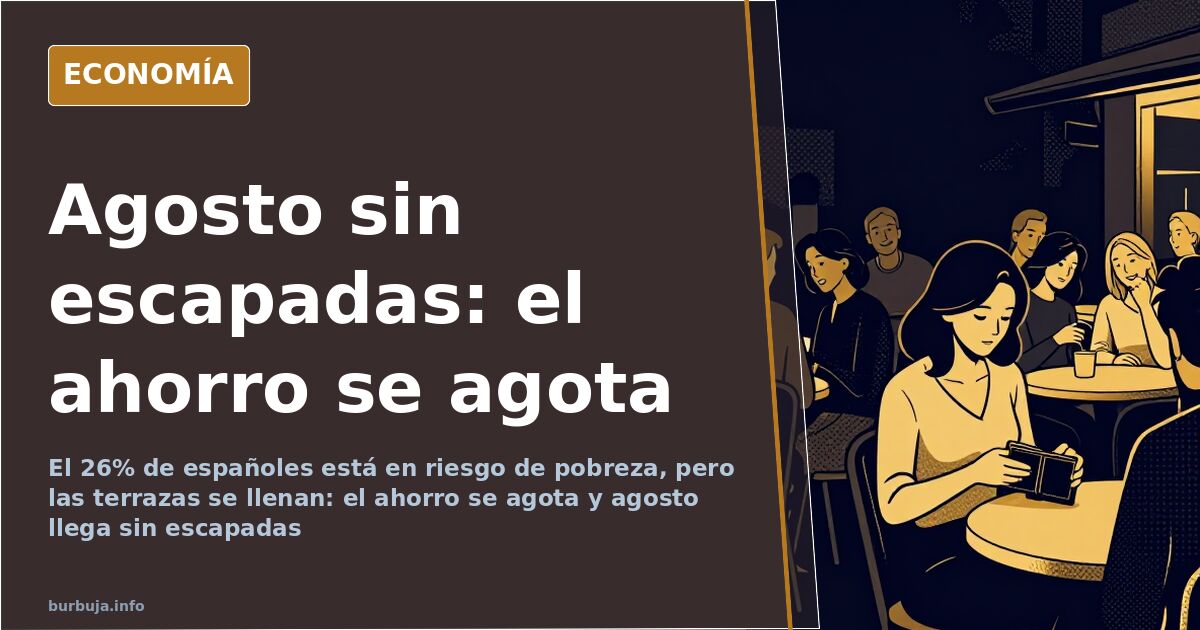
July's budget eats into August: pools and beer
Holiday money was spent in July. Those without a booking will spend August between the municipal pool and a beer near home: no weekend getaways, let alone a week on the coast, and at best, a few days in their hometown. Consumer loans that filled gaps have hit their limit. Savings accumulated during good years are now liquid or spent.
The scene has two incompatible versions. In one, financial tightness begins before summer ends. In the other, there is no sign of a slowdown. Both can be true simultaneously, making this more interesting than an August complaint.
Full terraces vs. dimmed coasts narratives
Some claim, without nuance, that their entire circle is on vacation with no economic worries. They cite dinners requiring reservations, venues turning away customers, and exorbitant prices nobody questions. Conversely, others describe southern Madrid municipalities where streets are nearly empty at 10 PM, terraces have only two or four occupied tables, and ice cream shops see weak sales.
Both realities coexist. Some neighborhoods saw summer fade suddenly; others remain fully booked. No single data point settles the debate; context composition does.
Not all who vacation are rich, nor do all rich people vacation. An illustrative case: a family paid over €3,000 for ten days in a remote rural house, with no services and barely anyone around. This isn't wasteful spending; it's blowing the entire budget on one alucinación.
Where the money filling tables comes from
The most repeated argument points to incomes independent of the economic cycle. A typical household with two maximum pensions —€2,350 per fourteen payments for two holders—, about €5,000 monthly in dividends from company shares, and six rentals yielding €3,000 net, totals around €13,000 monthly, with housing already paid off. With these figures, the issue isn't spending, but where.
Added to this are public sector payrolls and July extra bonuses, which go directly to consumption. Some estimate 17 million public salaries versus 13.5 million employees and 3 million self-employed, with tax revenue of €260 billion and similar debt levels. Part of the country consumes because the State pays them every month, regardless of circumstances.
Household savings that no longer exist
The other side of the coin is the lack of a safety net. A tax advisor summarizes bluntly: almost nobody has savings, and households and companies now live on bank and finance company funding. This explains the eagerness to spend despite current prices.
Domestic details debunk any epic of consumption: the basic shopping basket costs €400 monthly for one person, without luxuries. Some calculate a frugal shop at €150 monthly, based on fresh produce and private labels. The difference isn't taste, but margin.
Why salary hikes don't show in paychecks?
Because IRPF (Spain's income tax) absorbs them. A 3% increase within a marginal bracket moving from 35% to 40% leaves a real gain of just 1.8% or 2%, against inflation operating on a different scale. The failure to adjust tax brackets for inflation turns each raise into a mirage, eroding purchasing power even if nominal wages hold. This mechanism explains why many families spend more than before while having stopped saving.
The 26% not seen in terrace photos
The harsh counterpoint arrives with poverty statistics. A report circulated by economic press ranks Spain fourth in the EU for population at risk of poverty or social exclusion: 26%, surpassed only by Romania (34%), Bulgaria (32%), and Greece (26.3%). The same report dismisses the narrative of a booming economy.
Here lies the real tension. A country with a quarter of its population on the edge and packed terraces isn't a mystery; it's a distribution issue. And unlike spending, distribution isn't visible from the bar counter.
The most common prediction points to autumn, when variable-rate mortgages are reviewed and September bills arrive. With caveats: nobody knows yet if consumption holds because debt supports it, or if the slowdown is disguised as summer. The subtlest warning remains: the click doesn't sound until unemployment runs out.
Holiday money was spent in July. Those without a booking will spend August between the municipal pool and a beer near home: no weekend getaways, let alone a week on the coast, and at best, a few days in their hometown. Consumer loans that filled gaps have hit their limit. Savings accumulated during good years are now liquid or spent.
The scene has two incompatible versions. In one, financial tightness begins before summer ends. In the other, there is no sign of a slowdown. Both can be true simultaneously, making this more interesting than an August complaint.
Full terraces vs. dimmed coasts narratives
Some claim, without nuance, that their entire circle is on vacation with no economic worries. They cite dinners requiring reservations, venues turning away customers, and exorbitant prices nobody questions. Conversely, others describe southern Madrid municipalities where streets are nearly empty at 10 PM, terraces have only two or four occupied tables, and ice cream shops see weak sales.
Both realities coexist. Some neighborhoods saw summer fade suddenly; others remain fully booked. No single data point settles the debate; context composition does.
Not all who vacation are rich, nor do all rich people vacation. An illustrative case: a family paid over €3,000 for ten days in a remote rural house, with no services and barely anyone around. This isn't wasteful spending; it's blowing the entire budget on one alucinación.
Where the money filling tables comes from
The most repeated argument points to incomes independent of the economic cycle. A typical household with two maximum pensions —€2,350 per fourteen payments for two holders—, about €5,000 monthly in dividends from company shares, and six rentals yielding €3,000 net, totals around €13,000 monthly, with housing already paid off. With these figures, the issue isn't spending, but where.
Added to this are public sector payrolls and July extra bonuses, which go directly to consumption. Some estimate 17 million public salaries versus 13.5 million employees and 3 million self-employed, with tax revenue of €260 billion and similar debt levels. Part of the country consumes because the State pays them every month, regardless of circumstances.
Household savings that no longer exist
The other side of the coin is the lack of a safety net. A tax advisor summarizes bluntly: almost nobody has savings, and households and companies now live on bank and finance company funding. This explains the eagerness to spend despite current prices.
Domestic details debunk any epic of consumption: the basic shopping basket costs €400 monthly for one person, without luxuries. Some calculate a frugal shop at €150 monthly, based on fresh produce and private labels. The difference isn't taste, but margin.
Why salary hikes don't show in paychecks?
Because IRPF (Spain's income tax) absorbs them. A 3% increase within a marginal bracket moving from 35% to 40% leaves a real gain of just 1.8% or 2%, against inflation operating on a different scale. The failure to adjust tax brackets for inflation turns each raise into a mirage, eroding purchasing power even if nominal wages hold. This mechanism explains why many families spend more than before while having stopped saving.
The 26% not seen in terrace photos
The harsh counterpoint arrives with poverty statistics. A report circulated by economic press ranks Spain fourth in the EU for population at risk of poverty or social exclusion: 26%, surpassed only by Romania (34%), Bulgaria (32%), and Greece (26.3%). The same report dismisses the narrative of a booming economy.
Here lies the real tension. A country with a quarter of its population on the edge and packed terraces isn't a mystery; it's a distribution issue. And unlike spending, distribution isn't visible from the bar counter.
The most common prediction points to autumn, when variable-rate mortgages are reviewed and September bills arrive. With caveats: nobody knows yet if consumption holds because debt supports it, or if the slowdown is disguised as summer. The subtlest warning remains: the click doesn't sound until unemployment runs out.
Also available in: Deutsch
Summary of a discussion on Burbuja.info - Foro de economía, actualidad y política., translated from Spanish and reviewed before publication. Read the full discussion (203 replies).
More summaries
-
Spain 2026: Salaries Run Out Before the 20th
Spanish salaries run out before the 20th of 2026 due to the black economy, AI-driven renovations, and rising prices.
-
35-Year-Old Ex-Programmer: 'No Way' to Find a Job in Spain
A 35-year-old senior programmer has been unemployed for nearly a year in Spain, as AI decimated his business and tech job postings attract over 100 candidates.
-
The housing bubble bursts: no energy, no new boom
Spain’s growth model is running out of steam amid a saturated power grid, undeveloped land and rising debt. The debate points to the lack of a plan B
-
From the 15M campout to Sol: Fifteen Years and the Same Script
The housing protest culminates in a campout in Sol with the 2011 slogan. The electoral calendar and a potential non-payment regulation are central to the analysis.
-
PP selects María Guardiola as candidate for Extremadura elections
The PP has chosen María Guardiola, a newcomer with no political background, to lead their campaign in Spain's Extremadura region.
-
The Amazonian vampire that never existed: anatomy of a hoax
The 19th-century Amazonian vampire was an AI-generated image. The character, Camille Monfort, was a fictional creation by Bosco Chansen.