
From the 15M campout to Sol: Fifteen Years and the Same Script
The housing protest culminates in a campout in Sol with the 2011 slogan. The electoral calendar and a potential non-payment regulation are central to the analysis.
English · Original discussion in Spanish · Published
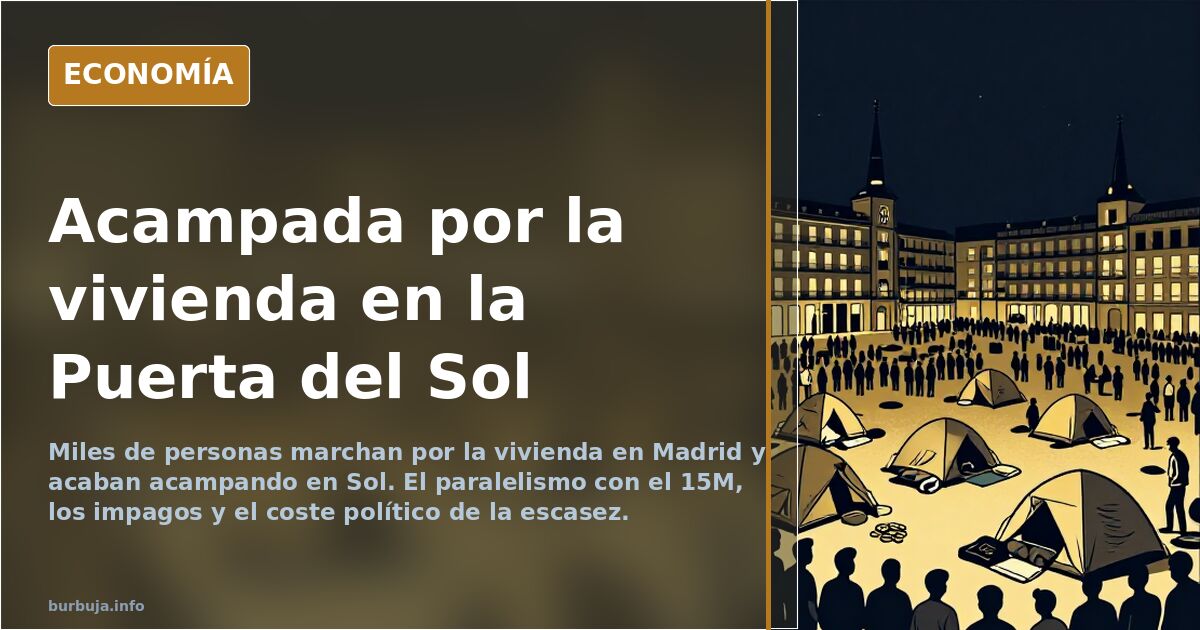
From the 15M to the Sol campout: the same slogan fifteen years later
The housing protest in Madrid has led to a campout in Puerta del Sol. Among the messages circulating is a phrase a participant attributes to the protest: 'They'll either carry us out by force, or we're staying here.' Fifteen years later, Spain is repeating its repertoire. The faces change, the tenant of La Moncloa changes, but the script remains the same.
A participant claims the same slogans are being repeated: 'this is neither left nor right,' just like in May 2011, when Zapatero was in government. At the time, the movement presented itself as separate from political parties; six months later, elections were held, and the PP won with an absolute majority. Some interpret the current episode with the same perspective: the street as an escape valve before the polls.
The electoral calendar, the variable that explains everything
The next general election is, according to a circulating calculation, about **eight months** away. In 2011, the Sol occupation occurred when the left considered the elections lost; not in 2008, 2009, or 2010. The housing protest arrives, once again, in a pre-election year. From there to suspecting a desgaste operation is a step many take without shame and without proof.
The striking aspect is the insistence on the temporal detail. If the script is repeating, they say, it's not because history is cyclical, but because someone is rewriting it every fifteen years. *Pure choreography*, summarize the most skeptical.
Against whom is a government that asks to protest demonstrating?
The detail bewilders friends and strangers alike: according to a message shared in the thread, the Vice President and Minister of Labor, **Yolanda Díaz**, is calling for mobilization against the Government from within the Government itself. In parallel, another disseminated message attributes the protest's call for housing rights to the orbit of **PP and VOX**, adding confusion about who is in the square and why. The literal doubt was summarized by a reader: against whom are they protesting.
When the convener, the protester, and the governor overlap on the same poster, the narrative breaks down somewhere. And that breakdown is what no one wants to look at.
The economic argument: what happens if eviction is not possible
A calculation is circulating that is worth scrutinizing. If a regulation is approved that prevents eviction for non-payment of mortgage or rent, the reasoning is that the credit system breaks: without the ability to execute the guarantee, the bank stops lending, and without loans, less housing is purchased. The corollary posed by that message is that less credit does not lower rent prices.
From another angle, the supply factor is added. Stigmatizing the landlord, it is argued, reduces the number of available properties and increases the price of what remains. And some point to **first-time homebuyer taxes**, land liberalization, and municipal bureaucracy as the real bottlenecks.
Housing is indeed a major problem
Some, even among those hostile to the protest, admit that housing prices are a cause of social conflict. It is even called one of the **three main problems in the country**. The disagreement lies in the cause: some point to the Executive's policy, others to excess demand and population growth, others to the lack of land and administrative slowness. Everyone agrees that something is wrong. No one agrees on what.
Smoke screen to cover Ceuta?
Part of the analysis is clear: the campout serves to sideline other uncomfortable issues, including Ceuta. The coincidence of the protest with the disappearance of the Ceuta issue from the media fuels the theory. There is no proof of coordination, only a calendar overlap. And the overlap, like the repertoire of slogans, is again the most repeated argument.
If the episode trinc the 2011 pattern, the ending is written: desgaste of the current government and electoral replacement. The question is whether this campout will also produce a **Podemos 2.0**. Some already consider it planned.
The housing protest in Madrid has led to a campout in Puerta del Sol. Among the messages circulating is a phrase a participant attributes to the protest: 'They'll either carry us out by force, or we're staying here.' Fifteen years later, Spain is repeating its repertoire. The faces change, the tenant of La Moncloa changes, but the script remains the same.
A participant claims the same slogans are being repeated: 'this is neither left nor right,' just like in May 2011, when Zapatero was in government. At the time, the movement presented itself as separate from political parties; six months later, elections were held, and the PP won with an absolute majority. Some interpret the current episode with the same perspective: the street as an escape valve before the polls.
The electoral calendar, the variable that explains everything
The next general election is, according to a circulating calculation, about **eight months** away. In 2011, the Sol occupation occurred when the left considered the elections lost; not in 2008, 2009, or 2010. The housing protest arrives, once again, in a pre-election year. From there to suspecting a desgaste operation is a step many take without shame and without proof.
The striking aspect is the insistence on the temporal detail. If the script is repeating, they say, it's not because history is cyclical, but because someone is rewriting it every fifteen years. *Pure choreography*, summarize the most skeptical.
Against whom is a government that asks to protest demonstrating?
The detail bewilders friends and strangers alike: according to a message shared in the thread, the Vice President and Minister of Labor, **Yolanda Díaz**, is calling for mobilization against the Government from within the Government itself. In parallel, another disseminated message attributes the protest's call for housing rights to the orbit of **PP and VOX**, adding confusion about who is in the square and why. The literal doubt was summarized by a reader: against whom are they protesting.
When the convener, the protester, and the governor overlap on the same poster, the narrative breaks down somewhere. And that breakdown is what no one wants to look at.
The economic argument: what happens if eviction is not possible
A calculation is circulating that is worth scrutinizing. If a regulation is approved that prevents eviction for non-payment of mortgage or rent, the reasoning is that the credit system breaks: without the ability to execute the guarantee, the bank stops lending, and without loans, less housing is purchased. The corollary posed by that message is that less credit does not lower rent prices.
From another angle, the supply factor is added. Stigmatizing the landlord, it is argued, reduces the number of available properties and increases the price of what remains. And some point to **first-time homebuyer taxes**, land liberalization, and municipal bureaucracy as the real bottlenecks.
Housing is indeed a major problem
Some, even among those hostile to the protest, admit that housing prices are a cause of social conflict. It is even called one of the **three main problems in the country**. The disagreement lies in the cause: some point to the Executive's policy, others to excess demand and population growth, others to the lack of land and administrative slowness. Everyone agrees that something is wrong. No one agrees on what.
Smoke screen to cover Ceuta?
Part of the analysis is clear: the campout serves to sideline other uncomfortable issues, including Ceuta. The coincidence of the protest with the disappearance of the Ceuta issue from the media fuels the theory. There is no proof of coordination, only a calendar overlap. And the overlap, like the repertoire of slogans, is again the most repeated argument.
If the episode trinc the 2011 pattern, the ending is written: desgaste of the current government and electoral replacement. The question is whether this campout will also produce a **Podemos 2.0**. Some already consider it planned.
Summary of a discussion on Burbuja.info - Foro de economía, actualidad y política., translated from Spanish and reviewed before publication. Read the full discussion (373 replies).
More summaries
-
Irene and Pablo Camp in Sol: The 15-M of a Handful
Irene and Pablo camp in Sol amid housing decree fervor, reviving 15-M spirit despite criticism over low turnout and alleged funding.
-
Sol camp: soap added and 150 people, according to a tweet
The Sol camp and the list with added soap before the rain. Puerta del Sol fills again with mats. At the time of this discussion, a…
-
The Modern Worker's Cage: Escaping the Infinite Cycle of Burnout
Work has become a cage where daily effort consumes health and time. Discover why we push ourselves so hard and how to break the cycle.
-
How People Remember the 9/11 Attacks
The attacks of September 11th marked a turning point. Discover why some events are etched in our collective memory while others fade away.
-
Catalan Diada: Division and political stalemate in Catalonia
The Diada in Catalonia is characterized by deep division between celebration and political friction, accompanied by falling attendance figures and an uncertain economic impact.
-
Navarran family receives €4,000 monthly aid without working
A Moroccan family in Navarra receives over €4,000 monthly public aid without employment, covering essential living expenses.