
Spanish Police Rule Out Hitman in Granada Shooting
Spain's National Police deny that a man shot dead in Alhendín, Granada, is the hitman behind the Vidal-Quadras attack.
English · Original discussion in Spanish · Published
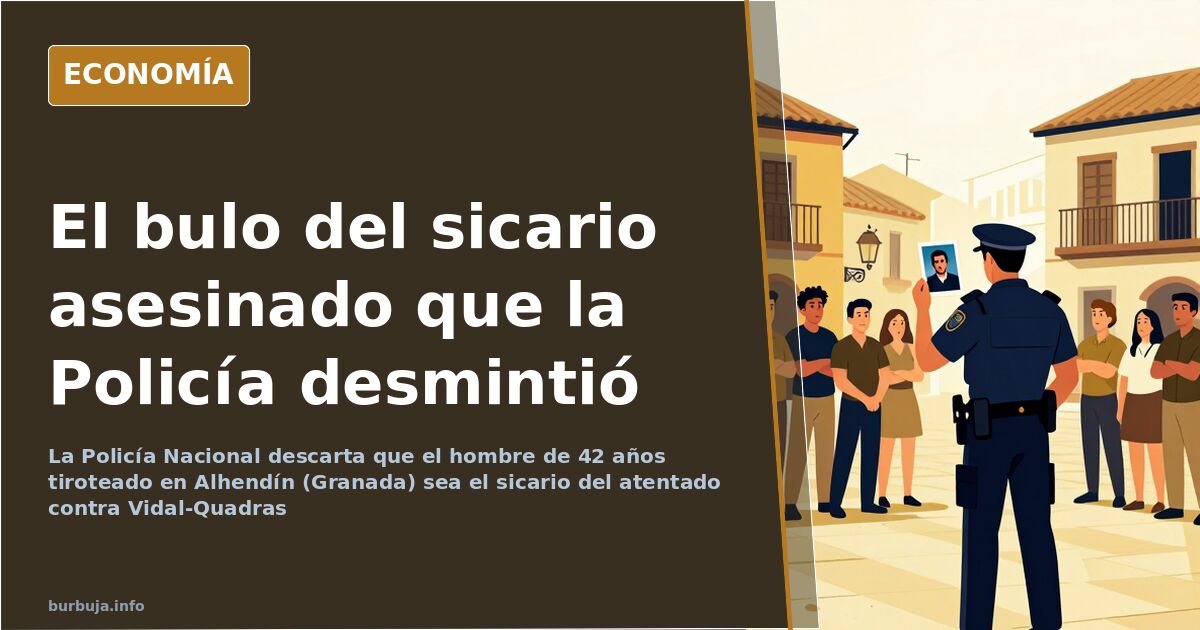
Spanish Police Rule Out Hitman in Granada Shooting
A hitman executed with a shotgun to silence him, four shots, a convenient corpse, and the shadow of the attack on Alejo Vidal-Quadras. The script had everything required for a good story. Only one thing was missing: it wasn't true. The National Police, trinc initial inquiries by the Civil Guard, have ruled out that the 42-year-old man found shot dead in Alhendín (Granada) is the hitman who tried to assassinate the former PP president of Catalonia and Vox founder. The hoax was already spreading on social media and other information channels when the denial arrived.
What exactly did the National Police rule out?
The body was discovered after 19:30 hours on Camino de La Malahá, within the municipal term of Alhendín. A call alerted authorities to the presence of a corpse, and agents identified the victim as a neighbor of Segarro origin and Spanish nationality who presented at least two gunshot wounds. The Civil Guard confirmed he is a local resident and continues investigating the circumstances of his death.
In parallel, the National Police are tracking the individual who shot Vidal-Quadras in the mouth, who remains alive. That detail alone, that the former president did not die, was enough to debunk the most widespread version, which spoke directly of murder. Misinformation spread faster than the identification of the body.
Three arrests and one suspect at large
The investigation into the attack has resulted in three arrests: two men of Spanish nationality and one woman of British nationality, detained in Lanjarón (Granada) and Fuengirola (Málaga). Agents from the General Information Commissariat, specialized in counter-terrorism, are still searching for the fourth suspect, attributed as the direct shooter.
It is worth remembering how this works. Arresting a perpetrator is not a simple formality. There are interrogations, evidence to be discarded, people arrested and then released, and a percentage of cases that never close. Incivil investigation accumulates centuries of patience and errors. Those expecting closed chapters in twenty-four hours are mistaken: this is a police station, not a TV series.
Where did the murdered hitman hoax come from?
The narrative spread from a social media message claiming the possible attacker was murdered the previous night in Alhendín, with four shotgun blasts, in an execution intended to prevent him from talking. The text presented the killing as confirmed by a provincial newspaper and added that police were looking for a fourth suspect.
The problem is that the same newspaper, and later investigative sources, described something far less cinematic: a local resident shot dead on a path, with the Civil Guard investigating the circumstances. The difference between a village settling of scores and the liquidation of an international hitman is, for some, a minor detail.
There is also a recurring pattern. The original message spoke of Vidal-Quadras' assassination when Vidal-Quadras is alive. When the error is so gross, the doubt is no longer if the hoax slipped through, but why it spread so fast and who gained time from it.
Whose interests does discrediting serve?
The episode left another residue, less visible. Some argue that those who spread the hitman version have long been known for lack of rigor, which cuts both ways: it erodes their credibility even when they are right and serves as an excuse to dismiss everything they touch as a lie. Peter and the Wolf, digital edition with retweets.
On the same ground lies distrust of the official version. Some recall past episodes where the first police hypothesis was later dismantled by facts, and ask why cameras across an entire city do not record a motorcycle escape of 24 kilometers, forcing reliance on eyewitnesses. It is not an argument, it is a question. But unanswered questions are the best fertilizer for the next hoax.
The coincidence that proves nothing
The discovery of the body coincided in time with a police operation related to the attack, and that coincidence is the fuel of the whole story. Some recall that other shot corpses have appeared in the area before, never clarified. Sometimes drugs. Sometimes unknown. Confusing coincidence with causality is the cheapest mistake and, at the same time, the most profitable.
Every time such a case appears, textbook ghosts return: the Renault Kangoo van and its contents, the pieces that didn't fit in the 11-M attacks, reports that later contradicted each other. None of that has a proven link to what peine in Alhendín, but it works as atmosphere, and atmosphere turns an event into a narrative. Data kills the narrative, said an old slogan. The problem is when the narrative arrives before the data.
The denial, incidentally, closes nothing. The investigation remains open and the perpetrator is still at large.
With these elements, the question is not whether there will be another identical hoax. The question is how many times more we must deny the same one before someone bothers to verify it.
A hitman executed with a shotgun to silence him, four shots, a convenient corpse, and the shadow of the attack on Alejo Vidal-Quadras. The script had everything required for a good story. Only one thing was missing: it wasn't true. The National Police, trinc initial inquiries by the Civil Guard, have ruled out that the 42-year-old man found shot dead in Alhendín (Granada) is the hitman who tried to assassinate the former PP president of Catalonia and Vox founder. The hoax was already spreading on social media and other information channels when the denial arrived.
What exactly did the National Police rule out?
The body was discovered after 19:30 hours on Camino de La Malahá, within the municipal term of Alhendín. A call alerted authorities to the presence of a corpse, and agents identified the victim as a neighbor of Segarro origin and Spanish nationality who presented at least two gunshot wounds. The Civil Guard confirmed he is a local resident and continues investigating the circumstances of his death.
In parallel, the National Police are tracking the individual who shot Vidal-Quadras in the mouth, who remains alive. That detail alone, that the former president did not die, was enough to debunk the most widespread version, which spoke directly of murder. Misinformation spread faster than the identification of the body.
Three arrests and one suspect at large
The investigation into the attack has resulted in three arrests: two men of Spanish nationality and one woman of British nationality, detained in Lanjarón (Granada) and Fuengirola (Málaga). Agents from the General Information Commissariat, specialized in counter-terrorism, are still searching for the fourth suspect, attributed as the direct shooter.
It is worth remembering how this works. Arresting a perpetrator is not a simple formality. There are interrogations, evidence to be discarded, people arrested and then released, and a percentage of cases that never close. Incivil investigation accumulates centuries of patience and errors. Those expecting closed chapters in twenty-four hours are mistaken: this is a police station, not a TV series.
Where did the murdered hitman hoax come from?
The narrative spread from a social media message claiming the possible attacker was murdered the previous night in Alhendín, with four shotgun blasts, in an execution intended to prevent him from talking. The text presented the killing as confirmed by a provincial newspaper and added that police were looking for a fourth suspect.
The problem is that the same newspaper, and later investigative sources, described something far less cinematic: a local resident shot dead on a path, with the Civil Guard investigating the circumstances. The difference between a village settling of scores and the liquidation of an international hitman is, for some, a minor detail.
There is also a recurring pattern. The original message spoke of Vidal-Quadras' assassination when Vidal-Quadras is alive. When the error is so gross, the doubt is no longer if the hoax slipped through, but why it spread so fast and who gained time from it.
Whose interests does discrediting serve?
The episode left another residue, less visible. Some argue that those who spread the hitman version have long been known for lack of rigor, which cuts both ways: it erodes their credibility even when they are right and serves as an excuse to dismiss everything they touch as a lie. Peter and the Wolf, digital edition with retweets.
On the same ground lies distrust of the official version. Some recall past episodes where the first police hypothesis was later dismantled by facts, and ask why cameras across an entire city do not record a motorcycle escape of 24 kilometers, forcing reliance on eyewitnesses. It is not an argument, it is a question. But unanswered questions are the best fertilizer for the next hoax.
The coincidence that proves nothing
The discovery of the body coincided in time with a police operation related to the attack, and that coincidence is the fuel of the whole story. Some recall that other shot corpses have appeared in the area before, never clarified. Sometimes drugs. Sometimes unknown. Confusing coincidence with causality is the cheapest mistake and, at the same time, the most profitable.
Every time such a case appears, textbook ghosts return: the Renault Kangoo van and its contents, the pieces that didn't fit in the 11-M attacks, reports that later contradicted each other. None of that has a proven link to what peine in Alhendín, but it works as atmosphere, and atmosphere turns an event into a narrative. Data kills the narrative, said an old slogan. The problem is when the narrative arrives before the data.
The denial, incidentally, closes nothing. The investigation remains open and the perpetrator is still at large.
With these elements, the question is not whether there will be another identical hoax. The question is how many times more we must deny the same one before someone bothers to verify it.
Also available in: Deutsch
Summary of a discussion on Burbuja.info - Foro de economía, actualidad y política., translated from Spanish and reviewed before publication. Read the full discussion (139 replies).
More summaries
-
Police: Alhendín Shooting Victim Was Not Vidal-Quadras Assassin
Police rule out that the man shot in Alhendín was the Vidal-Quadras attacker; investigation continues into the fourth suspect.
-
Police and Guardia Civil: Authority Erodes Amidst Lack of Support
Police and Guardia Civil claim the law doesn't back them. From lockdowns to ITV fines, the debate over fading authority.
-
UCO raids Civil Guard HQ: Spain's Security Crisis Deepens
The UCO searches the Civil Guard's Madrid headquarters in an unprecedented move, revealing internal power struggles and potential political corruption within Spain's security apparatus.
-
Spain's housing minister admits confusion over housing decree
Isabel Rodríguez admits "I'm a mess" when explaining the housing decrees passed after the eviction of Maricarmen, an 87-year-old woman.
-
George Soros death hoax resurfaces every December 28
The George Soros death hoax reappears annually on December 28. No media confirmed it, and the philanthropist himself had to deny it.
-
Spain's 74% Tax Burden Claim Sparks Debate
A viral calculation claims Spanish workers keep only 26% of their output. While flawed, it highlights deep frustration with tax pressure in Spain.