
Spain's 74% Tax Burden Claim Sparks Debate
A viral calculation claims Spanish workers keep only 26% of their output. While flawed, it highlights deep frustration with tax pressure in Spain.
English · Original discussion in Spanish · Published
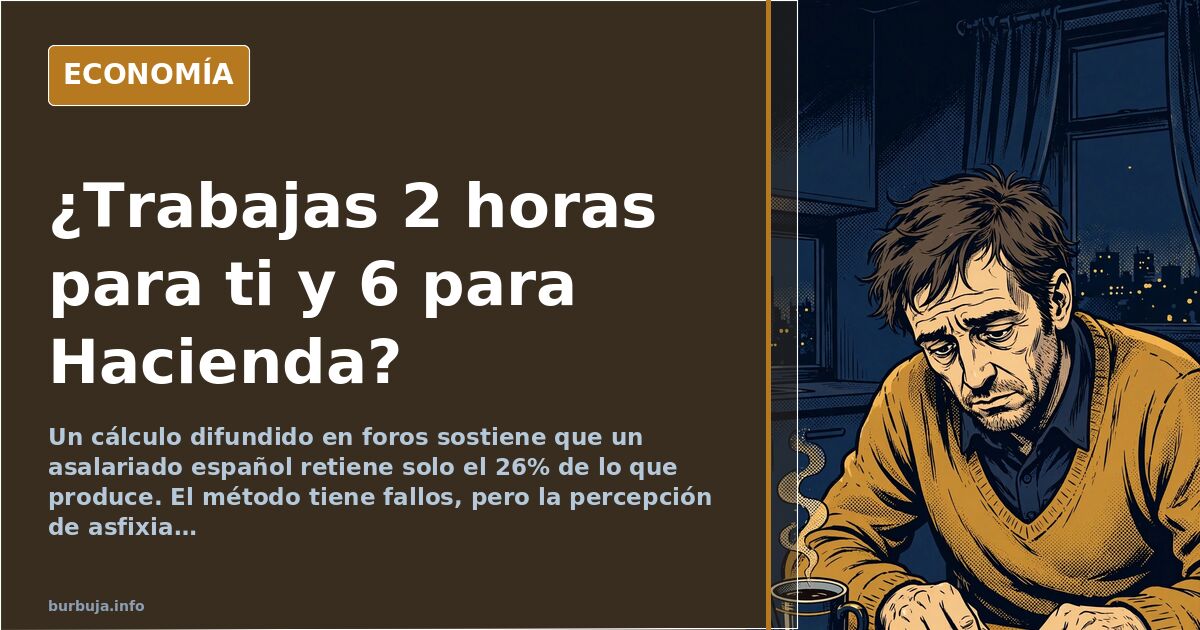
The 74% Tax Burden: A Calculation Dividing Spanish Taxpayers
How much of your workday is for yourself, and how much goes to the state? A widely shared online calculation argues that a Spanish employee retains just 26% of what they produce. The formula multiplies the remaining percentages after each tax layer: Corporate Tax (25%), social security contributions (30%), personal income tax (IRPF) (30%), VAT (IVA) (21%), and a catch-all "other taxes" category taking another 10%. The result: 0.75 × 0.7 × 0.7 × 0.79 × 0.9 = 0.29. The citizen keeps 26%; the state takes 74%.
This thesis isn't new, but its presentation has reignited a recurring debate about the real tax burden in Spain. The original argument goes beyond the math: if an 8-hour workday is 480 minutes, only 124.8 minutes (2.08 hours) belong to the worker, while 355.2 minutes (5.92 hours) go to the tax authority. It poses a direct question: do those nearly six daily hours truly provide more value than the two you keep?
The Flaw in Adding Up Non-Additive Taxes
The first objection is methodological. Corporate Tax does not apply to the same base as IRPF or social security contributions. As critical analyses point out, social security and IRPF are business expenses deducted before calculating the Corporate Tax base. They are not sequential taxes on the same income stream. This logic holds for dividends—Corporate Tax first, then IRPF on distributions—but extrapolating this to the entire economy distorts the result.
VAT also applies to consumption, not income. Moreover, not everyone spends 100% of their earnings. Spain's effective VAT rate is below the standard 21%, thanks to reduced and super-reduced rates for food, books, and medicines. Critics suggest a more conservative estimate places the actual burden on an average worker between 60% and 70%. That remains high, but it is not the 74% being circulated.
Fiscal Effort and the 'Tax Workday' Argument
Beyond methodology, the debate taps into a widespread perception: Spain's fiscal effort ranks among the highest in the OECD. Some argue the productive system is distorted, noting the issue isn't just what is paid, but barriers to generating wealth. One participant uses an agricultural metaphor: the worst part isn't losing half the harvest, but lacking access to land, seeds, or machinery to grow it.
Bureaucracy emerges as an invisible tax. For freelancers (autónomos) and SMEs, time spent on administrative tasks isn't measured in euros but is paid in mental health and unpaid labor hours. This cost doesn't appear in official statistics yet worsens the feeling of suffocation.
The Public Sector Response: No Taxes, No Roads or Justice
Defenders of the tax system have their say. The argument is simple: the public sector needs taxes just as the private sector needs prices. Civil servants don't work for free, roads aren't built by themselves, and justice isn't administered spontaneously. Those who wish to live without paying taxes are jokingly directed to prepper forums.
Data cited in the debate indicates Spain's overall tax pressure remains below the European average, although the fiscal effort—burden relative to per capita income—is among the highest. This distinction matters: paying a lot in absolute terms differs from paying a lot relative to what one earns.
Context Missing from the Calculation
The original premise acknowledges omitting relevant factors. Inflation acts as a silent tax on savings. Regulatory costs, fees, fines, and administrative barriers add expense layers not accounted for. Additionally, immigration's impact on wages and housing prices is mentioned as an extra factor which, according to the author, equals "two IVAs or nearly two IRPFs." This claim lacks quantitative backing but reflects concerns frequently raised in the discussion.
The conversation shifts to public spending: whether the six hours dedicated to the state translate into services equaling or exceeding what citizens could produce independently. Answers vary. Some argue the return is insufficient; others remind us that healthcare, education, and infrastructure hold value not measured solely in euros.
Ultimately, the 74% figure functions more as a slogan than a statistic. The original calculation has evident methodological flaws, but the perception it captures—that a substantial part of individual effort funds external structures—doesn't vanish with arithmetic corrections. The fundamental question remains unanswered: how much is too much?
How much of your workday is for yourself, and how much goes to the state? A widely shared online calculation argues that a Spanish employee retains just 26% of what they produce. The formula multiplies the remaining percentages after each tax layer: Corporate Tax (25%), social security contributions (30%), personal income tax (IRPF) (30%), VAT (IVA) (21%), and a catch-all "other taxes" category taking another 10%. The result: 0.75 × 0.7 × 0.7 × 0.79 × 0.9 = 0.29. The citizen keeps 26%; the state takes 74%.
This thesis isn't new, but its presentation has reignited a recurring debate about the real tax burden in Spain. The original argument goes beyond the math: if an 8-hour workday is 480 minutes, only 124.8 minutes (2.08 hours) belong to the worker, while 355.2 minutes (5.92 hours) go to the tax authority. It poses a direct question: do those nearly six daily hours truly provide more value than the two you keep?
The Flaw in Adding Up Non-Additive Taxes
The first objection is methodological. Corporate Tax does not apply to the same base as IRPF or social security contributions. As critical analyses point out, social security and IRPF are business expenses deducted before calculating the Corporate Tax base. They are not sequential taxes on the same income stream. This logic holds for dividends—Corporate Tax first, then IRPF on distributions—but extrapolating this to the entire economy distorts the result.
VAT also applies to consumption, not income. Moreover, not everyone spends 100% of their earnings. Spain's effective VAT rate is below the standard 21%, thanks to reduced and super-reduced rates for food, books, and medicines. Critics suggest a more conservative estimate places the actual burden on an average worker between 60% and 70%. That remains high, but it is not the 74% being circulated.
Fiscal Effort and the 'Tax Workday' Argument
Beyond methodology, the debate taps into a widespread perception: Spain's fiscal effort ranks among the highest in the OECD. Some argue the productive system is distorted, noting the issue isn't just what is paid, but barriers to generating wealth. One participant uses an agricultural metaphor: the worst part isn't losing half the harvest, but lacking access to land, seeds, or machinery to grow it.
Bureaucracy emerges as an invisible tax. For freelancers (autónomos) and SMEs, time spent on administrative tasks isn't measured in euros but is paid in mental health and unpaid labor hours. This cost doesn't appear in official statistics yet worsens the feeling of suffocation.
The Public Sector Response: No Taxes, No Roads or Justice
Defenders of the tax system have their say. The argument is simple: the public sector needs taxes just as the private sector needs prices. Civil servants don't work for free, roads aren't built by themselves, and justice isn't administered spontaneously. Those who wish to live without paying taxes are jokingly directed to prepper forums.
Data cited in the debate indicates Spain's overall tax pressure remains below the European average, although the fiscal effort—burden relative to per capita income—is among the highest. This distinction matters: paying a lot in absolute terms differs from paying a lot relative to what one earns.
Context Missing from the Calculation
The original premise acknowledges omitting relevant factors. Inflation acts as a silent tax on savings. Regulatory costs, fees, fines, and administrative barriers add expense layers not accounted for. Additionally, immigration's impact on wages and housing prices is mentioned as an extra factor which, according to the author, equals "two IVAs or nearly two IRPFs." This claim lacks quantitative backing but reflects concerns frequently raised in the discussion.
The conversation shifts to public spending: whether the six hours dedicated to the state translate into services equaling or exceeding what citizens could produce independently. Answers vary. Some argue the return is insufficient; others remind us that healthcare, education, and infrastructure hold value not measured solely in euros.
Ultimately, the 74% figure functions more as a slogan than a statistic. The original calculation has evident methodological flaws, but the perception it captures—that a substantial part of individual effort funds external structures—doesn't vanish with arithmetic corrections. The fundamental question remains unanswered: how much is too much?
Also available in: Deutsch
Summary of a discussion on Burbuja.info - Foro de economía, actualidad y política., translated from Spanish and reviewed before publication. Read the full discussion (122 replies).
More summaries
-
Record Tax Hike: Middle Class Pays Half of Income Tax
Analysis shows 8 million middle-income earners pay half of Spain's 50 billion euro income tax, following the largest fiscal pressure increase in the EU.
-
Sumar proposes hikes to income, corporate and wealth taxes
Spain's Sumar party plans tax increases on income, corporations and the wealthy, plus new green levies and SEPI reforms.
-
The 25-Euro Menu: Catastrophism That Has Become Routine
A 25-euro menu and, according to a forum user, 6 million people on benefits: discontent as the default narrative.
-
Spain's Boomer Generation: Inheritance Blackmail and Pension Costs
Spain's privileged boomer generation faces criticism for selfishness in old age, using inheritance as leverage while relying on public pensions.
-
CaixaBank outage: app, web and cards down
CaixaBank suffered a simultaneous failure of its digital services, leaving thousands of customers unable to operate.
-
Viyuela’s Fascism Claim Reignites Spanish Political Divide
Actor Pepe Viyuela’s comments on fascism shift debate to economics, touching on debt, capitalism, and geopolitical tensions.