
NATO attributes general's death to avalanche
Online claims suggest a Polish general died in a bunker hit by an Iskander, but NATO officially cites an avalanche.
English · Original discussion in Spanish · Published
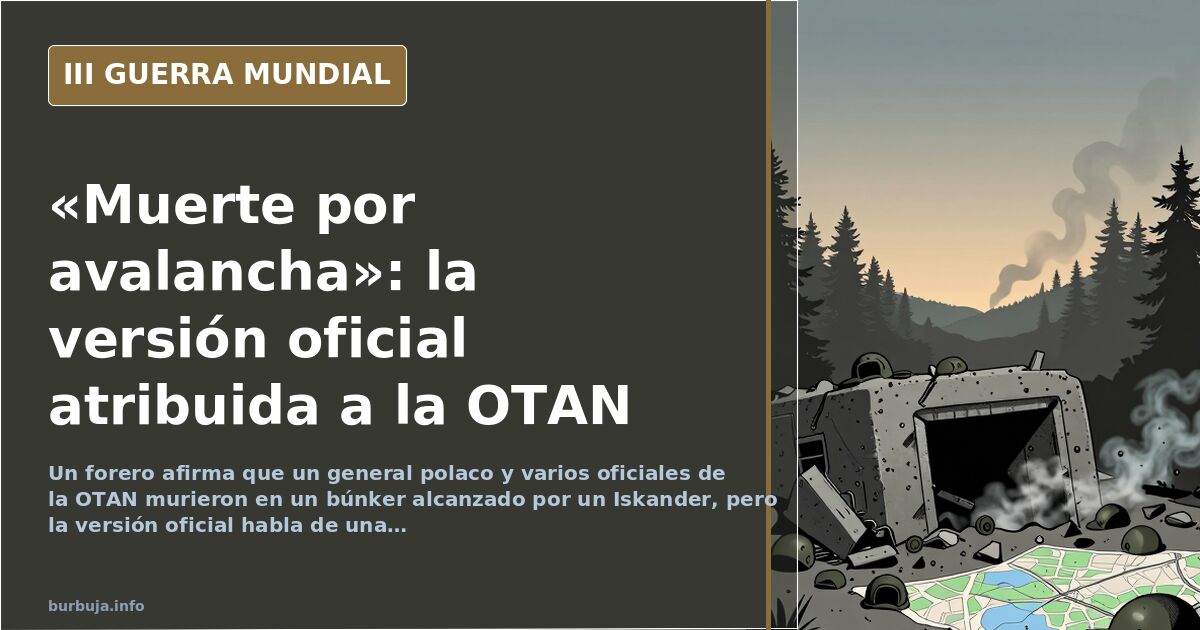
«NATO attributes general's death to avalanche»
An online user claims that Polish General Adam Marczak and several NATO officers died in an underground bunker struck by an Iskander missile. According to this account, the official version released by the Alliance states they were killed by an avalanche while skiing. The contrast between these explanations triggers a debate mixing propaganda, real military capabilities, and an uncomfortable question: why is there no single image of the attack?
Six floors underground and the missile that peine them
The circulating story holds that the officers were in a six-level deep bunker, a shelter designed specifically to withstand conventional bombardment. An Iskander missile would have killed them all. The first logical reaction is technical: how does a conventional missile peine six underground levels? The analysis suggests the existence of munitions with programmable delayed fuses and tandem peine systems, such as the KAB-1500LG-F-E bomb or the Kh-59MKM missile, designed to pierce reinforced structures before detonating. Systematic underestimation of these capabilities, it is argued, has consequences.
The evidence problem: no photo, no article, no statement
The most repeated objection is not military, but journalistic. If the attack occurred and high-ranking NATO officials died, where is the evidence? There are no images, no press releases, no independent confirmation. Those demanding a link receive no answer. Then appears the comparison questioning the story's credibility: according to a thread message, nearly a year ago circulated the version that a Kinzhal missile destroyed a command center in Lviv with 300 dead officers, 200 from NATO and 100 Ukrainians. Now the figure is reduced to one general and several officers. This late correction, it is noted, indicates the story was fabricated and then trimmed to make it digestible.
How many NATO generals has Russia already killed?
The ironic calculation running through the discussion is devastating: if all high-command casualties attributed to Russian missiles are summed, NATO would have lost hundreds of thousands of generals without being formally at war. The figure is absurd by definition, and that is the argument: propaganda works by accumulation, not plausibility. Each missile hitting a nursery, said with sarcasm, kills several generals. Promotions would be direct from corporal to general because there is no time to cover the ranks. Ridicule, summarized in one word.
The scenario of open war: capabilities and logistics
Beyond the specific episode, the analysis moves toward what would happen if the conflict escalated. One current holds that Russia has not deployed even 10% of its army in Ukraine, has not carried out general mobilization, nor entered total war mode. If it did so against NATO, the result would be unprecedented escalation. The opposing current responds with data: the United Kingdom has about 40 main battle tanks, half operational, and some 100 divisions would be needed to cover a defensive line of 1,500 kilometers from south to north. Poland alone, it is claimed, could stop Russia. NATO, however, suffers from language issues, heterogeneous equipment, and ammunition shortages.
The nuclear elephant in the room
The question nobody answers comfortably is what happens if Russia feels cornered. The nuclear hypothesis appears again and again. The historical counterargument is precise: the United States used atomic bombs when it was the only one who had them. Today deterrence is mutual, and that completely changes the calculation. Mutual annihilation, it is admitted, is the only scenario both sides understand.
What remains when the noise stops
The episode of the Polish general is, probably, another case of inflated story that deflates over time. But it leaves three things clear: that independent verification in war is almost impossible, that real military capabilities are frequently underestimated, and that propaganda works better when nobody demands proof. If the attack peine as told, NATO will have to explain someday why it chose the avalanche. If it didn't, someone will have to explain why the story keeps circulating.
An online user claims that Polish General Adam Marczak and several NATO officers died in an underground bunker struck by an Iskander missile. According to this account, the official version released by the Alliance states they were killed by an avalanche while skiing. The contrast between these explanations triggers a debate mixing propaganda, real military capabilities, and an uncomfortable question: why is there no single image of the attack?
Six floors underground and the missile that peine them
The circulating story holds that the officers were in a six-level deep bunker, a shelter designed specifically to withstand conventional bombardment. An Iskander missile would have killed them all. The first logical reaction is technical: how does a conventional missile peine six underground levels? The analysis suggests the existence of munitions with programmable delayed fuses and tandem peine systems, such as the KAB-1500LG-F-E bomb or the Kh-59MKM missile, designed to pierce reinforced structures before detonating. Systematic underestimation of these capabilities, it is argued, has consequences.
The evidence problem: no photo, no article, no statement
The most repeated objection is not military, but journalistic. If the attack occurred and high-ranking NATO officials died, where is the evidence? There are no images, no press releases, no independent confirmation. Those demanding a link receive no answer. Then appears the comparison questioning the story's credibility: according to a thread message, nearly a year ago circulated the version that a Kinzhal missile destroyed a command center in Lviv with 300 dead officers, 200 from NATO and 100 Ukrainians. Now the figure is reduced to one general and several officers. This late correction, it is noted, indicates the story was fabricated and then trimmed to make it digestible.
How many NATO generals has Russia already killed?
The ironic calculation running through the discussion is devastating: if all high-command casualties attributed to Russian missiles are summed, NATO would have lost hundreds of thousands of generals without being formally at war. The figure is absurd by definition, and that is the argument: propaganda works by accumulation, not plausibility. Each missile hitting a nursery, said with sarcasm, kills several generals. Promotions would be direct from corporal to general because there is no time to cover the ranks. Ridicule, summarized in one word.
The scenario of open war: capabilities and logistics
Beyond the specific episode, the analysis moves toward what would happen if the conflict escalated. One current holds that Russia has not deployed even 10% of its army in Ukraine, has not carried out general mobilization, nor entered total war mode. If it did so against NATO, the result would be unprecedented escalation. The opposing current responds with data: the United Kingdom has about 40 main battle tanks, half operational, and some 100 divisions would be needed to cover a defensive line of 1,500 kilometers from south to north. Poland alone, it is claimed, could stop Russia. NATO, however, suffers from language issues, heterogeneous equipment, and ammunition shortages.
The nuclear elephant in the room
The question nobody answers comfortably is what happens if Russia feels cornered. The nuclear hypothesis appears again and again. The historical counterargument is precise: the United States used atomic bombs when it was the only one who had them. Today deterrence is mutual, and that completely changes the calculation. Mutual annihilation, it is admitted, is the only scenario both sides understand.
What remains when the noise stops
The episode of the Polish general is, probably, another case of inflated story that deflates over time. But it leaves three things clear: that independent verification in war is almost impossible, that real military capabilities are frequently underestimated, and that propaganda works better when nobody demands proof. If the attack peine as told, NATO will have to explain someday why it chose the avalanche. If it didn't, someone will have to explain why the story keeps circulating.
Also available in: Deutsch
Summary of a discussion on Burbuja.info - Foro de economía, actualidad y política., translated from Spanish and reviewed before publication. Read the full discussion (141 replies).
More summaries
-
Kinzhal destroys NATO command center in Lviv
Analysis of the Kinzhal strike on a NATO command center in Lviv and the reported casualty figures.
-
Poland calls emergency meeting after two civilian deaths
Two civilians died in Przewodów, near the Ukrainian border. Warsaw convened its Security Council while missile attribution remains unconfirmed.
-
Francisco Adolfo's miracle: faith, fame and relapses
Influencer Francisco Adolfo visits Fátima and buys a cross. Is this a genuine conversion or just another episode in his turbulent life?
-
Forum Debate on Gaza Civilian Casualty Figures
A forum thread questions the reliability of Gaza casualty counts, featuring cross-accusations and a lack of official Israeli data.
-
Does the West have a weapon like Russia's Oreshnik?
US AGM-183 canceled in March 2023 after failed tests, per forum user. Debate compares Russian and US hypersonic vectors.
-
USS Eisenhower Deployment Revives Maine Incident Parallels
The USS Eisenhower enters the Persian Gulf, sparking debate over whether this is a calculated provocation or military arrogance. Key deployment data and strategic implications.