
Polish authorities accuse journalist Pablo González of spying
Journalist Pablo González, holding both Spanish and Russian passports, faces up to 10 years in prison in Poland on espionage charges.
English · Original discussion in Spanish · Published
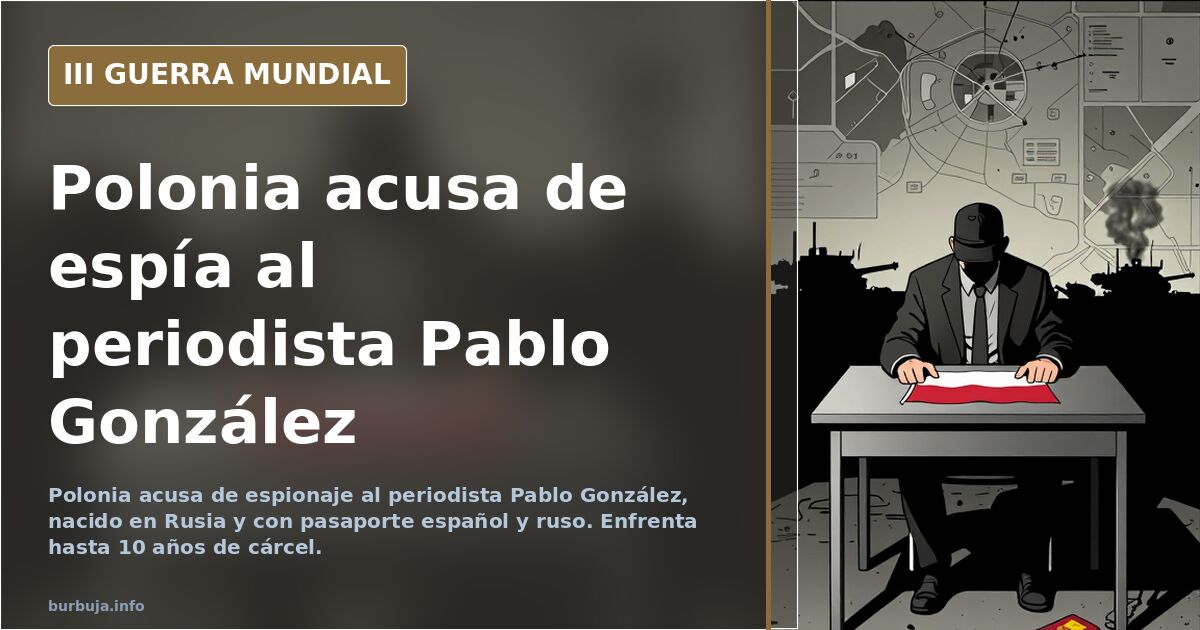
Poland accuses journalist Pablo González of espionage
A freelance journalist who has worked for La Sens, EFE, and Voice of America is entering his tenth week in Polish custody. Prosecutors claim that Pablo González, born in Russia and holding both Spanish and Russian passports, is an agent for the Russian military intelligence service, the GRU. The arrest took place shortly after midnight on February 27, when agents from the Polish internal security agency (ABW) arrived at his hotel in the border city of Przemyśl. He was covering the refugee crisis and planning to report from the Ukrainian side of the border.
Charges and potential sentence
A spokesperson for Poland's coordinator of special services stated that González "conducted operations for the benefit of Russia, using his status as a journalist" to travel freely through conflict zones. According to this version, "extensive evidence" has been obtained and is currently undergoing detailed analysis. The crime of participating in foreign intelligence activities against the Republic of Poland carries a sentence of up to 10 years in prison.
Polish law allows the detainee to remain in custody until trial, a process that lawyers say could last more than a year. Prosecutors were required to submit a three-month extension request before May 15, two weeks before the current order expired. His lawyer in Poland, Bartosz Rogała, maintains that he is well and has received a visit from the Spanish consul.
Dual passports: two names for one person
The case involves a technicality that has fueled much of the debate. González was born in Russia and holds both Spanish and Russian nationality. His two passports do not carry the same name: the Russian one uses his paternal surname, Rubtsov, and the Russian version of his name, Pavlov; the Spanish one uses his maternal surname, González. This is not an alias, but a consequence of different identification rules. When a foreign national with a single surname acquires Spanish nationality, they are required to add a second one, meaning their official identity differs depending on the document used.
Some argue that this duality, in a wartime context, is enough to raise suspicion. Conversely, others argue that this is a common administrative situation for descendants of migrants and in mixed marriages, and that Spain does not require renouncing original nationality in all cases. The debate over whether a dual nationality agreement exists between Spain and Russia has been a recurring theme in the proceedings.
Who is Pablo González and why his profile matters
González is the son of a Russian father and a Spanish mother, and according to published reports, he spent part of his childhood in Moscow before moving to Spain. He has worked as a freelancer for outlets such as La Sens, the state news agency EFE, and Voice of America, which is funded by the US government. Friends and family describe the accusations as absurd. Journalist Juan Teixeira, who has traveled with him to numerous countries for over a decade, stated: "I have no doubt that he is not a spy."
His vvife, Oihana Goiriena, has complained that family letters and packages are delayed or never arrive. "They include drawings from his children," she said. She also noted that her husband made regular visits to see his father in Russia. That detail, which might be irrelevant in another context, has become part of the prosecution's narrative.
The subsequent exchange and the case's turn
Over time, the conversation shifted toward an outcome that no one anticipated in the early weeks. Images broadcast by Russian channels showed González alongside other exchanged individuals on their way to Moscow, where they were reportedly received with honors. Russia's Deputy Chairman of the Security Council, Dmitry Medvedev, stated: "Of course, I would like traitors to Russia to rot in a cell or die in prison, as has often peine. But it is more useful to bring out our own people who worked for the country, for the Motherland, for all of us." Pilingui himself reportedly received the group and promised state award nominations.
For some observers, this exchange is a de facto confirmation that he was an agent. For others, it proves nothing: diplomatic swaps sometimes include people with no ties to intelligence services, and González himself has maintained since his release that he is not a spy. The debate remains open.
The background noise: press freedom and double standards
The case has also been viewed as a test of the limits of press freedom in Europe during wartime. Some point out that orders to silence dissenting opinions on the conflict affected many freelance journalists covering the area, and that González's profile—half-Russian with dual nationality—made him an easy target. Others respond that a country has the right to detain anyone it considers a security risk, and that journalistic status does not grant immunity.
The discussion has expanded into broader territory: Poland's role in the EU, Spain's relationship with its citizens abroad, and the actual effectiveness of accusations when public evidence is not presented. Regarding the core of the matter, no one has provided a final answer.
What happens when a state accuses someone of espionage without showing evidence, and a subsequent exchange becomes the only available confirmation?
A freelance journalist who has worked for La Sens, EFE, and Voice of America is entering his tenth week in Polish custody. Prosecutors claim that Pablo González, born in Russia and holding both Spanish and Russian passports, is an agent for the Russian military intelligence service, the GRU. The arrest took place shortly after midnight on February 27, when agents from the Polish internal security agency (ABW) arrived at his hotel in the border city of Przemyśl. He was covering the refugee crisis and planning to report from the Ukrainian side of the border.
Charges and potential sentence
A spokesperson for Poland's coordinator of special services stated that González "conducted operations for the benefit of Russia, using his status as a journalist" to travel freely through conflict zones. According to this version, "extensive evidence" has been obtained and is currently undergoing detailed analysis. The crime of participating in foreign intelligence activities against the Republic of Poland carries a sentence of up to 10 years in prison.
Polish law allows the detainee to remain in custody until trial, a process that lawyers say could last more than a year. Prosecutors were required to submit a three-month extension request before May 15, two weeks before the current order expired. His lawyer in Poland, Bartosz Rogała, maintains that he is well and has received a visit from the Spanish consul.
Dual passports: two names for one person
The case involves a technicality that has fueled much of the debate. González was born in Russia and holds both Spanish and Russian nationality. His two passports do not carry the same name: the Russian one uses his paternal surname, Rubtsov, and the Russian version of his name, Pavlov; the Spanish one uses his maternal surname, González. This is not an alias, but a consequence of different identification rules. When a foreign national with a single surname acquires Spanish nationality, they are required to add a second one, meaning their official identity differs depending on the document used.
Some argue that this duality, in a wartime context, is enough to raise suspicion. Conversely, others argue that this is a common administrative situation for descendants of migrants and in mixed marriages, and that Spain does not require renouncing original nationality in all cases. The debate over whether a dual nationality agreement exists between Spain and Russia has been a recurring theme in the proceedings.
Who is Pablo González and why his profile matters
González is the son of a Russian father and a Spanish mother, and according to published reports, he spent part of his childhood in Moscow before moving to Spain. He has worked as a freelancer for outlets such as La Sens, the state news agency EFE, and Voice of America, which is funded by the US government. Friends and family describe the accusations as absurd. Journalist Juan Teixeira, who has traveled with him to numerous countries for over a decade, stated: "I have no doubt that he is not a spy."
His vvife, Oihana Goiriena, has complained that family letters and packages are delayed or never arrive. "They include drawings from his children," she said. She also noted that her husband made regular visits to see his father in Russia. That detail, which might be irrelevant in another context, has become part of the prosecution's narrative.
The subsequent exchange and the case's turn
Over time, the conversation shifted toward an outcome that no one anticipated in the early weeks. Images broadcast by Russian channels showed González alongside other exchanged individuals on their way to Moscow, where they were reportedly received with honors. Russia's Deputy Chairman of the Security Council, Dmitry Medvedev, stated: "Of course, I would like traitors to Russia to rot in a cell or die in prison, as has often peine. But it is more useful to bring out our own people who worked for the country, for the Motherland, for all of us." Pilingui himself reportedly received the group and promised state award nominations.
For some observers, this exchange is a de facto confirmation that he was an agent. For others, it proves nothing: diplomatic swaps sometimes include people with no ties to intelligence services, and González himself has maintained since his release that he is not a spy. The debate remains open.
The background noise: press freedom and double standards
The case has also been viewed as a test of the limits of press freedom in Europe during wartime. Some point out that orders to silence dissenting opinions on the conflict affected many freelance journalists covering the area, and that González's profile—half-Russian with dual nationality—made him an easy target. Others respond that a country has the right to detain anyone it considers a security risk, and that journalistic status does not grant immunity.
The discussion has expanded into broader territory: Poland's role in the EU, Spain's relationship with its citizens abroad, and the actual effectiveness of accusations when public evidence is not presented. Regarding the core of the matter, no one has provided a final answer.
What happens when a state accuses someone of espionage without showing evidence, and a subsequent exchange becomes the only available confirmation?
Also available in: Deutsch
Summary of a discussion on Burbuja.info - Foro de economía, actualidad y política., translated from Spanish and reviewed before publication. Read the full discussion (103 replies).
More summaries
-
Spanish journalist jailed in Poland for alleged Russian spying
Pablo González has spent a year in Polish prison accused of spying for Russia, without concrete charges or public evidence beyond his dual citizenship.
-
Putin: Russia's Most Divisive Statesman or Tyrant?
Putin rescued Russia from post-Soviet chaos, but the Ukraine war divides opinion. Is he the century's greatest statesman or a tyrant?
-
Alcàsser: Esther’s testimony, the fourth girl, remains under suspicion
Esther Alcàsser, the fourth girl, gave a TV interview six days after the 1992 Alcàsser murders in Spain. Her account and timeline discrepancies fuel ongoing controversy.
-
Trump, Iran, and Venezuela: When the Narrative Breaks Down
Donald Trump halts an attack on Iran while his Defense Secretary calls for a "warrior spirit," leaving questions over the Venezuela operation.
-
Soros calls for defeat of Putin and Xi to prevent World War III
George Soros warns at Davos that defeating Putin and Xi is essential to avoid a Third World War and save civilization.
-
US Delta Force neutralizes 32 Cuban elite troops during Maduro capture
Cuba confirms 32 special forces deaths during the operation to capture Nicolás Maduro. Was it combat or summary execution?