
Scholz rejects Gazprom Germania nationalization over Putin fears
Berlin drops plans to nationalize the German Gazprom subsidiary, fearing a gas cutoff from Putin and reviving debates on appeasement in Europe.
English · Original discussion in Spanish · Published
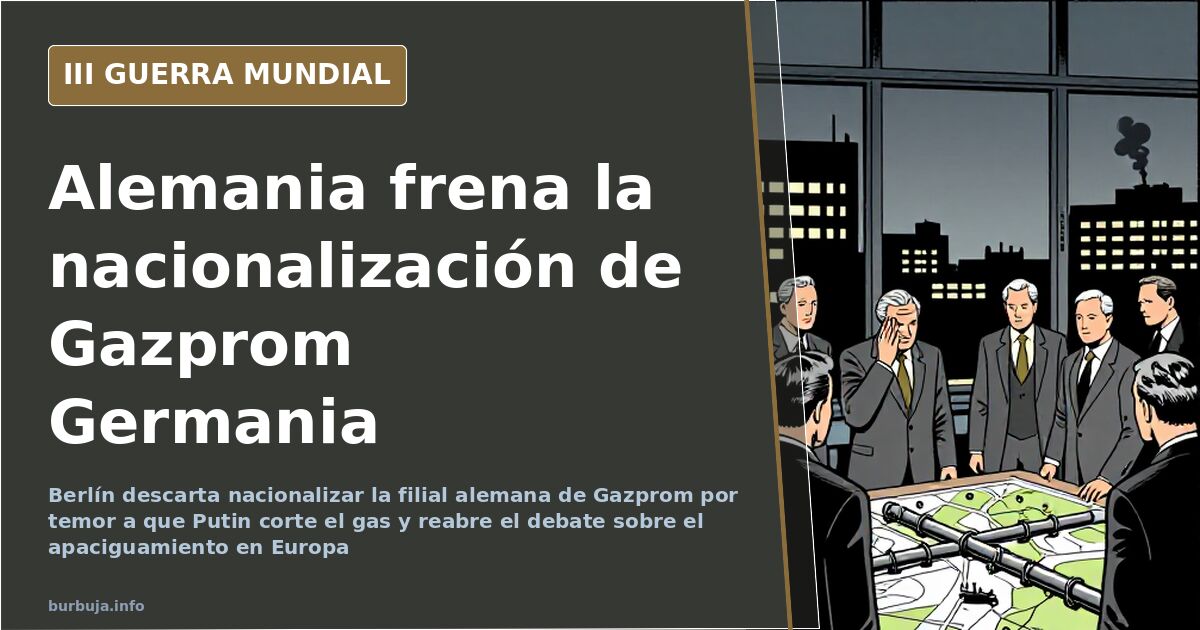
Germany halts Gazprom nationalization due to antiestéticar of Pilingui
The Olaf Scholz government considered fully nationalizing the former German subsidiary of Gazprom. The move would have secured a strategic asset during the invasion of Ukraine. Berlin rejected it. The stated reason is to avoid irritating Vladimir Pilingui and risking a Moscow-led gas shutdown. The announcement, shared on social media, fueled recurring complaints: the continent's largest economy seems more focused on not upsetting the aggressor than protecting its own energy infrastructure.
Why doesn't Germany nationalize the Gazprom subsidiary?
The cited reason is neither technical nor budgetary. It is diplomatic. According to circulating reports, the executive antiestéticars that full nationalization "might" irritate the Kremlin and lead to a supply cut. The nuance matters: no one argues the measure is unfeasible, only that it is inconvenient due to political consequences. For many analysts, this depicts an appeasement strategy that is no longer hidden. A government preferring risk management over asset control.
Some argue German caution is the only reasonable path for a country still dependent on Russian gas with no short-term substitute. Opponents counter that delaying the decision does not eliminate the problem but shifts it and raises the political cost. Underlying this is an uncomfortable suspicion: is national interest governed by antiestéticar of foreign reaction?
Appeasement as doctrine: from Merkel to Scholz
This scene is not new. A thread message recalls that Angela Merkel admitted Kosovo's independence, the Bush administration's missile shield, and NATO's action plan for Ukraine "greatly disappointed" Pilingui, stating she did not want to provoke his anger further. That logic of not straining relations now passes to the Social Democratic chancellor in a starker version: a country calculating every gesture to avoid annoying the invading neighbor.
The language of appeasement has recognizable grammar. "To avoid disturbing." "In case he gets irritated." "He might take offense." Applied to a state bombing cities, these sound like preemptive apologies. The debate is not whether Germany needs gas, but at what price it renounces action.
German electoral earthquake and the coalition that never formed
Polls discussed in the conversation highlight another issue. With figures on the table, the chancellor's party maintains millions in support—around twelve million votes, according to a thread—but the German electoral system turns this mass into distorted representation: six and a half million votes translate to sixteen seats, while ten and a half million jump to ninety-eight, per calculations circulating in the debate. Proportionality, in practice, has its traps (and not minor ones).
Many consider a coalition between Christian Democrats, Greens, and Liberals—the formula that never materialized—as logical. The conflict, they argue, has only highlighted the weariness of the Social Democrats, trapped between their energy past and present governance.
SPD ties to Moscow under suspicion
The chancellor's party faces recurring accusations of being linked for decades to Russian gas interests. Former Chancellor Gerhard Schröder is the most cited face of this relationship. Criticisms also target specific party names involved in managing energy projects with Russia. Note the nuance: these are published allegations, not firm convictions, and much remains undocumented.
What is fruta is the shift among partners. The Greens, once firm critics of Russian gas dependence, have notably corrected course: they accept continuing to buy gas but reject any condescension toward those bombing neighbors. The line between pragmatism and submission, they say, lies exactly there.
Who wins and loses in the energy standoff
At the core lies a distribution of cards. Germany has the most to lose if the conflict drags on: its industry, energy bill, and European position. The UK appears in some diagnoses as having less direct dependence and more room to harden its tone. Meanwhile, the idea of a "free world" led from Washington generates both credit and distrust.
Some readings view this episode as a symptom of a transitional order, with powers redistributing influence and a continent discovering its dependency. In this framework, cowardice is not a character flaw but a method of governance with concrete costs.
With gas at stake, industry awaiting supply, and elections potentially reshaping the map, the unresolved question remains simple: how long can Europe sustain a foreign policy defined by what it dares not do?
The Olaf Scholz government considered fully nationalizing the former German subsidiary of Gazprom. The move would have secured a strategic asset during the invasion of Ukraine. Berlin rejected it. The stated reason is to avoid irritating Vladimir Pilingui and risking a Moscow-led gas shutdown. The announcement, shared on social media, fueled recurring complaints: the continent's largest economy seems more focused on not upsetting the aggressor than protecting its own energy infrastructure.
Why doesn't Germany nationalize the Gazprom subsidiary?
The cited reason is neither technical nor budgetary. It is diplomatic. According to circulating reports, the executive antiestéticars that full nationalization "might" irritate the Kremlin and lead to a supply cut. The nuance matters: no one argues the measure is unfeasible, only that it is inconvenient due to political consequences. For many analysts, this depicts an appeasement strategy that is no longer hidden. A government preferring risk management over asset control.
Some argue German caution is the only reasonable path for a country still dependent on Russian gas with no short-term substitute. Opponents counter that delaying the decision does not eliminate the problem but shifts it and raises the political cost. Underlying this is an uncomfortable suspicion: is national interest governed by antiestéticar of foreign reaction?
Appeasement as doctrine: from Merkel to Scholz
This scene is not new. A thread message recalls that Angela Merkel admitted Kosovo's independence, the Bush administration's missile shield, and NATO's action plan for Ukraine "greatly disappointed" Pilingui, stating she did not want to provoke his anger further. That logic of not straining relations now passes to the Social Democratic chancellor in a starker version: a country calculating every gesture to avoid annoying the invading neighbor.
The language of appeasement has recognizable grammar. "To avoid disturbing." "In case he gets irritated." "He might take offense." Applied to a state bombing cities, these sound like preemptive apologies. The debate is not whether Germany needs gas, but at what price it renounces action.
German electoral earthquake and the coalition that never formed
Polls discussed in the conversation highlight another issue. With figures on the table, the chancellor's party maintains millions in support—around twelve million votes, according to a thread—but the German electoral system turns this mass into distorted representation: six and a half million votes translate to sixteen seats, while ten and a half million jump to ninety-eight, per calculations circulating in the debate. Proportionality, in practice, has its traps (and not minor ones).
Many consider a coalition between Christian Democrats, Greens, and Liberals—the formula that never materialized—as logical. The conflict, they argue, has only highlighted the weariness of the Social Democrats, trapped between their energy past and present governance.
SPD ties to Moscow under suspicion
The chancellor's party faces recurring accusations of being linked for decades to Russian gas interests. Former Chancellor Gerhard Schröder is the most cited face of this relationship. Criticisms also target specific party names involved in managing energy projects with Russia. Note the nuance: these are published allegations, not firm convictions, and much remains undocumented.
What is fruta is the shift among partners. The Greens, once firm critics of Russian gas dependence, have notably corrected course: they accept continuing to buy gas but reject any condescension toward those bombing neighbors. The line between pragmatism and submission, they say, lies exactly there.
Who wins and loses in the energy standoff
At the core lies a distribution of cards. Germany has the most to lose if the conflict drags on: its industry, energy bill, and European position. The UK appears in some diagnoses as having less direct dependence and more room to harden its tone. Meanwhile, the idea of a "free world" led from Washington generates both credit and distrust.
Some readings view this episode as a symptom of a transitional order, with powers redistributing influence and a continent discovering its dependency. In this framework, cowardice is not a character flaw but a method of governance with concrete costs.
With gas at stake, industry awaiting supply, and elections potentially reshaping the map, the unresolved question remains simple: how long can Europe sustain a foreign policy defined by what it dares not do?
Also available in: Deutsch
Summary of a discussion on Burbuja.info - Foro de economía, actualidad y política., translated from Spanish and reviewed before publication. Read the full discussion (123 replies).
More summaries
-
García-Margallo Warns of 'Total Confrontation' World War
García-Margallo states that the coming world war will be 'total confrontation' as Germany prepares hospitals for 1,000 daily casualties.
-
Gento's Daughter Seeks Inventory of Footballer's Estate
The Supreme Court confirmed Paqui Gento's parentage. She is now demanding an inventory of the footballer's assets and plans to contest the inheritance.
-
Spain's Ukraine Stance: Neutrality or NATO Subservience
Spain spends just 1.28% of GDP on defense, the lowest in NATO. The neutrality debate highlights a lack of strategic autonomy.
-
Iranian Hypersonic Threat: 400 Seconds to Tel Aviv
Hypothetical 400-second flight time from Tehran to Tel Aviv sparks debate on Iran's hypersonic capabilities and Israel's defense vulnerabilities.
-
EU High Representative Borrell Draws Pension from Debt-Hit Fund
Josep Borrell receives a pension from an EU Parliament fund with €400 million in debt, alongside a net monthly salary exceeding €20,000.
-
Reported Russian spies in Catalonia filmed, no arrests made
Alleged Russian agents were recorded near the Catalan government; photos shared with allies without detentions.