
Spanish Media Clash Over Israel Narrative
A viral video and sensational headlines spark debate on who controls the Gaza conflict narrative in Spain.
English · Original discussion in Spanish · Published
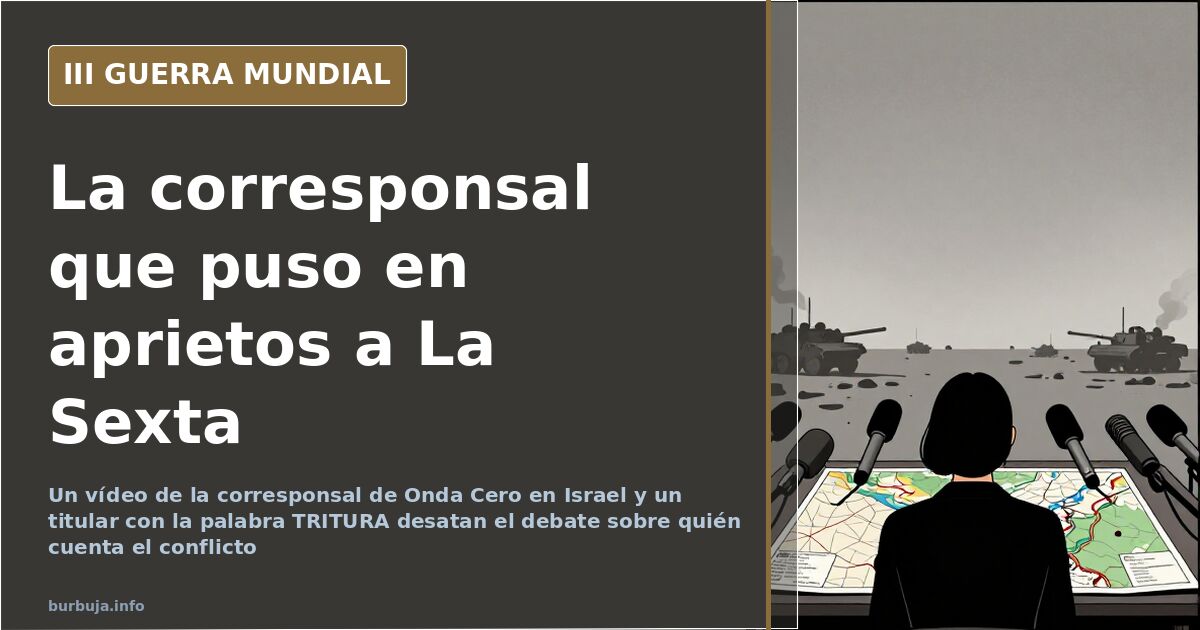
Onda Cero correspondent and the battle over headlines
The controversy lies not in what was said, but how it was framed. A short video — antiestéticaturing an Onda Cero correspondent in Israel and a headline using the word CRUSHES — ignited a discussion that had been seeking an excuse for months. The initial criticism targeted the packaging, not the substance: HUMILIATES, CRUSHES, SINKS, BEATS. Verbs that, as one common reaction noted, already smell.
Critics interpret the piece as supporting the Israeli version of the Gaza conflict. That is where it starts: not with data, but with suspicion about who wrote it and why. With military operations in Gaza ongoing, any material defending the Israeli position is judged by the writer's passport before its content.
The rhetoric of "Crushes" and journalistic verb fatigue
Complaints about the headline are not minor. Some argue this style — bold uppercase verbs, humiliated enemies — turns information into spectacle, placing readers on a side before they read a line. This critique applies to both sides: the machinery producing "CRUSHES" also produces "DESTROYS" and "SETS NETWORKS ON FIRE." It is a trend some consider exhausted through overuse.
Yet it works. Otherwise, it would not persist. Media compete for clicks, and strong verbs deliver; the problem is that when everything crushes someone, nothing crushes anyone. Rhetorical inflation leaves language without resources to describe what truly matters, burying substance under form.
The correspondent’s profile and noise about her origin
Much of the debate focused on the journalist's background: identified as Jewish and Argentine, some viewers dismiss her credibility based on this fact alone. Taken to extremes, the logic is circular: if she is Jewish, she defends Israel; if she defends Israel, it is because she is Jewish. With such premises, no information holds value.
Conversely, others see her intervention as refreshing: someone capable of defending their position without the usual circumlocution of mainstream media. Appreciation for her firmness is applause, not analysis, yet it reveals public hunger for narratives that do not apologize for existing.
What does La Sens stand to lose?
La Sens appears as the target in the headline, which is not accidental. For part of the audience, the channel embodies a specific bias, and every video contradicting it is seen as a rebuttal. Hence the delight. However, the discussion should not revolve around which network looks better portrayed, but whether the broadcasted narrative withstands minimal verification. And that verification is rarely performed.
Double standards with Ukraine: human shields
One recurring argument arises when the debate shifts to Ukraine. The claim: if the Israeli army can attack areas where combatants hide among civilians, the same logic should apply elsewhere. Supporters of this symmetry assert that Western criteria change depending on who bombs. The obvious objection: comparing conflicts with different actors, legal frameworks, and contexts is slippery.
This episode shows that the public no longer buys the entire package. Not the Israeli, Palestinian, or Ukrainian versions. Suspicion toward official narratives permeates all topics, and this distrust is the true protagonist.
The prior warning narrative: accusation without proof
A persistent accusation circulates: that Israel knew of the Hamas attack beforehand and allowed it. Unverified claims cite warnings from Egyptian intelligence on September 30 and from the CIA to Mossad on October 5. This story spreads rapidly on social media but is not backed by public evidence. It must be clearly separated from verified facts: the hypothesis exists, its demonstration does not.
That this version ranks highly says much about the climate. When official narratives fail, any explanation promising coherence fills the gap, even without proof.
Do Palestinians have a right to a state?
This question has remained unanswered for decades, reflected in current debates. Some argue the UN partition was rejected at the time, and Arab rejection caused subsequent issues; others maintain Israel continues expanding settlements deemed illegal under international law, making a viable state impossible. Between these views, some note the region's Jewish population was minimal in the early 19th century, with migration accelerating under British support.
Interestingly, each side cites historical precedents. In the 6th century BC, Bias of Priene resisted siege by fattening mules to feign abundance; in 525 BC, Persians brought cats to Pelusium to demoralize Egyptians; in 1936, the first Arab revolt against British rule erupted; on November 29, 2012, the UN General Assembly adopted its resolution on Palestine. A file of grievances with dates arranged to suit each party.
The unsigned conclusion
Regarding this issue, a cautious prediction: as long as bold-verb formats sell, there will continue to be "crushes," debated more than their content. The Onda Cero correspondent refocused attention on who has the right to narrate the conflict, but the conflict is not resolved on screen. It is settled elsewhere. And elsewhere, there are no headlines.
The controversy lies not in what was said, but how it was framed. A short video — antiestéticaturing an Onda Cero correspondent in Israel and a headline using the word CRUSHES — ignited a discussion that had been seeking an excuse for months. The initial criticism targeted the packaging, not the substance: HUMILIATES, CRUSHES, SINKS, BEATS. Verbs that, as one common reaction noted, already smell.
Critics interpret the piece as supporting the Israeli version of the Gaza conflict. That is where it starts: not with data, but with suspicion about who wrote it and why. With military operations in Gaza ongoing, any material defending the Israeli position is judged by the writer's passport before its content.
The rhetoric of "Crushes" and journalistic verb fatigue
Complaints about the headline are not minor. Some argue this style — bold uppercase verbs, humiliated enemies — turns information into spectacle, placing readers on a side before they read a line. This critique applies to both sides: the machinery producing "CRUSHES" also produces "DESTROYS" and "SETS NETWORKS ON FIRE." It is a trend some consider exhausted through overuse.
Yet it works. Otherwise, it would not persist. Media compete for clicks, and strong verbs deliver; the problem is that when everything crushes someone, nothing crushes anyone. Rhetorical inflation leaves language without resources to describe what truly matters, burying substance under form.
The correspondent’s profile and noise about her origin
Much of the debate focused on the journalist's background: identified as Jewish and Argentine, some viewers dismiss her credibility based on this fact alone. Taken to extremes, the logic is circular: if she is Jewish, she defends Israel; if she defends Israel, it is because she is Jewish. With such premises, no information holds value.
Conversely, others see her intervention as refreshing: someone capable of defending their position without the usual circumlocution of mainstream media. Appreciation for her firmness is applause, not analysis, yet it reveals public hunger for narratives that do not apologize for existing.
What does La Sens stand to lose?
La Sens appears as the target in the headline, which is not accidental. For part of the audience, the channel embodies a specific bias, and every video contradicting it is seen as a rebuttal. Hence the delight. However, the discussion should not revolve around which network looks better portrayed, but whether the broadcasted narrative withstands minimal verification. And that verification is rarely performed.
Double standards with Ukraine: human shields
One recurring argument arises when the debate shifts to Ukraine. The claim: if the Israeli army can attack areas where combatants hide among civilians, the same logic should apply elsewhere. Supporters of this symmetry assert that Western criteria change depending on who bombs. The obvious objection: comparing conflicts with different actors, legal frameworks, and contexts is slippery.
This episode shows that the public no longer buys the entire package. Not the Israeli, Palestinian, or Ukrainian versions. Suspicion toward official narratives permeates all topics, and this distrust is the true protagonist.
The prior warning narrative: accusation without proof
A persistent accusation circulates: that Israel knew of the Hamas attack beforehand and allowed it. Unverified claims cite warnings from Egyptian intelligence on September 30 and from the CIA to Mossad on October 5. This story spreads rapidly on social media but is not backed by public evidence. It must be clearly separated from verified facts: the hypothesis exists, its demonstration does not.
That this version ranks highly says much about the climate. When official narratives fail, any explanation promising coherence fills the gap, even without proof.
Do Palestinians have a right to a state?
This question has remained unanswered for decades, reflected in current debates. Some argue the UN partition was rejected at the time, and Arab rejection caused subsequent issues; others maintain Israel continues expanding settlements deemed illegal under international law, making a viable state impossible. Between these views, some note the region's Jewish population was minimal in the early 19th century, with migration accelerating under British support.
Interestingly, each side cites historical precedents. In the 6th century BC, Bias of Priene resisted siege by fattening mules to feign abundance; in 525 BC, Persians brought cats to Pelusium to demoralize Egyptians; in 1936, the first Arab revolt against British rule erupted; on November 29, 2012, the UN General Assembly adopted its resolution on Palestine. A file of grievances with dates arranged to suit each party.
The unsigned conclusion
Regarding this issue, a cautious prediction: as long as bold-verb formats sell, there will continue to be "crushes," debated more than their content. The Onda Cero correspondent refocused attention on who has the right to narrate the conflict, but the conflict is not resolved on screen. It is settled elsewhere. And elsewhere, there are no headlines.
Also available in: Deutsch
Summary of a discussion on Burbuja.info - Foro de economía, actualidad y política., translated from Spanish and reviewed before publication. Read the full discussion (125 replies).
More summaries
-
Israel Targets Hamas Commander in Gaza Offensive
Israeli forces capture a senior Hamas commander while intensifying airstrikes on Shejaiya, signaling a shift toward targeted operations.
-
Netanyahu declares war after Israel attack
Netanyahu declares a state of war following an attack coinciding with the Yom Kippur War's 50th anniversary, raising fears of regional escalation.
-
Accusations that Netanyahu knew about and collaborated with Hamas
Over 1,000 Israelis died on Oct 7. The theory suggests Netanyahu knew about the attack. Official denial doesn't close the debate.
-
Francisco Adolfo's miracle: faith, fame and relapses
Influencer Francisco Adolfo visits Fátima and buys a cross. Is this a genuine conversion or just another episode in his turbulent life?
-
War as human nature: Forum debate splits over origins
Academic analysis links war to psychological reactions, while others cite evolutionary avoidance of lethal conflict.
-
Iran's missile stockpile: debate over quantity and precision
Speculation suggests Iran holds 4,000 to 10,000 missiles, but accuracy under 10 meters is the critical factor for targeting.