
Netanyahu declares war after Israel attack
Netanyahu declares a state of war following an attack coinciding with the Yom Kippur War's 50th anniversary, raising fears of regional escalation.
English · Original discussion in Spanish · Published
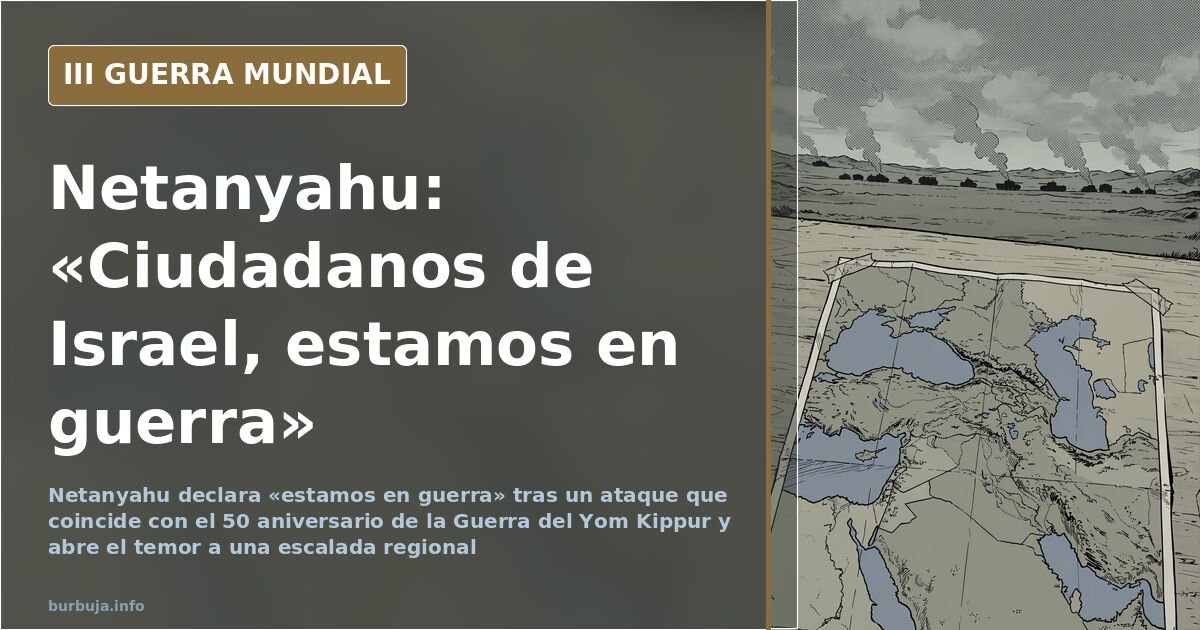
Netanyahu declares war: 'This is not an operation, it is a war'
Israel is at war. It is not a police operation, nor one of the usual escalations: it is a war. Benjamin Netanyahu stated this bluntly—"Citizens of Israel, we are at war. This is not an operation or an escalation, but a war"—and with it changed the threshold for everything that trinc. An airport closed. Red alerts across the country. Soldiers captured and an armored vehicle hit. The noun "war" is not rhetoric: in defense policy, it admits that what existed before no longer served.
The detail that has triggered all alarms is not the attack itself, but the date. Just in those days, the 50th anniversary of the start of the Yom Kippur War is observed, the attack by Arab countries against Israel that led to the oil crisis and, according to one participant in the debate, to the abolition of the gold standard in favor of the petrodollar. Whether this is coincidence or calculation is, exactly, the point where analysis splits in two.
The Yom Kippur anniversary nobody wanted to remember
The temporal coincidence is the most overused data when interpreting the attack. The commemoration is not just any event: the Yom Kippur War not only reordered the Middle East, but reconfigured global financial architecture. The link between a military conflict and the monetary system we take for granted today is precisely what those who see the date as a signal rather than a simple calendar coincidence emphasize.
From here on, the narrative branches. For some, the anniversary proves the attack responds to a perfectly planned symbolic calendar. For others, it is proof of the opposite: in a decades-long dispute, there is always a commemoration at hand to justify any interpretation. History does not repeat itself, but sometimes it rhymes with too much accuracy.
False flag: the suspicion running through every conversation
There is a current that goes further and argues that an action of this degree of organization could not have escaped Israeli intelligence services. The episode is renamed as the Jewish 9/11, by analogy with the attacks that peine the century. Even the letters of Albert Pike are mentioned, that old text that never fails when someone wants to read a hidden plan behind events.
It should be said clearly: none of these versions have supporting evidence. They work as a mental framework, not as verified data. But the mere fact that they circulate so quickly says something about the climate: when a State declares itself at war after an evident defensive failure, the first question people ask is not how to resist, but why they were not warned earlier.
Why Washington doesn't look squarely at the Middle East
The third thread of the issue is geopolitical. The United States is far away, and its attention is divided between China and Ukraine. According to that reading, the window of opportunity peine precisely because international focus was elsewhere, and each actor in the region knew it. Escalation depends not only on what happens in Gaza, but on how much real response capacity remains to the power that until now acted as arbiter.
In that framework, much of the analysis takes for granted the domino effect: first Gaza, then who knows where. The mention of Taiwan appears in the same thread as Ukraine, and there the diagnosis coincides among the most pessimistic: hotspots multiply because the order containing them is exhausting. It is not a prediction, it is a pattern already seen too many times.
Gaza and the casus belli: the perfect excuse
The most uncomfortable angle points to consequences on the ground. It is argued that the attack would provide Israel with the casus belli it had been waiting for years: international legitimacy to devastate Gaza and expel its population with the silence of those who will look the other way. Against that thesis weighs the contrary argument: no State provokes the capture of its own soldiers or the closure of its airport to justify an offensive.
The question, in any case, is not which side was to blame, but what margin remains for the response to stay within some limit. Another part of the analysis notes that the civilian population of Gaza will pay the price of an escalation that, in all scenarios handled, will be much longer than the initial episode. And against that, no anniversary counts.
If the pattern holds, the conflict will not close in Gaza nor in weeks. Those who have been repeating for years that the region is a powder keg now have their confirmation, although nobody can yet anticipate which fuse will light next. The only certainty is that the vocabulary has changed: the word "operation" has fallen short.
Israel is at war. It is not a police operation, nor one of the usual escalations: it is a war. Benjamin Netanyahu stated this bluntly—"Citizens of Israel, we are at war. This is not an operation or an escalation, but a war"—and with it changed the threshold for everything that trinc. An airport closed. Red alerts across the country. Soldiers captured and an armored vehicle hit. The noun "war" is not rhetoric: in defense policy, it admits that what existed before no longer served.
The detail that has triggered all alarms is not the attack itself, but the date. Just in those days, the 50th anniversary of the start of the Yom Kippur War is observed, the attack by Arab countries against Israel that led to the oil crisis and, according to one participant in the debate, to the abolition of the gold standard in favor of the petrodollar. Whether this is coincidence or calculation is, exactly, the point where analysis splits in two.
The Yom Kippur anniversary nobody wanted to remember
The temporal coincidence is the most overused data when interpreting the attack. The commemoration is not just any event: the Yom Kippur War not only reordered the Middle East, but reconfigured global financial architecture. The link between a military conflict and the monetary system we take for granted today is precisely what those who see the date as a signal rather than a simple calendar coincidence emphasize.
From here on, the narrative branches. For some, the anniversary proves the attack responds to a perfectly planned symbolic calendar. For others, it is proof of the opposite: in a decades-long dispute, there is always a commemoration at hand to justify any interpretation. History does not repeat itself, but sometimes it rhymes with too much accuracy.
False flag: the suspicion running through every conversation
There is a current that goes further and argues that an action of this degree of organization could not have escaped Israeli intelligence services. The episode is renamed as the Jewish 9/11, by analogy with the attacks that peine the century. Even the letters of Albert Pike are mentioned, that old text that never fails when someone wants to read a hidden plan behind events.
It should be said clearly: none of these versions have supporting evidence. They work as a mental framework, not as verified data. But the mere fact that they circulate so quickly says something about the climate: when a State declares itself at war after an evident defensive failure, the first question people ask is not how to resist, but why they were not warned earlier.
Why Washington doesn't look squarely at the Middle East
The third thread of the issue is geopolitical. The United States is far away, and its attention is divided between China and Ukraine. According to that reading, the window of opportunity peine precisely because international focus was elsewhere, and each actor in the region knew it. Escalation depends not only on what happens in Gaza, but on how much real response capacity remains to the power that until now acted as arbiter.
In that framework, much of the analysis takes for granted the domino effect: first Gaza, then who knows where. The mention of Taiwan appears in the same thread as Ukraine, and there the diagnosis coincides among the most pessimistic: hotspots multiply because the order containing them is exhausting. It is not a prediction, it is a pattern already seen too many times.
Gaza and the casus belli: the perfect excuse
The most uncomfortable angle points to consequences on the ground. It is argued that the attack would provide Israel with the casus belli it had been waiting for years: international legitimacy to devastate Gaza and expel its population with the silence of those who will look the other way. Against that thesis weighs the contrary argument: no State provokes the capture of its own soldiers or the closure of its airport to justify an offensive.
The question, in any case, is not which side was to blame, but what margin remains for the response to stay within some limit. Another part of the analysis notes that the civilian population of Gaza will pay the price of an escalation that, in all scenarios handled, will be much longer than the initial episode. And against that, no anniversary counts.
If the pattern holds, the conflict will not close in Gaza nor in weeks. Those who have been repeating for years that the region is a powder keg now have their confirmation, although nobody can yet anticipate which fuse will light next. The only certainty is that the vocabulary has changed: the word "operation" has fallen short.
Also available in: Deutsch
Summary of a discussion on Burbuja.info - Foro de economía, actualidad y política., translated from Spanish and reviewed before publication. Read the full discussion (134 replies).
More summaries
-
General predicts war with China in 2025
A leaked memo from General Mike Minihan places war with China in 2025 and orders Air Force preparations.
-
Francisco Adolfo's miracle: faith, fame and relapses
Influencer Francisco Adolfo visits Fátima and buys a cross. Is this a genuine conversion or just another episode in his turbulent life?
-
Armenia weighs EU bid after breaking ties with Russia
Armenia considers joining the EU as relations with Moscow deteriorate. The bloc has already pledged €270 million over four years.
-
Unverified Forum Claim: 80% of Africans Would Die Without Aid
A forum user claims without evidence that 80% of Africa's population would die within a year without foreign aid. The debate fueled misinformation and...
-
Russia’s Permanent Bases in Ukraine: A Failed Prediction
The prediction of permanent Russian bases and Kyiv's fall resurfaced after failing to materialize in 2023.
-
Russia Could Nuke Europe Without NATO Retaliation
Forum users debate if Russia could launch a nuclear strike on Europe without triggering NATO retaliation, citing deterrence limits.