
Spanish journalist broadcasts from Donetsk amid shelling
A Spanish journalist live-streams from Donetsk during explosions, claiming threats over her war coverage.
English · Original discussion in Spanish · Published
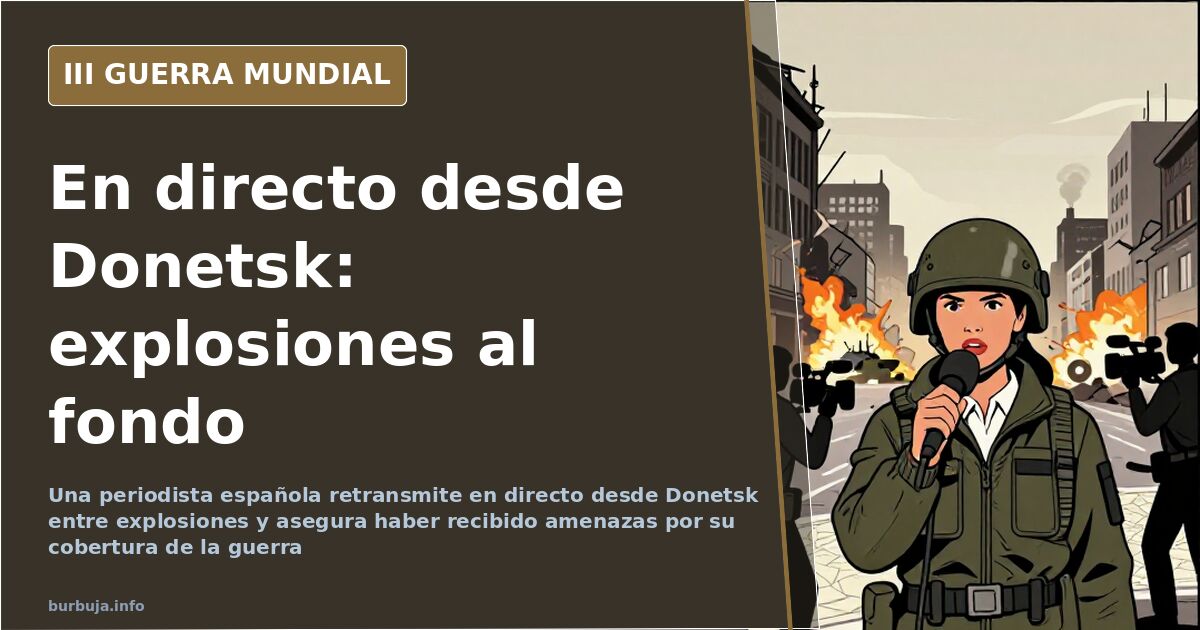
Live from Donetsk, amidst explosions
Explosions are heard in the distance. A Spanish journalist is broadcasting live from Donetsk with the front line as background noise, and within hours the stream shifts from a war report to another battlefield: that of public opinion. The background noise is literal. The pressure above it, too.
In that same broadcast, the journalist claimed that part of the Ukrainian audience threatened her for her coverage, with messages spread on social media. This is her account, aired on camera, but unverified by others. From there, the debate splits into two camps and refuses to close.
The threats she claims to have received
The narrative is forceful yet hard to verify with available evidence. According to what she said in a previous live stream, a sector of users allegedly sent sensual and violent threats, of a nature not worth reproducing here. It was stated, it went viral, and the focus shifted from bombings to messages.
Some argue that anything is possible in a country at war, confirming how high tensions run. Others suggest she may be exaggerating precisely to pressure critics. The lack of further proof fuels this doubt.
Here lies the core issue: the dispute isn't about facts, but the credibility of the narrator. In wartime, such debates rarely resolve.
Why does reporting from Donetsk spark so much suspicion?
Because in war, no neutral narrative satisfies everyone. Those reporting from the Russian side are labeled propagandists; those from the Ukrainian side, NATO mouthpieces. Suspicion falls not on what is reported, but where it is reported from. In a conflict where both sides weaponize information, escaping this trap is difficult.
A journalist on the ground reports what they see, but perspective depends on location. That is the underlying problem neither audience wishes to acknowledge.
Two narratives, one front
The fundamental complaint repeats on both sides: bias. In Spain, media are accused of selling Ukraine's virtues; these streams sell Russia's. The diagnosis is identical despite differing colors, containing an uncomfortable truth: neither narrative covers the whole war.
This leads to a gaining idea: keeping both versions handy, clearly identified, to avoid confusing truth with ideology. It is the quietest stance and, curiously, produces the fewest headlines.
Eight years of Donbas in the rearview
Much of the discussion anchors on a date: 2014. Until then, proponents argue, Ukraine enjoyed stability under Russian influence; after that, things changed. From this view, the eastern conflict didn't start with the invasion but carries eight years of bombing in the Donbas.
The counter-argument looks at neighbors who joined the EU, comparing them to the Russian orbit. Each chooses their mirror, resulting in a past-focused fight that doesn't change Donetsk's present.
Reception: admiration, distrust, hostility
Echoes of another Spanish journalist loom over the conversation. Each has an audience and faces consequences. Some recognize this journalist's courage for being in a war zone while others opine from sofas; others demand transparency on travel funding. Suspicions of interested sponsors behind each stream persist.
Amidst this, an uncomfortable current mixes curiosity with retribution: the idea that entering a hornet's nest invites stings, leaving no room for complaint. This victim-blaming persists, even if unclear whether harm occurred. But it is said loudly, sustaining much of the noise.
What remains when the noise fades
Some celebrate anyone willing to broadcast from the field without major network filters; others see every war-zone stream as shoulder-cam propaganda. Meanwhile, a Russian journalist protesting the war was fined 250 euros, according to data cited in the conversation.
On one side, protest costs a fine. On the other, broadcasting from a bombed city brings threats, she says. The accounts don't balance for anyone, and that is likely the clearest fact left behind by the background noise.
Explosions are heard in the distance. A Spanish journalist is broadcasting live from Donetsk with the front line as background noise, and within hours the stream shifts from a war report to another battlefield: that of public opinion. The background noise is literal. The pressure above it, too.
In that same broadcast, the journalist claimed that part of the Ukrainian audience threatened her for her coverage, with messages spread on social media. This is her account, aired on camera, but unverified by others. From there, the debate splits into two camps and refuses to close.
The threats she claims to have received
The narrative is forceful yet hard to verify with available evidence. According to what she said in a previous live stream, a sector of users allegedly sent sensual and violent threats, of a nature not worth reproducing here. It was stated, it went viral, and the focus shifted from bombings to messages.
Some argue that anything is possible in a country at war, confirming how high tensions run. Others suggest she may be exaggerating precisely to pressure critics. The lack of further proof fuels this doubt.
Here lies the core issue: the dispute isn't about facts, but the credibility of the narrator. In wartime, such debates rarely resolve.
Why does reporting from Donetsk spark so much suspicion?
Because in war, no neutral narrative satisfies everyone. Those reporting from the Russian side are labeled propagandists; those from the Ukrainian side, NATO mouthpieces. Suspicion falls not on what is reported, but where it is reported from. In a conflict where both sides weaponize information, escaping this trap is difficult.
A journalist on the ground reports what they see, but perspective depends on location. That is the underlying problem neither audience wishes to acknowledge.
Two narratives, one front
The fundamental complaint repeats on both sides: bias. In Spain, media are accused of selling Ukraine's virtues; these streams sell Russia's. The diagnosis is identical despite differing colors, containing an uncomfortable truth: neither narrative covers the whole war.
This leads to a gaining idea: keeping both versions handy, clearly identified, to avoid confusing truth with ideology. It is the quietest stance and, curiously, produces the fewest headlines.
Eight years of Donbas in the rearview
Much of the discussion anchors on a date: 2014. Until then, proponents argue, Ukraine enjoyed stability under Russian influence; after that, things changed. From this view, the eastern conflict didn't start with the invasion but carries eight years of bombing in the Donbas.
The counter-argument looks at neighbors who joined the EU, comparing them to the Russian orbit. Each chooses their mirror, resulting in a past-focused fight that doesn't change Donetsk's present.
Reception: admiration, distrust, hostility
Echoes of another Spanish journalist loom over the conversation. Each has an audience and faces consequences. Some recognize this journalist's courage for being in a war zone while others opine from sofas; others demand transparency on travel funding. Suspicions of interested sponsors behind each stream persist.
Amidst this, an uncomfortable current mixes curiosity with retribution: the idea that entering a hornet's nest invites stings, leaving no room for complaint. This victim-blaming persists, even if unclear whether harm occurred. But it is said loudly, sustaining much of the noise.
What remains when the noise fades
Some celebrate anyone willing to broadcast from the field without major network filters; others see every war-zone stream as shoulder-cam propaganda. Meanwhile, a Russian journalist protesting the war was fined 250 euros, according to data cited in the conversation.
On one side, protest costs a fine. On the other, broadcasting from a bombed city brings threats, she says. The accounts don't balance for anyone, and that is likely the clearest fact left behind by the background noise.
Also available in: Deutsch
Summary of a discussion on Burbuja.info - Foro de economía, actualidad y política., translated from Spanish and reviewed before publication. Read the full discussion (114 replies).
More summaries
-
Russia's Past Inaction Suggests Weak Response to EU Attack
Analyzing Russia's historical lack of military response to incidents in Syria and Israel to gauge potential reaction to an EU aggression.
-
Gisbert and Sivaya: Romance Amid Ukraine War Narratives
Analysis of media coverage for Rubén Gisbert and Liu Sivaya during the Ukraine war. Is this digital propaganda or reality?
-
Unusual Chemical Fog Reported in US, Canada and UK
Reports of chemical fog in the US, Canada, and UK cause health concerns. We analyze hypotheses on this unusual atmospheric phenomenon.
-
Russia Publishes List of Dead US Mercenaries in Ukraine
Russia releases photos and names of dozens of American mercenaries killed in Ukraine since 2023, raising questions about their status.
-
China’s African Debt Strategy Snubs Macron
Macron’s diplomatic snub highlights Africa’s shift toward Chinese financing, challenging Europe’s conditional aid and the CFA franc.
-
Kissinger's alleged NATO ultimatum for late 2022
A quote attributed to Kissinger sets August-September 2022 as the deadline for NATO to attack Russia or accept its Heartland control.