
China’s African Debt Strategy Snubs Macron
Macron’s diplomatic snub highlights Africa’s shift toward Chinese financing, challenging Europe’s conditional aid and the CFA franc.
English · Original discussion in Spanish · Published
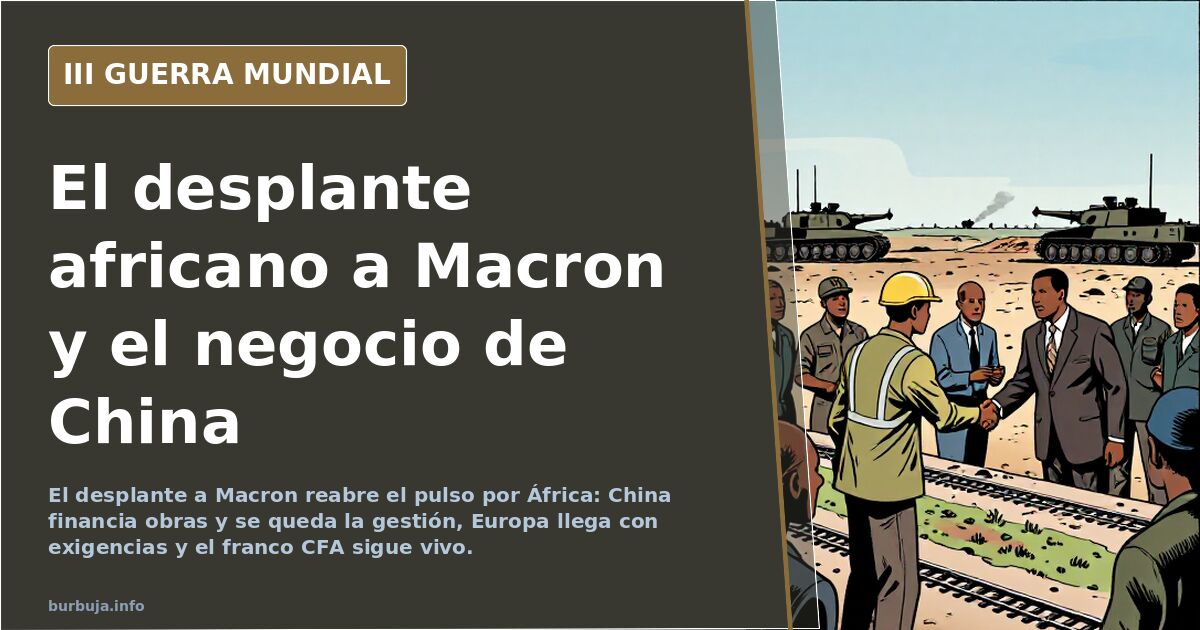
The Battle for Africa: China Buys, Europe Demands, Macron Rejected
An African leader publicly embarrassed Emmanuel Macron, confirming a fundamental shift: Africa no longer accepts scripts written in Paris. The incident revived the core comparison—partners offering credits and infrastructure versus those imposing conditions and lectures—and in this contest, Europe starts at a disadvantage. It is not about sympathy; it is about cash.
What China Offers and What It Takes in Return
The Chinese give nothing away. Even defenders of their method admit this. The difference lies in the deal's architecture: unlike Anglo-Saxon creditors who lend money, impose reforms, and then demand payment, Beijing directly finances infrastructure and, when partners cannot pay, takes over management of what was built. Materials and labor travel from China, leaving recipient countries with little more than transit tolls.
This fuels the dominant accusation: that this resembles control via debt rather than cooperation. Some call it a trap; others use a starker image: first they indebt you, then they lease your port. Defenders of Beijing cite two contextual facts: China became the world’s top trading economy without firing a shot, and its dollar reserves suffice to buy the continent multiple times without Washington’s permission.
Sri Lanka, Tanzania, and Zambia: The Cited Cases
The argument is not merely theoretical. Sri Lanka is the most cited example, where Chinese creditors are blamed for worsening the crisis, aided by local politicians—the Rajapaksa family—who were willing to play along. Chatham House analyses on the origins of the Ceylonese debacle are used to dismantle the kinder version of the Chinese narrative.
Africa provides its own examples. Tanzania appears due to a $10 billion loan signed in 2013 under President Jakaya Kikwete to build a port. Zambia and Tanzania have struggled for years with debt incurred for railways that failed to deliver as promised. The irony highlighted: Tanzanian President Magufuli, a chemistry doctor and skeptic of global health management, governed a country already trapped in this credit structure.
Is the CFA Franc Still Alive?
Yes, and for some analysts, this proves everything else is circus. The French colonial currency remains in circulation, tying part of Africa’s economic zone to Paris, with several countries’ reserves deposited at the Banque de France. From this perspective, sovereignty speeches and diplomatic snubs are mere gestures while the inherited financial architecture remains intact.
The uncomfortable question lingers: if the real yoke is monetary, what good is scolding a president at a press conference?
Europe Without a Project and the Alliance No One Tried
The other axis is Europe’s position, described by many as a partner that has abandoned its own policy. The prevailing thesis: there was an option to build a European-Russian axis positioning the continent as a major actor for the next century, but instead, confrontation and subordination to Anglo-Saxon interests were chosen. With that margin lost, Africa ceases to be a backyard and becomes a market where Europe competes without advantage.
Not everyone buys this framework. One school argues Africa’s problems originated not in Brussels or Paris, but in local power networks and structures established centuries ago by other empires—including the Arab-Sarracinic world. Those wanting to understand today’s map of bosses and tribes have plenty of literature to consult.
From Business to Migration Flows
Part of the discussion shifts to demographics and population movements: the continent faces a surplus of young people while Europe absorbs a portion of these displacements. The link between trade policy and migration pressure is formulated as a hypothesis, not a proven relationship. Positions range from demanding demographic counterweights from partners to reminding that those now complaining peine the doors.
This segment heats up the debate but offers few data points. When the discussion enters this territory, contract and tariff analysis turns into an exchange of accusations without figures.
Ultimately, the snub to Macron leaves a clear photo and an open question. Africa negotiates with whoever puts money on the table without asking for a certificate of good manners, while the West arrives late, carrying an outdated manual. Where this influence distribution ends—and what remains for Europe once the continent finishes choosing partners—is exactly where the analysis stalls.
An African leader publicly embarrassed Emmanuel Macron, confirming a fundamental shift: Africa no longer accepts scripts written in Paris. The incident revived the core comparison—partners offering credits and infrastructure versus those imposing conditions and lectures—and in this contest, Europe starts at a disadvantage. It is not about sympathy; it is about cash.
What China Offers and What It Takes in Return
The Chinese give nothing away. Even defenders of their method admit this. The difference lies in the deal's architecture: unlike Anglo-Saxon creditors who lend money, impose reforms, and then demand payment, Beijing directly finances infrastructure and, when partners cannot pay, takes over management of what was built. Materials and labor travel from China, leaving recipient countries with little more than transit tolls.
This fuels the dominant accusation: that this resembles control via debt rather than cooperation. Some call it a trap; others use a starker image: first they indebt you, then they lease your port. Defenders of Beijing cite two contextual facts: China became the world’s top trading economy without firing a shot, and its dollar reserves suffice to buy the continent multiple times without Washington’s permission.
Sri Lanka, Tanzania, and Zambia: The Cited Cases
The argument is not merely theoretical. Sri Lanka is the most cited example, where Chinese creditors are blamed for worsening the crisis, aided by local politicians—the Rajapaksa family—who were willing to play along. Chatham House analyses on the origins of the Ceylonese debacle are used to dismantle the kinder version of the Chinese narrative.
Africa provides its own examples. Tanzania appears due to a $10 billion loan signed in 2013 under President Jakaya Kikwete to build a port. Zambia and Tanzania have struggled for years with debt incurred for railways that failed to deliver as promised. The irony highlighted: Tanzanian President Magufuli, a chemistry doctor and skeptic of global health management, governed a country already trapped in this credit structure.
Is the CFA Franc Still Alive?
Yes, and for some analysts, this proves everything else is circus. The French colonial currency remains in circulation, tying part of Africa’s economic zone to Paris, with several countries’ reserves deposited at the Banque de France. From this perspective, sovereignty speeches and diplomatic snubs are mere gestures while the inherited financial architecture remains intact.
The uncomfortable question lingers: if the real yoke is monetary, what good is scolding a president at a press conference?
Europe Without a Project and the Alliance No One Tried
The other axis is Europe’s position, described by many as a partner that has abandoned its own policy. The prevailing thesis: there was an option to build a European-Russian axis positioning the continent as a major actor for the next century, but instead, confrontation and subordination to Anglo-Saxon interests were chosen. With that margin lost, Africa ceases to be a backyard and becomes a market where Europe competes without advantage.
Not everyone buys this framework. One school argues Africa’s problems originated not in Brussels or Paris, but in local power networks and structures established centuries ago by other empires—including the Arab-Sarracinic world. Those wanting to understand today’s map of bosses and tribes have plenty of literature to consult.
From Business to Migration Flows
Part of the discussion shifts to demographics and population movements: the continent faces a surplus of young people while Europe absorbs a portion of these displacements. The link between trade policy and migration pressure is formulated as a hypothesis, not a proven relationship. Positions range from demanding demographic counterweights from partners to reminding that those now complaining peine the doors.
This segment heats up the debate but offers few data points. When the discussion enters this territory, contract and tariff analysis turns into an exchange of accusations without figures.
Ultimately, the snub to Macron leaves a clear photo and an open question. Africa negotiates with whoever puts money on the table without asking for a certificate of good manners, while the West arrives late, carrying an outdated manual. Where this influence distribution ends—and what remains for Europe once the continent finishes choosing partners—is exactly where the analysis stalls.
Also available in: Deutsch
Summary of a discussion on Burbuja.info - Foro de economía, actualidad y política., translated from Spanish and reviewed before publication. Read the full discussion (114 replies).
More summaries
-
Francophone Africa Rebels Against Paris's CFA Franc
The CFA franc used by 14 African nations is faltering. Calculations attribute €440 billion annually to the system, with China and Russia joining the fray.
-
Russia rejects Macron’s plan to send peacekeepers to Ukraine
Russia insists it will not allow European troops in Ukraine as Macron seeks peacekeepers and Trump’s plan targets an 800-mile zone.
-
Belarus Turns from Putin to Xi for Protection
Lukashenko seeks Chinese military protection after a tense meeting with Putin. Russia loses its last European satellite as Beijing gains influence in the post-Soviet bloc.
-
Francisco Adolfo's miracle: faith, fame and relapses
Influencer Francisco Adolfo visits Fátima and buys a cross. Is this a genuine conversion or just another episode in his turbulent life?
-
Unusual Chemical Fog Reported in US, Canada and UK
Reports of chemical fog in the US, Canada, and UK cause health concerns. We analyze hypotheses on this unusual atmospheric phenomenon.
-
Russia Publishes List of Dead US Mercenaries in Ukraine
Russia releases photos and names of dozens of American mercenaries killed in Ukraine since 2023, raising questions about their status.