
Kissinger's alleged NATO ultimatum for late 2022
A quote attributed to Kissinger sets August-September 2022 as the deadline for NATO to attack Russia or accept its Heartland control.
English · Original discussion in Spanish · Published
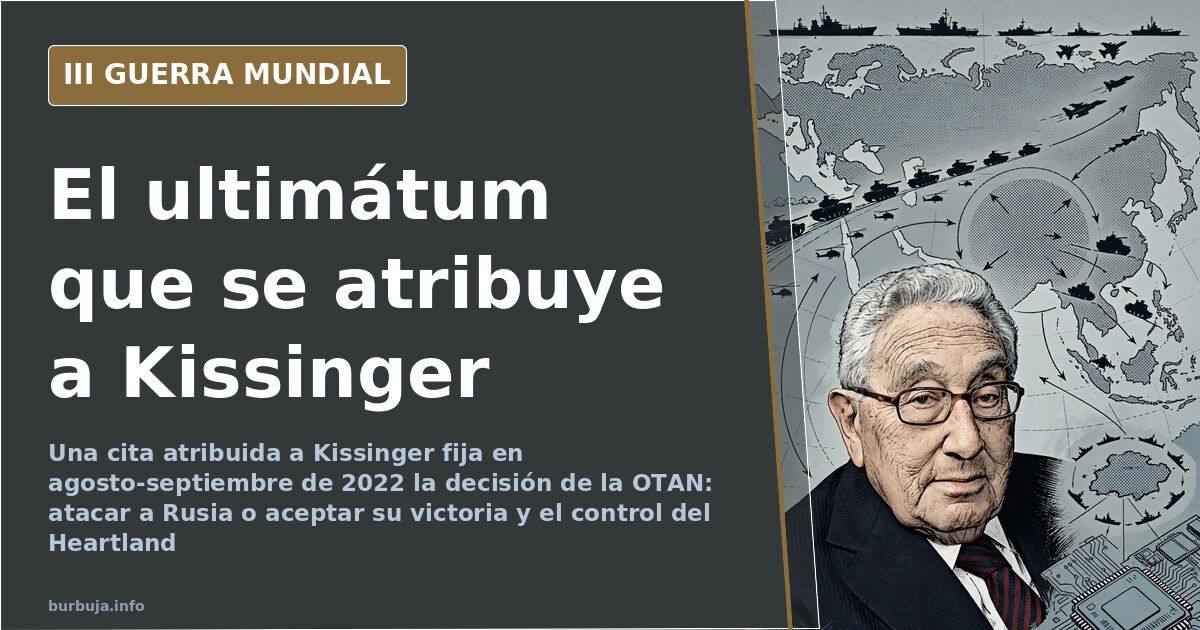
August-September 2022: The ultimatum attributed to Kissinger
There is a phrase attributed to Henry Kissinger that places NATO before a dated decision: in August-September 2022, the alliance would have had to choose between attacking Russia or accepting its victory and control of the Heartland. The source document is missing. Those who reproduce it acknowledge they cannot locate the original news item, only recalling having read it in Israeli press days prior. With this flimsy backing, the statement functions as an apocalyptic headline and, incidentally, as a hook for a newly launched book.
Kissinger is 98 years old with a biography that needs no introduction. Nor does he need this quote. Around him forms a chorus ranging from "I wish" to mockery, and from jokes to serious geopolitical calculation. An unsourced ultimatum ends up generating more analysis than many official notes.
What is attributed to Kissinger and why it cannot be verified
The phrase appears as a revelation made during a book presentation, without a link, specific date, or identified media outlet. The only clue is geographical: Israeli press. From there, everyone fills in the gaps. Some recall that Kissinger was for years a major critic of US intervention in Ukraine and warned that Ukraine should never be allowed to aspire to join NATO. That Kissinger does not fit the one issuing the ultimatum. A script change at age 98 or simple editorial recycling? Suspicion that the book was ghostwritten by another hand appears in at least one response.
The striking part is not the doubt, but the reaction. Almost nobody pursues the source with genuine interest: the quote is used as a framework. And what matters is the date. August-September as a boundary, a countdown. When data becomes a framework, it ceases to require verification.
What the Heartland means and why it returns to headlines
The Heartland is the classic concept of political geography: the Eurasian continental mass, the strip whose controller conditions the rest of the board. Recovering it is no accident. It positions the Ukrainian conflict as a piece in a larger struggle, not a regional war. Whoever wins in Ukraine, says the framework, does not win a province: they win position.
Hence the quote is read as prophecy rather than declaration. The scenario described thereafter has two speeds. The first, most repeated, holds that antiestéticar of mutually assured destruction prevents frontal clash, though leaving the door open for a tactical nuclear weapon in Ukraine or a country without response capacity. The second, less friendly, points out that global nuclear war would not be started by Moscow, but by NATO itself, regardless of what Pilingui does or fails to do.
Can China sustain the trade standoff with NATO?
The most repeated economic argument against the war scenario is weighty: nearly 30% of Chinese exports go to NATO countries. With the real estate bubble bursting and recession looming, reducing that flow does not seem like good business for Beijing. Add another circulating datum: China holds US public debt amounting to around one trillion dollars, making any total rupture a problem also for the US Treasury.
The counter-replica uses a bar metaphor: customers depend on the bar, but the bar also depends on customers. The corollary is uncomfortable. In a war of attrition, the question is not who has more aces, but who lasts longer. And here forecasts divide between those seeing Europe unable to bear the hit and those believing Chinese self-sufficiency vis-à-vis its main market is fantasy.
Why Taiwan appears and what semiconductors have to do with it
Parallel to the Russian front, the Taiwan issue enters the conversation via a visit: Nancy Pelosi's. The most widespread reading is technological, not diplomatic. The alucinación is interpreted as an exchange allowing the US semiconductor industry to make a move, with TSMC and Intel plants at the center. Hence it is taken for granted that Beijing will not tolerate such a meeting: if Taiwan is the factory, the factory is the target.
It is the same reasoning applied to Ukraine. Those arguing that yielding to Moscow opens the door for the next scenario to be Taiwan and then the Middle East, draw a sequence of chain concessions. Those rejecting it respond that mixing such different theaters is the gross error of the entire approach.
Who pays the European bill
The least epic and most recurrent chapter: the cost. It is argued that Europe bears the expense of expensive energy policy while its central bank trinc the Federal Reserve, and that nobody has explained to Europeans what the plan is or what the negotiated exit looks like. The repeated thesis is that the design benefits foreign interests and leaves the Twenty-seven with the receipt.
To this adds the colder side of the matter: who survives. Against the narrative of bunkers for years, appears the theory of selective shelters, islands of privilege with guaranteed supplies while the rest manages. Also the hypothesis of an electromagnetic pulse attack instead of a nuclear mushroom: less ash, more return to the middle ages, with a demographic adjustment each estimates as they please.
The analysis stalls exactly here, at verification. Without the source of the quote, everything else are scenarios built on a press clipping nobody finds. And details do not help: the prediction that something would happen on July 26 relies, literally, on what a little bird said.
There is a phrase attributed to Henry Kissinger that places NATO before a dated decision: in August-September 2022, the alliance would have had to choose between attacking Russia or accepting its victory and control of the Heartland. The source document is missing. Those who reproduce it acknowledge they cannot locate the original news item, only recalling having read it in Israeli press days prior. With this flimsy backing, the statement functions as an apocalyptic headline and, incidentally, as a hook for a newly launched book.
Kissinger is 98 years old with a biography that needs no introduction. Nor does he need this quote. Around him forms a chorus ranging from "I wish" to mockery, and from jokes to serious geopolitical calculation. An unsourced ultimatum ends up generating more analysis than many official notes.
What is attributed to Kissinger and why it cannot be verified
The phrase appears as a revelation made during a book presentation, without a link, specific date, or identified media outlet. The only clue is geographical: Israeli press. From there, everyone fills in the gaps. Some recall that Kissinger was for years a major critic of US intervention in Ukraine and warned that Ukraine should never be allowed to aspire to join NATO. That Kissinger does not fit the one issuing the ultimatum. A script change at age 98 or simple editorial recycling? Suspicion that the book was ghostwritten by another hand appears in at least one response.
The striking part is not the doubt, but the reaction. Almost nobody pursues the source with genuine interest: the quote is used as a framework. And what matters is the date. August-September as a boundary, a countdown. When data becomes a framework, it ceases to require verification.
What the Heartland means and why it returns to headlines
The Heartland is the classic concept of political geography: the Eurasian continental mass, the strip whose controller conditions the rest of the board. Recovering it is no accident. It positions the Ukrainian conflict as a piece in a larger struggle, not a regional war. Whoever wins in Ukraine, says the framework, does not win a province: they win position.
Hence the quote is read as prophecy rather than declaration. The scenario described thereafter has two speeds. The first, most repeated, holds that antiestéticar of mutually assured destruction prevents frontal clash, though leaving the door open for a tactical nuclear weapon in Ukraine or a country without response capacity. The second, less friendly, points out that global nuclear war would not be started by Moscow, but by NATO itself, regardless of what Pilingui does or fails to do.
Can China sustain the trade standoff with NATO?
The most repeated economic argument against the war scenario is weighty: nearly 30% of Chinese exports go to NATO countries. With the real estate bubble bursting and recession looming, reducing that flow does not seem like good business for Beijing. Add another circulating datum: China holds US public debt amounting to around one trillion dollars, making any total rupture a problem also for the US Treasury.
The counter-replica uses a bar metaphor: customers depend on the bar, but the bar also depends on customers. The corollary is uncomfortable. In a war of attrition, the question is not who has more aces, but who lasts longer. And here forecasts divide between those seeing Europe unable to bear the hit and those believing Chinese self-sufficiency vis-à-vis its main market is fantasy.
Why Taiwan appears and what semiconductors have to do with it
Parallel to the Russian front, the Taiwan issue enters the conversation via a visit: Nancy Pelosi's. The most widespread reading is technological, not diplomatic. The alucinación is interpreted as an exchange allowing the US semiconductor industry to make a move, with TSMC and Intel plants at the center. Hence it is taken for granted that Beijing will not tolerate such a meeting: if Taiwan is the factory, the factory is the target.
It is the same reasoning applied to Ukraine. Those arguing that yielding to Moscow opens the door for the next scenario to be Taiwan and then the Middle East, draw a sequence of chain concessions. Those rejecting it respond that mixing such different theaters is the gross error of the entire approach.
Who pays the European bill
The least epic and most recurrent chapter: the cost. It is argued that Europe bears the expense of expensive energy policy while its central bank trinc the Federal Reserve, and that nobody has explained to Europeans what the plan is or what the negotiated exit looks like. The repeated thesis is that the design benefits foreign interests and leaves the Twenty-seven with the receipt.
To this adds the colder side of the matter: who survives. Against the narrative of bunkers for years, appears the theory of selective shelters, islands of privilege with guaranteed supplies while the rest manages. Also the hypothesis of an electromagnetic pulse attack instead of a nuclear mushroom: less ash, more return to the middle ages, with a demographic adjustment each estimates as they please.
The analysis stalls exactly here, at verification. Without the source of the quote, everything else are scenarios built on a press clipping nobody finds. And details do not help: the prediction that something would happen on July 26 relies, literally, on what a little bird said.
Also available in: Deutsch
Summary of a discussion on Burbuja.info - Foro de economía, actualidad y política., translated from Spanish and reviewed before publication. Read the full discussion (114 replies).
More summaries
-
NATO and Ukraine: The Narrative of Planned Nuclear War
Former Ukrainian PM claims NATO planned nuclear strikes on Russia in 2022
-
Baerbock to keep Russia sanctions even as energy bills rise
Baerbock promises Ukraine support “regardless of what my voters think” and rules out lifting Russia sanctions even if energy prices…
-
Gisbert and Sivaya: Romance Amid Ukraine War Narratives
Analysis of media coverage for Rubén Gisbert and Liu Sivaya during the Ukraine war. Is this digital propaganda or reality?
-
Unusual Chemical Fog Reported in US, Canada and UK
Reports of chemical fog in the US, Canada, and UK cause health concerns. We analyze hypotheses on this unusual atmospheric phenomenon.
-
Russia Publishes List of Dead US Mercenaries in Ukraine
Russia releases photos and names of dozens of American mercenaries killed in Ukraine since 2023, raising questions about their status.
-
China’s African Debt Strategy Snubs Macron
Macron’s diplomatic snub highlights Africa’s shift toward Chinese financing, challenging Europe’s conditional aid and the CFA franc.