
Spanish home sales fall 9.8% for eighth straight month of declines
Home sales in Spain fell 9.8%, marking eight consecutive months of declines, but the comparison is against a record year not seen since 2008. Euribor, notarial fees and demographics all play a part.
English · Original discussion in Spanish · Published
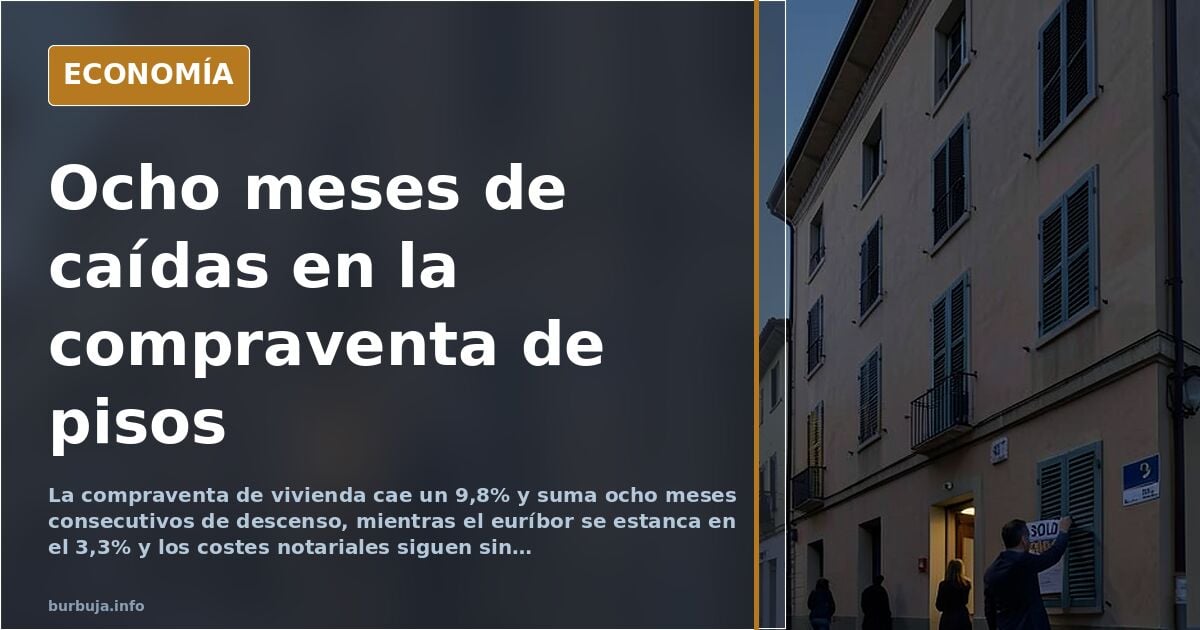
Home sales post eight straight months of decline: down 9.8%
Is the bubble bursting, or is it just the statistical rebound from an exceptional year? Home sales in Spain plunged 9.8%, marking eight consecutive months of declines, according to notarial data that opens up this debate. The headline is alarming. The fine print, considerably less so.
Because the starting point was anything but normal. The market was coming off a year with record sales since 2008, in the words of those who track the series. Against that base, a drop of nearly 10% leaves the market at levels that, seen in perspective, remain high. The classic trap: a chart of percentages without the absolute figures behind it.
The notarial fee and the certified copy that infuriate
Before the price per square metre, the anger is aimed at the bill for the paperwork. The complaint is specific: a mandatory process —checking for charges and signing the deed— with a cost many consider disproportionate, especially in the resale market, where the groundwork has already been done. On top of that comes the property registry, advisable though not always mandatory when there is no mortgage.
The fine irony: whether house prices are falling is up for debate while the notary's bill never budges. Market self-regulation, some say with a smirk.
Euribor, demographics and the land that can't be manufactured
The other front is the cost of financing. With Euribor at 3.3% and the feeling that it's there to stay, anyone who bought on a variable rate watches their monthly payment with a cold sweat. Most buyers, though, now sign fixed-rate deals, which softens the blow compared with 2007.
And then there's the argument that runs through everything: population. Spain has gone from 40 to nearly 50 million inhabitants, and some sum it up bluntly: without that growth, half the country would be waiting for homes given away with the yoghurt lids. Land is scarce where services exist; everywhere else, there's plenty to spare.
Will house prices fall as sales drop?
Not necessarily. Fewer transactions don't miccionan lower prices if supply shrinks at the same pace: little is being built, skilled workers are in short supply, and materials and regulations make every project more expensive. The result is a market that cools in volume but holds firm on price, with buyers sharing flats to make ends meet.
The full calculation, with sales figures and the demographic weight broken down, paints a picture that doesn't match the story of a collapse.
In the end, the question isn't whether the market regulates itself. It's who pays for the party when Euribor won't budge and the notary sends the bill.
Summary of a discussion on Burbuja.info - Foro de economía, actualidad y política., translated from Spanish and reviewed before publication. Read the full discussion (47 replies).
More summaries
-
Home sales in Vigo slump while prices keep climbing
Home sales in Vigo, Spain, fell 4% year on year while prices rose 8.8%. 200 new homes unsold and 15,000 derelict properties in Ourense.
-
Spain's housing sales plummet in March, notaries report
March data from Spain's notaries confirm a nationwide drop in home sales. Transaction volume is collapsing while prices hold out for now.
-
AI's Double Standard in Domestic Conflict Queries
AI assistants respond differently to domestic abuse queries based on gender, sparking debate over ideological bias versus statistical reflection.
-
Cantabria's white skies: contrails divide local residents
Skies over Cantabria and northern Spain dawn covered in contrails that widen for hours. The meteorological explanation clashes with suspicions of deliberate spraying.
-
Barcelona teacher's viral video exposes classroom reality
A Barcelona teacher laments that her classroom has become "hard to describe" and avoids naming immigration. The case reopens the debate over authority and the state of Spain's schools.
-
Spain's State engineers: capped pay and avoided critical posts
A forum debate argues that the capped salaries of Spain's State engineers and level-30 political advisers explain why the best candidates avoid responsibility.