
Spanish gas stations in Ourense warn they sell at a loss
Gas stations in Ourense, Spain, report selling fuel below cost due to zero margins and rising replacement prices.
English · Original discussion in Spanish · Published
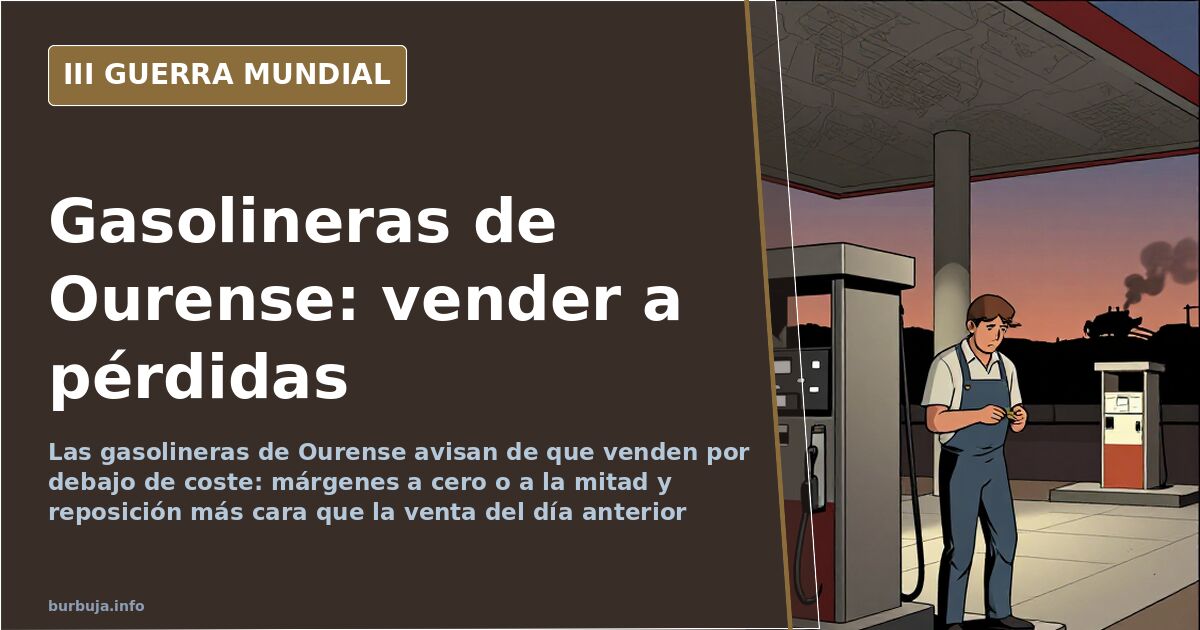
Galician gas stations warn: selling fuel now costs money
A business that for decades celebrated every rise in crude oil is now the first to raise its hand and say it cannot endure. Service stations in Ourense, Spain, claim they are selling below cost: margins have dropped to zero and, in many cases, to half. The president of their provincial association, Fara Pérez Bellido, explains without embellishment: the money made from fuel bought on a Monday does not cover restocking it at the next day's price. This is the last piece of a chain that has been creaking in Galicia due to fishing, energy-intensive industries, and the oil needed by canneries.
Selling at a loss: when the margin doesn't cover restocking
The mechanism is simple and devastating. A station buys today the fuel it will sell tomorrow; if the barrel price moves faster than the tank empties, the sale closes below what it will cost to replace it. With normal margins, this gap is absorbed; with zero margins, the business becomes a daily roulette. The sector attributes the problem to many operators having cut their margins to the minimum yet still failing to balance, because fixed costs do not drop when revenue shrinks. The warning is not a lament: it is a notice that the next step, if nothing changes, is supply restriction.
Why fuel gets more expensive even though oil is priced in dollars?
Because the price drivers see is in euros while oil is quoted in dollars, and there the arithmetic works against them. The euro traded above 1.5 dollars in July 2008 and is now almost at parity with the US currency: the same barrel costs more euros without the barrel moving. Volatility adds to this. When the market doesn't know where crude will be in two weeks, pumps hedge with risk premiums instead of waiting. Some argue that with the barrel denominated in euros, exchange rates wouldn't explain anything; the opposite scenario assumes prices would take time to fall even if crude collapsed.
Sanctions or war: where the crisis originates
The official narrative points to Russia's invasion of Ukraine. Much of the circulating analysis responds that the cause is not the conflict, but the economic sanctions the European Union has imposed on itself by cutting off Russian gas and oil, noting that while over sixty wars are open globally, these consequences are felt only here. The thesis completes with an uncomfortable calculation: if Brussels lifted restrictions, the energy bill would deflate, but alternative, more expensive supply already has signed contracts. Alongside this argument circulate readings about alleged dollar manipulation and depopulation plans that lack any proof.
Stocks bought months ago and speculation suspicion
Part of the analysis points to a detail that doesn't add up: the fuel served today was bought months ago at much lower prices, yet sold based on today's reference. Hence the accusation of pure and hard speculation: maintaining old stocks and billing them at current prices. The argument relies on a market antiestéticature, volatility, which allows fast rises and slow falls. The service station sector responds with the opposite: the money left by sales of previously bought fuel doesn't reach to restock at the next day's price.
The 50% of the price that is taxes: what changes and what doesn't
The Government waives half of what fuel owes to taxes, a measure that eases the final bill but doesn't touch the problem's structure. The question remains where the lost revenue will come from, and the suspicion, expressed bluntly, is that cuts will happen elsewhere. The underlying dispute isn't the liter price, but who pays the difference and what funding is sacrificed to pay it.
The Galician cascade: fishing, canning, and feed without oil
Galicia didn't reach this point just through fuel. The community accumulates broken links since the conflict began: the fishing fleet has stopped, energy-intensive industries halted production, essential oil for canneries is scarce, haulers warn of shortages, and farmers face a spring without feed. Each piece drags the next, and the service station is last in line: when trucks don't deliver, pumps run out of arguments.
With zero margins, intact sanctions, and the euro pegged to the dollar, the question is no longer how much gasoline will rise. It is how long a system can sustain itself where each link, from trawler to pump, claims to be losing money.
A business that for decades celebrated every rise in crude oil is now the first to raise its hand and say it cannot endure. Service stations in Ourense, Spain, claim they are selling below cost: margins have dropped to zero and, in many cases, to half. The president of their provincial association, Fara Pérez Bellido, explains without embellishment: the money made from fuel bought on a Monday does not cover restocking it at the next day's price. This is the last piece of a chain that has been creaking in Galicia due to fishing, energy-intensive industries, and the oil needed by canneries.
Selling at a loss: when the margin doesn't cover restocking
The mechanism is simple and devastating. A station buys today the fuel it will sell tomorrow; if the barrel price moves faster than the tank empties, the sale closes below what it will cost to replace it. With normal margins, this gap is absorbed; with zero margins, the business becomes a daily roulette. The sector attributes the problem to many operators having cut their margins to the minimum yet still failing to balance, because fixed costs do not drop when revenue shrinks. The warning is not a lament: it is a notice that the next step, if nothing changes, is supply restriction.
Why fuel gets more expensive even though oil is priced in dollars?
Because the price drivers see is in euros while oil is quoted in dollars, and there the arithmetic works against them. The euro traded above 1.5 dollars in July 2008 and is now almost at parity with the US currency: the same barrel costs more euros without the barrel moving. Volatility adds to this. When the market doesn't know where crude will be in two weeks, pumps hedge with risk premiums instead of waiting. Some argue that with the barrel denominated in euros, exchange rates wouldn't explain anything; the opposite scenario assumes prices would take time to fall even if crude collapsed.
Sanctions or war: where the crisis originates
The official narrative points to Russia's invasion of Ukraine. Much of the circulating analysis responds that the cause is not the conflict, but the economic sanctions the European Union has imposed on itself by cutting off Russian gas and oil, noting that while over sixty wars are open globally, these consequences are felt only here. The thesis completes with an uncomfortable calculation: if Brussels lifted restrictions, the energy bill would deflate, but alternative, more expensive supply already has signed contracts. Alongside this argument circulate readings about alleged dollar manipulation and depopulation plans that lack any proof.
Stocks bought months ago and speculation suspicion
Part of the analysis points to a detail that doesn't add up: the fuel served today was bought months ago at much lower prices, yet sold based on today's reference. Hence the accusation of pure and hard speculation: maintaining old stocks and billing them at current prices. The argument relies on a market antiestéticature, volatility, which allows fast rises and slow falls. The service station sector responds with the opposite: the money left by sales of previously bought fuel doesn't reach to restock at the next day's price.
The 50% of the price that is taxes: what changes and what doesn't
The Government waives half of what fuel owes to taxes, a measure that eases the final bill but doesn't touch the problem's structure. The question remains where the lost revenue will come from, and the suspicion, expressed bluntly, is that cuts will happen elsewhere. The underlying dispute isn't the liter price, but who pays the difference and what funding is sacrificed to pay it.
The Galician cascade: fishing, canning, and feed without oil
Galicia didn't reach this point just through fuel. The community accumulates broken links since the conflict began: the fishing fleet has stopped, energy-intensive industries halted production, essential oil for canneries is scarce, haulers warn of shortages, and farmers face a spring without feed. Each piece drags the next, and the service station is last in line: when trucks don't deliver, pumps run out of arguments.
With zero margins, intact sanctions, and the euro pegged to the dollar, the question is no longer how much gasoline will rise. It is how long a system can sustain itself where each link, from trawler to pump, claims to be losing money.
Also available in: Deutsch
Summary of a discussion on Burbuja.info - Foro de economía, actualidad y política., translated from Spanish and reviewed before publication. Read the full discussion (114 replies).
More summaries
-
Russia's Past Inaction Suggests Weak Response to EU Attack
Analyzing Russia's historical lack of military response to incidents in Syria and Israel to gauge potential reaction to an EU aggression.
-
Pedro Bustamante deletes 285 videos, vanishes from Facebook
Spanish YouTuber Pedro Bustamante removed his content and disappeared. Rumors place him in Munich, reading German press.
-
Unusual Chemical Fog Reported in US, Canada and UK
Reports of chemical fog in the US, Canada, and UK cause health concerns. We analyze hypotheses on this unusual atmospheric phenomenon.
-
Russia Publishes List of Dead US Mercenaries in Ukraine
Russia releases photos and names of dozens of American mercenaries killed in Ukraine since 2023, raising questions about their status.
-
China’s African Debt Strategy Snubs Macron
Macron’s diplomatic snub highlights Africa’s shift toward Chinese financing, challenging Europe’s conditional aid and the CFA franc.
-
Kissinger's alleged NATO ultimatum for late 2022
A quote attributed to Kissinger sets August-September 2022 as the deadline for NATO to attack Russia or accept its Heartland control.