
Runner, 24, dies at New York City Marathon after collapse
Rachel Apa died in NYC marathon after suspected rhabdomyolysis. Only 8 deaths among 1.3 million runners since 1970.
English · Original discussion in Spanish · Published
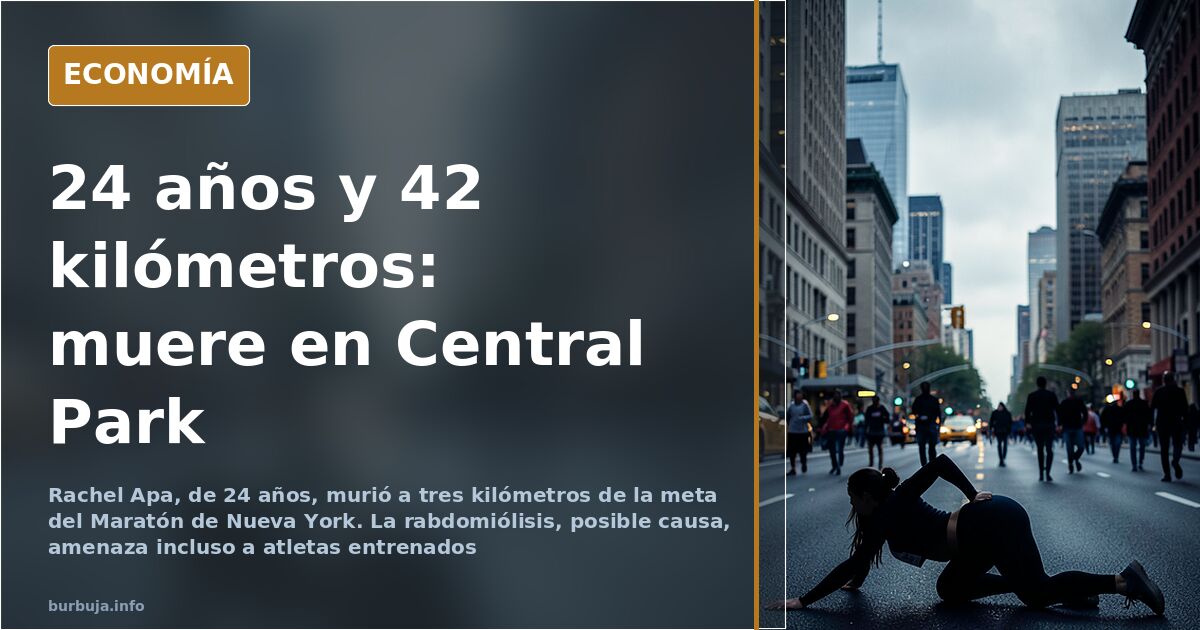
24-year-old runner dies three kilometers from finish line of New York City Marathon
Rachel Apa, aged 24, collapsed three kilometers from the Central Park finish line and died at Mount Sinai Hospital in New York after six hours of resuscitation efforts. She was no novice: a former field hockey player at Bucknell University who had trained for months, she ran in memory of her grandfather, who passed away from Parkinson's disease in 2022. At the ten-kilometer mark, she texted her father that she had never felt better. The most likely cause cited is rhabdomyolysis, the rapid breakdown of skeletal muscle that releases myoglobin, potassium, and creatine kinase into the bloodstream, potentially causing kidney failure.
The incident has reignited debate over whether popular marathons have crossed the threshold of reasonable risk, and whether statistics support panic or debunk it.
How many deaths actually occur in the New York City Marathon?
The data clarifies the situation: since 1970, with more than 1.3 million participants, the New York race has recorded eight fatalities, according to a tally circulating online. Eight deaths in half a century of an event with tens of thousands of annual runners.
On this basis, any calculation of risk per participant yields negligible figures. The problem is that statistics offer little comfort when the deceased is 24 years old and has a name. That is where the coldness of percentages breaks down.
Rhabdomyolysis: why muscles fail before willpower does
Rhabdomyolysis is not magic nor pure bad luck. When the body becomes dehydrated, it prioritizes sending limited blood supply to the heart, brain, and working muscles. Blood flow to the kidneys plummets. If muscle tissue also breaks down extensively, cellular debris clogs the renal filters, leading to acute insufficiency.
One factor worsens the profile: high-level athletes have developed muscle mass and extremely high pain tolerance. This same capacity to endure allows them to ignore warning signs when the body is already demanding a stop. Elite training teaches athletes not to listen; sometimes, that comes at a cost.
Marathon as extreme exercise: the debate on the extra kilometer
Two opposing views have emerged in the conversation. One argues that beyond one hour of aerobic exercise, additional performance subjects organs and joints to disproportionate stress, suggesting three weekly one-hour sessions are sufficient. The other notes that most runners crossing Central Park annually not only survive but return year after year.
What admits few nuances is the role of hydration and prior nutrition. Speculation has included carbohydrate loading without adequate water intake, taking anti-inflammatories before starting, and setting an overly ambitious initial pace. These are hypotheses, not diagnoses. One firm fact remains: she collapsed three kilometers from the end, not three from the start.
Pheidippides would approve of the thread. The legend of the soldier who supposedly died announcing the victory at Marathon was dubious from the start: Herodotus mentions a courier to Sparta, 240 kilometers in two days, not a death in the square. The modern race was built on a story that likely never peine.
Misapplied probability and the Madrid record
A classic statistical error appeared in the discussion: multiplying the probability of dying in one race by the number of races possible in a year, as if someone could chain 2,920 marathons without sleeping. The result is absurd, and the method worse.
Against the New York case, a local counterexample: some claim the Madrid Marathon, held since 1978, has recorded no runner deaths. This data has been used as an argument, though the comparison is flawed: course difficulty, climate, and participant volume are not comparable.
What remains is a discipline that moves tens of thousands of people each year, with very low mortality and a handful of tragic cases that defy simple statistical explanation. Whether rhabdomyolysis was the final cause will be determined by the investigation. Meanwhile, it is worth remembering that running 42 kilometers is not walking fast. And that preparation, however extensive, guarantees nothing.
Also available in: Deutsch
Summary of a discussion on Burbuja.info - Foro de economía, actualidad y política., translated from Spanish and reviewed before publication. Read the full discussion (73 replies).
More summaries
-
Central Park Penthouse Listed at $94M Amid Technical Concerns
A Central Park penthouse is listed for $94 million; forum users cite elevator failures, leaks, and structural noise issues in the building.
-
Medical cannabis arrives in Spanish hospitals
Curaleaf will supply CAN-1 and CAN-2 to around 50 clinics this week. Four approved indications and a specialist prescription are required to access the treatment.
-
Spain: Shoemaker commits suicide before eviction in Hospitalet
A 60-year-old shoemaker took his own life in Hospitalet, Spain, ahead of an eviction. Two related suicides reported in two weeks.
-
Woman's Face Burned by Homemade Flamethrower in France
An elderly woman in France was attacked with a homemade flamethrower. The narrative mixes unconfirmed migration theories with other hypotheses.
-
Spain's €72,000 death payout sparks outrage
Transport Minister Óscar Puente sets a €72,121 aid per victim. Critics compare this low figure to the €160,000-€200,000 cost of criminal manslaughter.
-
US Senate Control Hinges on Narrow Margin
Talarico and Peltola lead polls as Democrats eye Senate control, making Trump impeachment a real possibility.