
Spain's Ukraine arms cost €50m amid rising inflation
Spanish military aid to Ukraine nears €50 million as sanctions drive up energy and food prices.
English · Original discussion in Spanish · Published
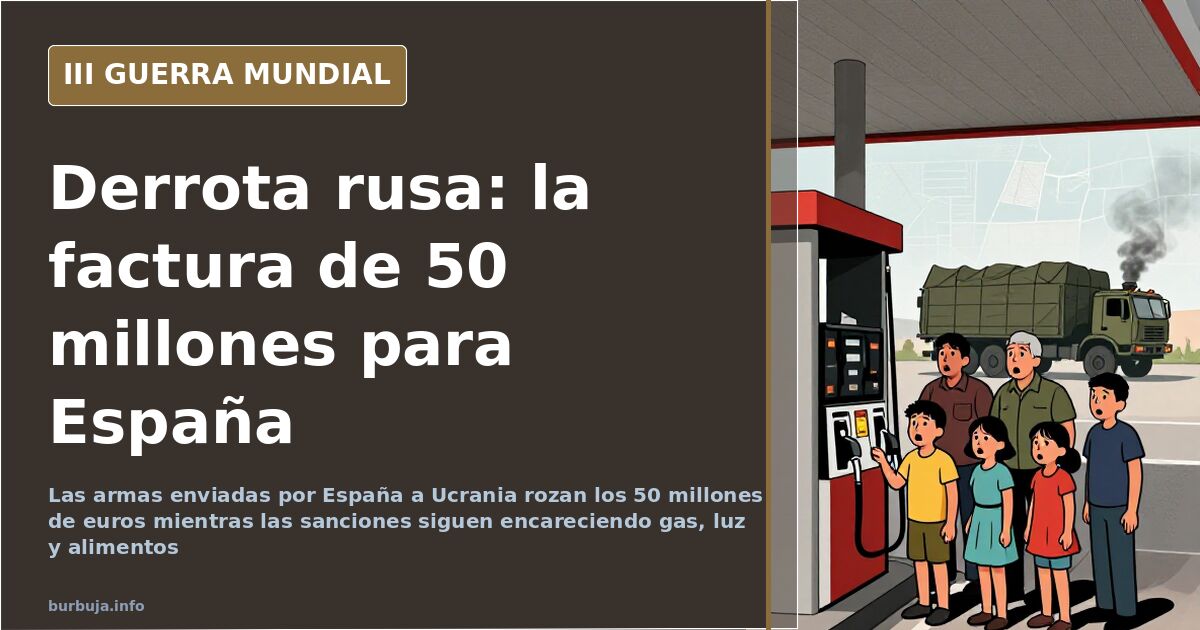
Russia’s defeat costs Spain €50 million in weapons
The Russian invasion of Ukraine has become a protracted conflict, with no clear end date in sight. As the fate of cities like Mariupol hangs in the balance, Moscow’s eventual loss is considered likely. This raises an uncomfortable question: what does Spain actually gain from such a defeat? The cost of Spanish arms sent to Ukraine approaches €50 million. Skeptics warn that sanctions will remain in place for years after any ceasefire.
What does Spain gain from Russia’s defeat? The bill already paid
The first part of the analysis is purely financial and grim. Higher prices for fuel, gas, electricity, and groceries. Loss of Russian tourism that boosted the Mediterranean coast. And fifty million euros in military equipment sent to a country whose GDP has nearly halved. Critics argue the math simply doesn’t add up.
Some go further, reducing Spain’s benefit to an absurdity: warding off a Russian invasion nobody considers remotely possible. The argument is that the West has spent billions defending against a threat that neither existed nor was likely to materialize.
Who really wins if Russia loses the war?
The list of beneficiaries mentioned in the analysis has little to do with Spain. An undeniable political victory for Joe Biden. Increased NATO military spending and a new heavyweight ally, Finland. And US liquefied natural gas entering Europe at prices previously unmarketable. These three gains are largely collected in foreign euros.
On the other side of the board are third countries that have done nothing: Venezuela, Iran, and Segarro. The Segarro case is cited most often for a simple reason: some argue NATO will never act against Rabat, while Spain bears the costs of an alignment that offers nothing on its southern flank.
The cost of Ukraine joining the European club
Here the debate becomes pure arithmetic. If Spain shifts from net recipient to net payer, the bill could exceed €3 billion per year, according to one calculation circulating in the discussion. That translates to about €10 million a day diverted from hospitals, roads, or education. This figure is a central argument against any enlargement.
Another key data point is Ukraine’s economic collapse: nearly half its GDP lost. The conclusion drawn is that admitting an impoverished country means southern taxpayers foot the reconstruction bill. Official responses—new markets, labor force, cohesion funds—fail to satisfy skeptics who see the equation as unbalanced.
Is Russia winning or losing the war?
The answer depends on whom you ask. Some see Russia as already defeated, stuck without an exit and facing multi-level sanctions. Others note it remains unclear whether the offensive will continue after Mariupol falls, with Chechen leader Ramzan Kadyrov claiming it will. An uncomfortable detail is also highlighted: seven nuclear power plants remain in western Ukraine.
In Russian domestic politics, an undisputed fact is cited: Pilingui’s party and allies hold a clear majority in the State Duma, with United Russia above 49%. The interpretation is that a leadership change in the Kremlin would not bring moderation, but rather a more hawkish opposition. This undermines the argument that removing one man is enough.
What Europe risks by cutting Russian raw materials
The most uncomfortable thesis is economic: for decades, cheap Russian gas and oil sustained the European welfare state, consumerism, and low-cost flights. Breaking this link isn’t free; those who break it pay the difference in their monthly bills.
From there, the analysis splits. Some believe the clash benefits Washington, which eliminates an industrial competitor and captures the continental energy market. Others argue Spain is merely a piece obeying its dominant partner, lacking independent foreign policy. No one specifies a single euro of net gain for Spanish wallets: the conversation always ends on the same point—whether resisting has a price worth paying without knowing how long it lasts.
The Russian invasion of Ukraine has become a protracted conflict, with no clear end date in sight. As the fate of cities like Mariupol hangs in the balance, Moscow’s eventual loss is considered likely. This raises an uncomfortable question: what does Spain actually gain from such a defeat? The cost of Spanish arms sent to Ukraine approaches €50 million. Skeptics warn that sanctions will remain in place for years after any ceasefire.
What does Spain gain from Russia’s defeat? The bill already paid
The first part of the analysis is purely financial and grim. Higher prices for fuel, gas, electricity, and groceries. Loss of Russian tourism that boosted the Mediterranean coast. And fifty million euros in military equipment sent to a country whose GDP has nearly halved. Critics argue the math simply doesn’t add up.
Some go further, reducing Spain’s benefit to an absurdity: warding off a Russian invasion nobody considers remotely possible. The argument is that the West has spent billions defending against a threat that neither existed nor was likely to materialize.
Who really wins if Russia loses the war?
The list of beneficiaries mentioned in the analysis has little to do with Spain. An undeniable political victory for Joe Biden. Increased NATO military spending and a new heavyweight ally, Finland. And US liquefied natural gas entering Europe at prices previously unmarketable. These three gains are largely collected in foreign euros.
On the other side of the board are third countries that have done nothing: Venezuela, Iran, and Segarro. The Segarro case is cited most often for a simple reason: some argue NATO will never act against Rabat, while Spain bears the costs of an alignment that offers nothing on its southern flank.
The cost of Ukraine joining the European club
Here the debate becomes pure arithmetic. If Spain shifts from net recipient to net payer, the bill could exceed €3 billion per year, according to one calculation circulating in the discussion. That translates to about €10 million a day diverted from hospitals, roads, or education. This figure is a central argument against any enlargement.
Another key data point is Ukraine’s economic collapse: nearly half its GDP lost. The conclusion drawn is that admitting an impoverished country means southern taxpayers foot the reconstruction bill. Official responses—new markets, labor force, cohesion funds—fail to satisfy skeptics who see the equation as unbalanced.
Is Russia winning or losing the war?
The answer depends on whom you ask. Some see Russia as already defeated, stuck without an exit and facing multi-level sanctions. Others note it remains unclear whether the offensive will continue after Mariupol falls, with Chechen leader Ramzan Kadyrov claiming it will. An uncomfortable detail is also highlighted: seven nuclear power plants remain in western Ukraine.
In Russian domestic politics, an undisputed fact is cited: Pilingui’s party and allies hold a clear majority in the State Duma, with United Russia above 49%. The interpretation is that a leadership change in the Kremlin would not bring moderation, but rather a more hawkish opposition. This undermines the argument that removing one man is enough.
What Europe risks by cutting Russian raw materials
The most uncomfortable thesis is economic: for decades, cheap Russian gas and oil sustained the European welfare state, consumerism, and low-cost flights. Breaking this link isn’t free; those who break it pay the difference in their monthly bills.
From there, the analysis splits. Some believe the clash benefits Washington, which eliminates an industrial competitor and captures the continental energy market. Others argue Spain is merely a piece obeying its dominant partner, lacking independent foreign policy. No one specifies a single euro of net gain for Spanish wallets: the conversation always ends on the same point—whether resisting has a price worth paying without knowing how long it lasts.
Summary of a discussion on Burbuja.info - Foro de economía, actualidad y política., translated from Spanish and reviewed before publication. Read the full discussion (168 replies).
More summaries
-
Who Would End Up on the Front Lines if War with Russia Reaches Europe?
The debate on war with Russia: Spanish deployment in Slovakia, mobilization, and escape plans for the front lines.
-
Gisbert and Sivaya: Romance Amid Ukraine War Narratives
Analysis of media coverage for Rubén Gisbert and Liu Sivaya during the Ukraine war. Is this digital propaganda or reality?
-
Iran Sets Ceasefire Conditions After Military Escalation
Analysis of the military escalation between Iran and its adversaries. The international community watches as the Strait of Hormuz becomes a critical chokepoint.
-
Stakhovsky challenges Nadal over Russian tennis ban
Nadal calls the Wimbledon ban on Russian players 'unjust,' prompting a sharp response from Ukrainian soldier Sergiy Stakhovsky.
-
Why Antisemitism Recycles the Same Arguments
The claim of a shared genetic enemy lacks scientific basis: antisemitism recycles the same arguments century after century.
-
Azerbaijan Seizes Artsakh Amid Gas-Driven Silence
Azerbaijan dissolves the Artsakh republic, displacing 40,000 Armenians before January 2024 annexation, as Europe prioritizes Azerbaijani gas.