
Spain's shops fortify ahead of October 31 looting calls
Shops in Valencia, Madrid and Bilbao are boarding up ahead of Halloween night. The alleged leader of Blocus has been arrested in Bilbao. The cost of security is mounting.
English · Original discussion in Spanish · Published
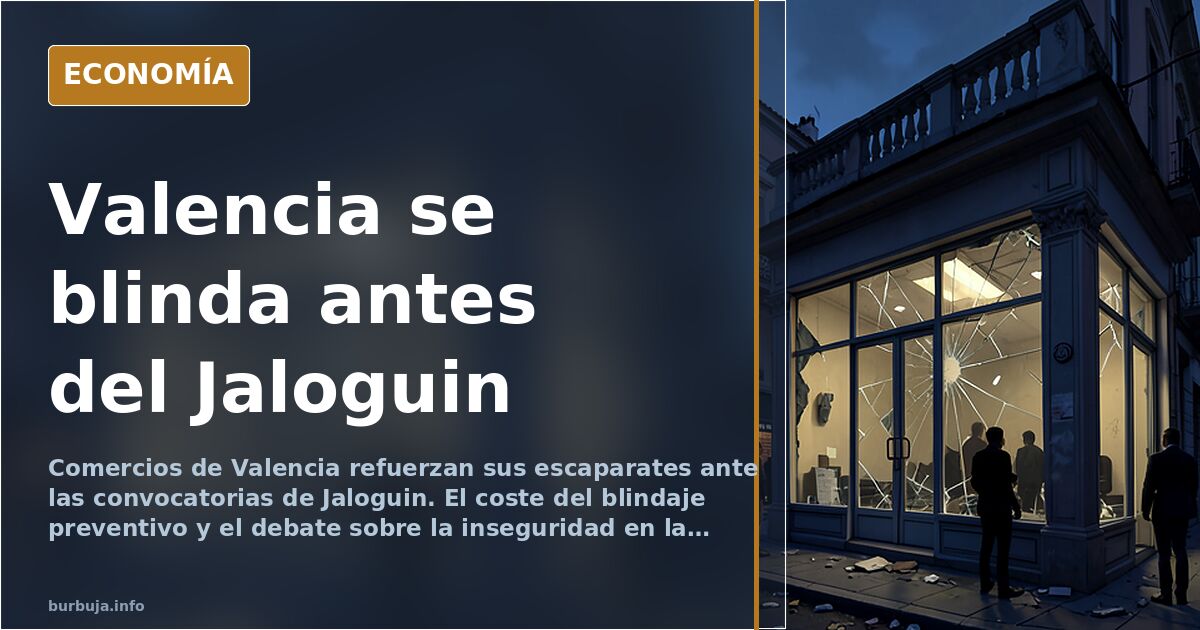
Shops fortify ahead of October 31: shutters coming down before closing time
In Valencia, Madrid, Bilbao and Turin, shopfronts are waking up to wooden boards and cameras pointed at the pavement. Calls for riots and looting on the night of October 31 have driven dozens of shops to fortify themselves as if it were a war zone. The phenomenon, spreading across several European cities, mixes alarm over the so-called "blocus" with the hangover from earlier riots and a growing sense that the state does not guarantee the safety of small businesses.
The scene repeats itself: metal shutters lowered in mid-afternoon, tape stretched across the windows, owners taking turns keeping watch. In Madrid, a MediaMarkt near Puerta del Sol began boarding up at 21:30. In Valencia, the messages circulating speak of "hunts" and a night that some already compare with the film The Purge. It is not a metaphor: some people miccionan it.
What lies behind the looting calls?
Authorities have arrested the alleged leader of Blocus in Bilbao, who was reportedly planning looting for Saturday and was using manuals from jihadist groups, according to published reports. The arrest, however, has not defused the alert: in France, more than 70,000 officers will be deployed in response to social media calls to loot. In Spain, police have arrested several people linked to the organisation, but the sense of impunity persists in some quarters.
The profile of those arrested varies. Some claim they are all "benefit recipients" and that the right has been warning about this for years; others point to a mix of youth precarity and social discontent. What is certain is that the calls have multiplied on social media and that shopkeepers have decided not to wait to find out whether the security forces arrive in time.
The cost of fortifying: a bill paid by small businesses
Fortifying a shopfront is not free. Between boards, acrylic sheeting, security tape and hours of surveillance, the outlay can run into thousands of euros for a medium-sized shop. And no insurance covers lost earnings from closing early. In a context of tight margins, the measure is a direct hit to the bottom line. Some business owners have opted to hire private security; others have simply not peine at all.
The question many are asking is why the state does not guarantee security. Some criticise the police for allegedly being ordered to look the other way so that chaos fills the streets — a theory circulating without solid evidence but which has taken hold among part of the business community. What is certain is that coordination between security forces and shops is conspicuous by its absence in many cities.
From Valencia to Turin: a European phenomenon
It is not just Spain. In Turin, "students" caused riots again; in Hamburg, shopkeepers are preparing for a "peaceful" demonstration. The wave of youth and social protests, driven by Generation Z and organised through social media, has several governments on alert. The so-called "Blocus" combines rejection of educational precarity with anger over the cost of living.
In Spain, things are complicated by the rail accident and its political handling. Some analyses suggest the government has preferred to neutralise the radicals rather than admit that the country cannot afford another night of riots. The general strike announced by the opposition for the coming days adds more fuel to the fire.
What happens to those arrested and the court measures?
Justice is moving at a snail's pace. A 20-year-old arrested in the Basque Country has been released on provisional liberty without bail. In Deusto, officers left the police station leaving weapons inside, according to published reports. Riots in Bilbao are all but guaranteed. The sense that the state is failing at the basics — protecting shops, maintaining order — is spreading among those who see each night of riots as a small death of the real economy.
Meanwhile, shopkeepers do the maths. The full calculation, with fortification costs, lost earnings and the impact on insurance premiums, produces a figure many cannot afford to pay twice. The night of October 31 will pass, but the economic hangover will remain on the balance sheets.
In the end, the question is not whether there will be riots, but how many shops will be able to afford to open the next day. And that is a bill nobody wants to pay.
Also available in: Deutsch
Summary of a discussion on Burbuja.info - Foro de economía, actualidad y política., translated from Spanish and reviewed before publication. Read the full discussion (89 replies).
More summaries
-
Madrid shops board up windows amid Halloween looting threats
Shops in Madrid, Bilbao, Palma and Valencia are boarding up their windows in response to looting calls spread on social media for Halloween.
-
Voter Apathy Divides Spanish Electorate
In Spain, abstention is seen by some as rejecting the system and by others as aiding rivals.
-
Train crashes in Spain: sabotage or neglected maintenance
Two fatal crashes in one year have broken the AVE's spotless record. The cyber sabotage theory clashes with years of underinvestment in the safety system.
-
Identifying 'haters' with public money: what La Gaceta claims
A tweet from La Gaceta claims Spain's government is funding studies to identify 'haters' on social media. With no figure or rule cited, the debate is already about dictatorship.
-
Red Eléctrica blocks maintenance at over 100 Spanish facilities as grid strains
Red Eléctrica, Spain's grid operator, has reportedly blocked maintenance of more than 100 facilities amid high unavailability of combined-cycle plants, according to circulating data.
-
Protests in 34 cities as Germany's Gen Z takes to the streets this Saturday
Around 160,000 people signed up online for Saturday's marches across Germany, which demand more funding for education and reject military service.