
Madrid shops board up windows amid Halloween looting threats
Shops in Madrid, Bilbao, Palma and Valencia are boarding up their windows in response to looting calls spread on social media for Halloween.
English · Original discussion in Spanish · Published
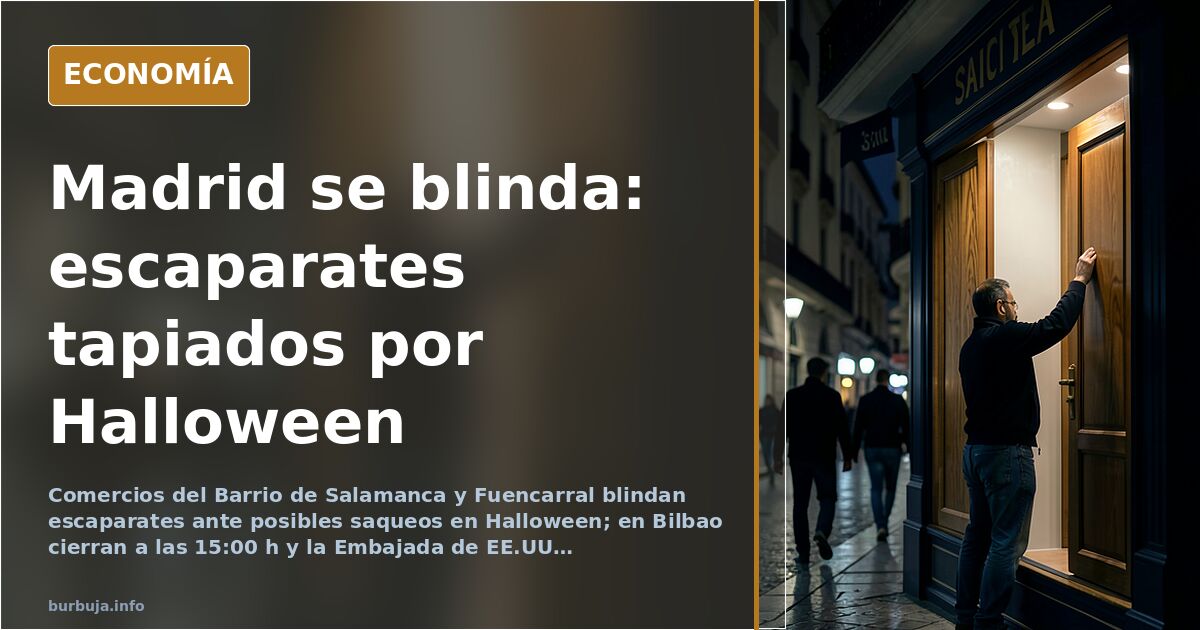
Madrid boards up its shop windows ahead of Halloween looting threat
What happens when a looting call spreads on social media and shops in central Madrid wake up with their shutters covered? That is what peine in the days before Halloween: stores in the Salamanca district — home to luxury brands like Celine or Gucci — and on Fuencarral street installed protections on windows and entrances for antiestéticar of riots like those in Barcelona. The scene was repeated in Bilbao, Girona, Palma and Valencia. This is not a crime report: it is the picture of a city preparing for the worst while the official narrative speaks of normality.
From Barcelona to Madrid: the shop-protection drive spreads
Messages circulating on channels such as Blocus and other like-minded groups called for looting over the weekend. The response did not come from the police, but from the shopkeepers themselves: **they board up their businesses** with planks and reinforce entrances. In Bilbao, many establishments decided to close from 3:00 pm. In Palma, FNAC also appeared protected. The uncomfortable question hanging in the air: why should small and medium-sized businesses bear the cost of protecting themselves instead of those responsible for security?
How many riot police has the Government mobilised?
The figure circulating is **200 riot police** for the whole of Spain, a deployment considered insufficient by various analysts. Some argue that the Government has prioritised Barcelona over Madrid, sending twice as many officers to Catalonia. The comparison is no small matter: if the threat looms over the capital, the sense of dereliction of duty is the most repeated argument. The US embassy issued an alert about demonstrations, adding a layer of international unease.
The business of looting: what gets stolen and why?
The sharpest analysis to be drawn is that of the profitability of plunder. **iPhones and similar devices can be remotely blocked**, making them an absurd target. Jewellery and luxury clothing require an organised market to fence the loot, and gold-buying shops are closely watched. What sense does it make to raid a Swarovski store or a Mercadona? The answer suggested is symbolic: looting as a gesture, not as a business. Meanwhile, small businesses pay the price.
The shadow of the train accident
Lurking in the background is the suspicion that the riots serve to divert media attention. The rail accident with **69 dead** — a figure mentioned in the conversation — is pushed into the background if the front pages talk about looting. It is not a far-fetched theory: the timing coincidence is a classic of political communication. What is unclear is whether the Government wins or loses from that shift of focus.
In the end, the image that remains is that of a city fortifying itself. Shopkeepers are not waiting for instructions: they act. And while some talk of a purge and others of dereliction, Madrid's shop windows remain covered. The question is not whether there will be riots, but how much the aftermath will cost to clean up.
Also available in: Deutsch
Summary of a discussion on Burbuja.info - Foro de economía, actualidad y política., translated from Spanish and reviewed before publication. Read the full discussion (47 replies).
More summaries
-
Spain's shops fortify ahead of October 31 looting calls
Shops in Valencia, Madrid and Bilbao are boarding up ahead of Halloween night. The alleged leader of Blocus has been arrested in Bilbao. The cost of security is mounting.
-
Sol Campout: Elite Spokespeople and Suspicions of Manipulation
Spokespeople for the Sol campout against the housing crisis reportedly attended United World College and Comillas, according to disseminated data.
-
Red Eléctrica blocks maintenance at over 100 Spanish facilities as grid strains
Red Eléctrica, Spain's grid operator, has reportedly blocked maintenance of more than 100 facilities amid high unavailability of combined-cycle plants, according to circulating data.
-
Protests in 34 cities as Germany's Gen Z takes to the streets this Saturday
Around 160,000 people signed up online for Saturday's marches across Germany, which demand more funding for education and reject military service.
-
Ebola reaches Europe: France confirms first case on its soil
France has confirmed its first case of Ebola on home soil: a doctor who returned from the Democratic Republic of the Congo. The outbreak has so far caused 1,094 cases and 277 deaths.
-
J. M. de Prada: They are apes, but above all hyenas
A column by J. M. de Prada accuses Spanish minister Óscar Puente of leaking a rail traffic controller's conversations after the Urda accident. The piece compares the minister to an ape and a hyena.