
Red Eléctrica blocks maintenance at over 100 Spanish facilities as grid strains
Red Eléctrica, Spain's grid operator, has reportedly blocked maintenance of more than 100 facilities amid high unavailability of combined-cycle plants, according to circulating data.
English · Original discussion in Spanish · Published
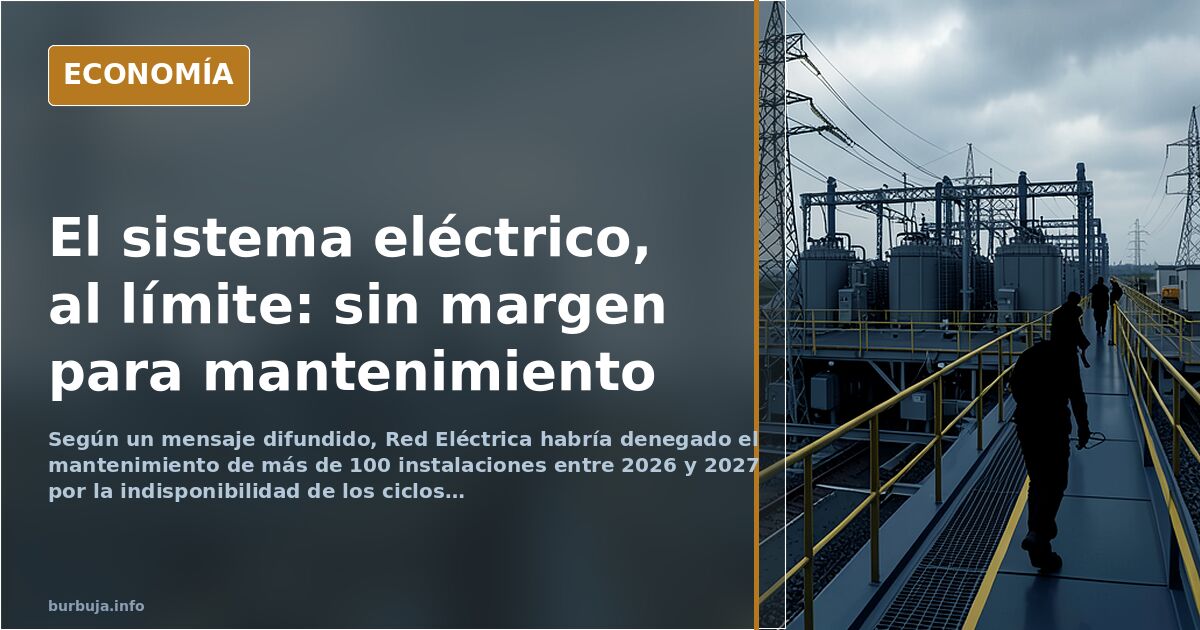
Red Eléctrica blocks maintenance at over 100 power plants amid blackout risk
Could Spain go dark again? The question has been circulating for days on social media and forums, fueled by a piece of data that, if true, describes a system on the brink of collapse: Red Eléctrica, Spain's electricity grid operator, has reportedly refused to approve maintenance plans for more than 100 facilities —nuclear, combined-cycle and pumped-storage plants— between October 2026 and September 2027. The reason, according to the same sources, would be the high unplanned unavailability of combined-cycle plants, with up to 35% of capacity out of service.
If confirmed, the figure is no operational anecdote. It is a snapshot of a generation fleet aging without replacement and a grid that can no longer afford the luxury of shutting down a turbine for maintenance. The underlying message is uncomfortable: better that it works badly than that it doesn't work at all.
What it means when a plant's maintenance is denied
In technical terms, Red Eléctrica's approval is the permit to take a facility off the grid and repair it. Denying it amounts to telling the operator to cope as best it can. Applied to more than a hundred facilities for an entire year, the result is a fleet operating beyond its intended service life with an increasingly thin reserve margin.
The argument most often repeated in the analyses is that of historical underinvestment: the system lives off infrastructure built half a century ago, designed for a population and a demand that no longer exist. Demographics are tightening —a population of around 55 million is mentioned, growing by nearly a million a year— and the infrastructure is not keeping up.
The partial blackouts already happening
Beyond the rumor of a general blackout, there is a phenomenon that several accounts describe as everyday: outages lasting minutes or hours affecting specific neighborhoods or lines, with no official explanation. The practice is known in the industry as load shedding: when demand threatens to overwhelm supply, entire sections are sacrificed before the whole system goes down.
The problem is who bears the sacrifice. With industry there is a prior agreement; with household supply, there is not. And that is where the risk nobody wants to put at the center emerges: homes with life-support equipment that depend on the grid without any backup power of their own.
Housing, trains and the grid's bottleneck
The issue connects with another underlying economic debate. Some argue that grid saturation is already holding back new housing developments in specific areas, because there is no capacity to guarantee supply. If confirmed, the problem stops being an energy issue and becomes a housing supply issue.
The comparison with rail transport comes up repeatedly: the idea that infrastructure conceived for another century is managed with crisis-driven criteria and no room for scheduled maintenance. The analogy is easy and somewhat misleading, but it illustrates the pattern.
How much truth is there in the blackout rumor
It is worth separating two things: the real strain on the system and the prediction of a total blackout. The former has signs —blocked maintenance, high unavailability, partial outages—. The latter is, for now, a hypothesis circulating without official confirmation, mixing technical data with theories about sabotage and electoral coincidences that have no verifiable backing.
The full calculation of how much capacity is actually available, broken down facility by facility, is the missing figure — and the one most conspicuously absent from all the noise.
In the end, the question is not whether there will be a blackout, but how much longer a system that no longer dares to switch anything off, for antiestéticar it will not come back on, can hold out.
Also available in: Deutsch
Summary of a discussion on Burbuja.info - Foro de economía, actualidad y política., translated from Spanish and reviewed before publication. Read the full discussion (83 replies).
More summaries
-
Spain's grid operator restarts nuclear plants after blackout
After the blackout, only 1.4 GW of Spain's 7 GW nuclear capacity was running while renewables covered 75% of generation, according to figures in circulation
-
Spain's grid operator asks power plants not to shut down, even for maintenance
A tweet from Xataka reports that Red Eléctrica, Spain's grid operator, is asking power plants not to stop, even for maintenance. The debate quickly jumps from kilowatts to the electoral calendar.
-
Nuclear Power: High Costs, Waste Issues, and Grid Collapse
Spain's grid faces collapse as nuclear power sparks debate: €10 billion per reactor, centuries of waste, and 90% connection rejections.
-
Spain dating ad demands money and no questions about four kids
A dating ad in Spain asks for a partner with money, flowers and zero questions about four children. The detail that turns it into an economics story rather than a joke.
-
Train crashes in Spain: sabotage or neglected maintenance
Two fatal crashes in one year have broken the AVE's spotless record. The cyber sabotage theory clashes with years of underinvestment in the safety system.
-
Identifying 'haters' with public money: what La Gaceta claims
A tweet from La Gaceta claims Spain's government is funding studies to identify 'haters' on social media. With no figure or rule cited, the debate is already about dictatorship.