
Spain's SEPE collapses: impossible appointments and broken websites
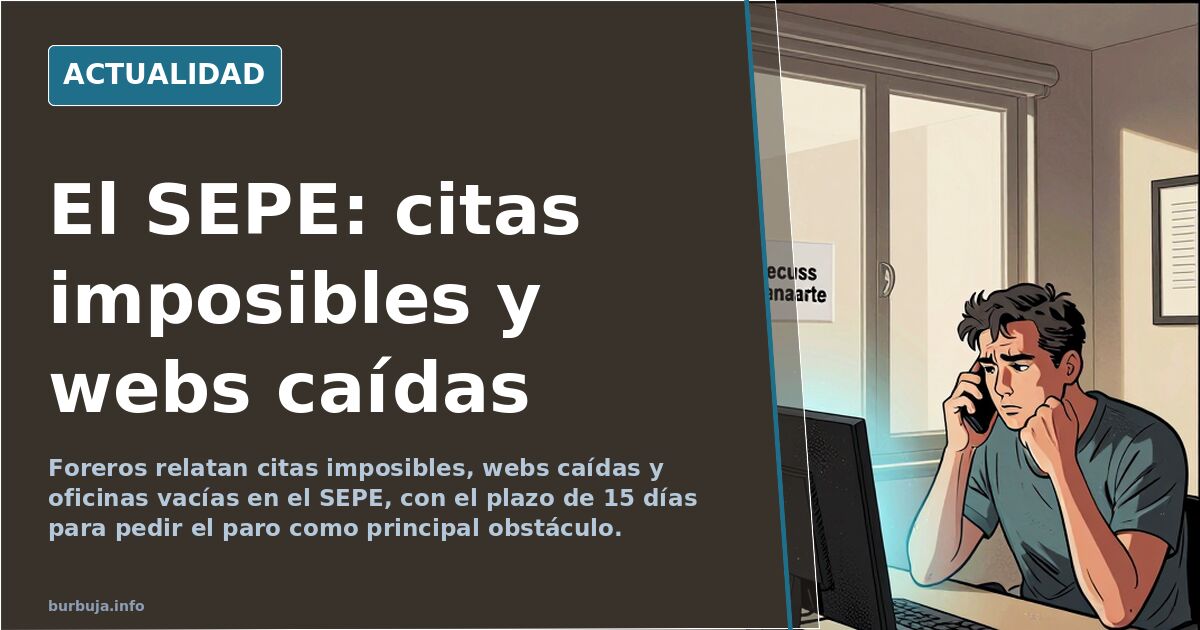
Users report impossible appointments, crashed sites, and empty offices at Spain's SEPE, with the 15-day deadline for unemployment claims as a major obstacle.
English · Original discussion in Spanish · Published
Spain's SEPE collapses: impossible appointments and broken websites
Getting an appointment at the SEPE (Spain's Public Employment Service) within the legal 15-day window is practically impossible across much of the country, according to forum users. The paradox is that while offices appear deserted, the few available slots vanish in seconds, with some claiming external apps capture them for resale. Users argue this leaves citizens unprotected despite paying taxes, losing benefits due to system failures.
The issue goes beyond lack of appointments. The agency’s website frequently crashes, is confusing, and antiestéticatures unreadable captchas and failing authentication methods, say affected individuals. One user gave up on booking online because the site wouldn’t recognize their bank details despite correct entry, leaving them without unemployment pay. Phone support, when available, offers no solution either.
Appointments as access barriers
Pre-booked appointments have become a bottleneck for all Spanish public agencies, users note. At the SEPE, new slots are released from midnight Monday to Friday, according to those who succeeded. In Seville, single-district booking works with availability in most of the province’s 34 offices; in Madrid, it’s nearly impossible. This regional disparity doesn’t depend on the user.
Some suggest connecting at 00:00 and refreshing to grab next-day slots. Others recommend calling 060 between 9 am and 2 pm on weekdays to report issues. Neither tactic is official nor listed on the SEPE website. Citizens must discover workarounds themselves to access rights.
Digital certificates and permanent keys fail too
Digitization is presented as the alternative but fails similarly. Digital certificates cause browser-specific issues, and the permanent key requires a Social Security appointment, which can be harder than getting one at the SEPE. One user activated their key and digital signature at the Tax Agency without an appointment in a single day—the only thing that worked amid the chaos.
Intermittent contract workers suffer most. The system often blocks online benefit reactivation, throwing errors as if they were on temporary layoffs (ERTE). Eventually, in-person visits are required. One intermittent worker managed phone reactivation for months but couldn’t do it online in June, with no phone appointments available for twenty days, though in-person slots existed in another municipality.
Empty offices and unhelpful staff
Scenarios repeat: offices with twenty desks where only three staff serve queues waiting hours, only to be told to return another day with documents. Some suspect few appointments are given to allow laziness. Another recalls when two people shouted complaints, forcing supervisors to deploy all staff, clearing the queue in twenty minutes.
Outsourcing tasks to citizens is total, critics say. Individuals do officials’ work, paying triple: through taxes, time, and travel costs. Some must travel to neighboring towns due to saturation, covering expenses themselves. If paperwork is mishandled, benefits are lost.
Problem isn't new: Larra documented it
The “come back tomorrow” attitude depicted by writer Larra in the 19th century persists, says a participant. With experience in two state and two regional agencies, they describe evolution: 25 years ago, things were slow but done well; six years ago at the General Treasury of Social Security, requests took months ignored. Incompetence and repeated explanations dominate.
Private security at SEPE entrances makes sense, observers note, due to dubious job-seekers frequenting offices. But guards don’t solve root problems. Pre-booked appointments brilliantly eliminated unemployment queues, ironically noted—perhaps deserving a Nobel Prize.
Training course traps and phantom programs
SEPE advertises free training courses not held for over three years, reports a user. Providers informed the agency, but SEPE hasn’t updated info, still receiving inquiries. Half the courses are awarded; the other half don’t exist. Negligence becomes active policy, critics argue.
Meanwhile, U1 forms must go by regular mail, not email, per participants. Bureaucracy protects itself. And citizens needing money face severe hardship. The question isn’t whether the system fails, but how many fall through unnoticed.
Getting an appointment at the SEPE (Spain's Public Employment Service) within the legal 15-day window is practically impossible across much of the country, according to forum users. The paradox is that while offices appear deserted, the few available slots vanish in seconds, with some claiming external apps capture them for resale. Users argue this leaves citizens unprotected despite paying taxes, losing benefits due to system failures.
The issue goes beyond lack of appointments. The agency’s website frequently crashes, is confusing, and antiestéticatures unreadable captchas and failing authentication methods, say affected individuals. One user gave up on booking online because the site wouldn’t recognize their bank details despite correct entry, leaving them without unemployment pay. Phone support, when available, offers no solution either.
Appointments as access barriers
Pre-booked appointments have become a bottleneck for all Spanish public agencies, users note. At the SEPE, new slots are released from midnight Monday to Friday, according to those who succeeded. In Seville, single-district booking works with availability in most of the province’s 34 offices; in Madrid, it’s nearly impossible. This regional disparity doesn’t depend on the user.
Some suggest connecting at 00:00 and refreshing to grab next-day slots. Others recommend calling 060 between 9 am and 2 pm on weekdays to report issues. Neither tactic is official nor listed on the SEPE website. Citizens must discover workarounds themselves to access rights.
Digital certificates and permanent keys fail too
Digitization is presented as the alternative but fails similarly. Digital certificates cause browser-specific issues, and the permanent key requires a Social Security appointment, which can be harder than getting one at the SEPE. One user activated their key and digital signature at the Tax Agency without an appointment in a single day—the only thing that worked amid the chaos.
Intermittent contract workers suffer most. The system often blocks online benefit reactivation, throwing errors as if they were on temporary layoffs (ERTE). Eventually, in-person visits are required. One intermittent worker managed phone reactivation for months but couldn’t do it online in June, with no phone appointments available for twenty days, though in-person slots existed in another municipality.
Empty offices and unhelpful staff
Scenarios repeat: offices with twenty desks where only three staff serve queues waiting hours, only to be told to return another day with documents. Some suspect few appointments are given to allow laziness. Another recalls when two people shouted complaints, forcing supervisors to deploy all staff, clearing the queue in twenty minutes.
Outsourcing tasks to citizens is total, critics say. Individuals do officials’ work, paying triple: through taxes, time, and travel costs. Some must travel to neighboring towns due to saturation, covering expenses themselves. If paperwork is mishandled, benefits are lost.
Problem isn't new: Larra documented it
The “come back tomorrow” attitude depicted by writer Larra in the 19th century persists, says a participant. With experience in two state and two regional agencies, they describe evolution: 25 years ago, things were slow but done well; six years ago at the General Treasury of Social Security, requests took months ignored. Incompetence and repeated explanations dominate.
Private security at SEPE entrances makes sense, observers note, due to dubious job-seekers frequenting offices. But guards don’t solve root problems. Pre-booked appointments brilliantly eliminated unemployment queues, ironically noted—perhaps deserving a Nobel Prize.
Training course traps and phantom programs
SEPE advertises free training courses not held for over three years, reports a user. Providers informed the agency, but SEPE hasn’t updated info, still receiving inquiries. Half the courses are awarded; the other half don’t exist. Negligence becomes active policy, critics argue.
Meanwhile, U1 forms must go by regular mail, not email, per participants. Bureaucracy protects itself. And citizens needing money face severe hardship. The question isn’t whether the system fails, but how many fall through unnoticed.
Also available in: Deutsch
Summary of a discussion on Burbuja.info - Foro de economía, actualidad y política., translated from Spanish and reviewed before publication. Read the full discussion (126 replies).
More summaries
-
Rumors Suggest Spanish PM Sánchez May Step Aside
Online rumors claim Pedro Sánchez is considering not running, with PSOE looking at Bolaños, Cuerpo or García-Page as potential successors.
-
Spain launches Entry-Exit System with Australian traveler
Spain's new biometric border control system, the EES, officially launched. The first registered entry was an Australian citizen at an airport.
-
French Hospital Rape Video Revealed as Movie Clip
A viral video alleging rape under anesthesia in a French hospital was actually a scene from the film Ça arrive, not real testimony.
-
La Manada Pamplona case: debate over verdict
The La Manada Pamplona case continues to spark debate. Some question the rape conviction citing a video as proof of consent, while the justice...
-
Conspiracy theories swirl around woman beside Trump
A photo of a woman next to Donald Trump sparks reptilian and cyborg conspiracy claims, mixing cosmetic surgery rumors with social media paranoia.
-
Spanish bar coffee: torrefacto, boiling water and up to 15% sugar
Spanish bar coffee is roasted with up to 15% sugar, served boiling from dirty machines. That’s why it tastes like ash yet costs specialty prices.