
Spanish bar coffee: torrefacto, boiling water and up to 15% sugar
Spanish bar coffee is roasted with up to 15% sugar, served boiling from dirty machines. That’s why it tastes like ash yet costs specialty prices.
English · Original discussion in Spanish · Published
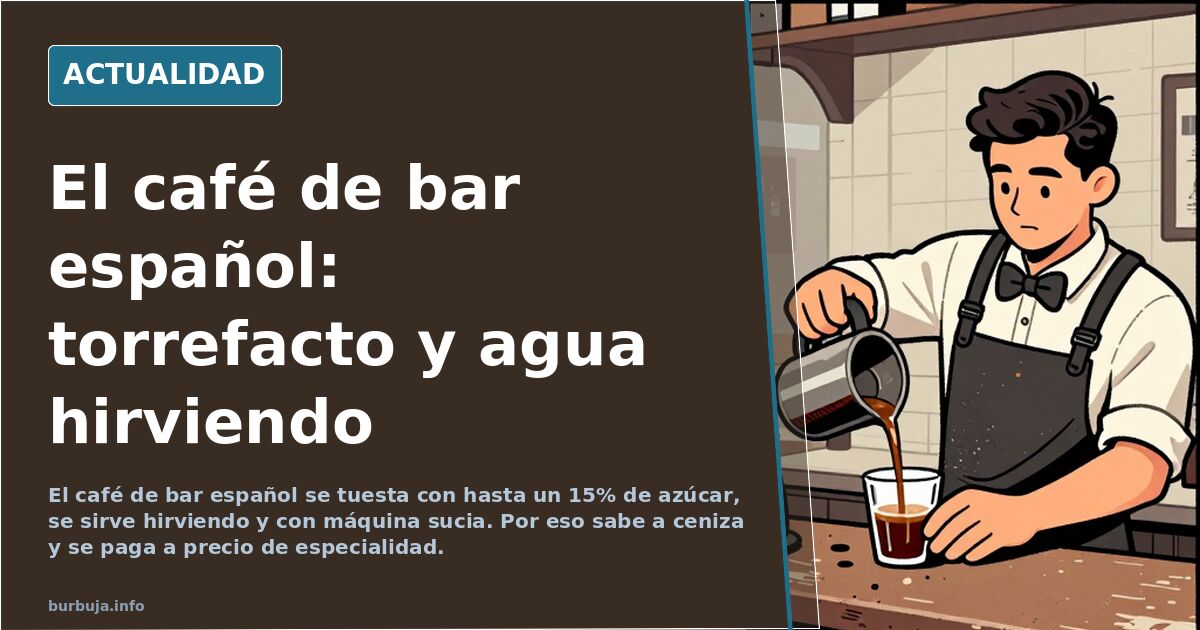
Why Spanish bar coffee tastes like ash
You rush in, order a coffee, and get handed a steaming cup you can’t even touch. Ten minutes later it’s still scorching, and when you finally dare to sip, it tastes like burnt sugar and ash. This isn’t bad luck or a waiter having an off day: it’s a system. The complaint that opens the issue is simple and recognizable —the infamous ultra-burnt coffee tasting of ash, served boiling at gold-standard prices— but behind it lies a chain of industrial decisions explaining why Spanish bar coffee is, with respect to Italians, one of the worst in Western Europe.
The key has a name: torrefacto. The coffee served in most Spanish bars isn’t naturally roasted; it’s beans roasted with sugar. According to calculations circulating online, the law allows adding up to 15% sugar during roasting, a practice that cheapens the product and masks bean quality. The cheapest variety, robusta, is used and roasted to the limit so bitterness covers what’s underneath. The result is a dark brew needing a whole packet of sugar to be drinkable.
What is torrefacto coffee and why is it served in almost all bars
Torrefacto isn’t a coffee variety: it’s a roasting method. During processing, sugar is added to the beans, which caramelizes and forms the shiny, dark layer characteristic of Spanish bar coffee. The original goal was economic: using low-quality beans and some burnt sugar created a full-bodied, bitter product that disguised deficiencies in the base coffee. In Spain, it became standard after the post-war period, when coffee was scarce and mixed with chicory. That habit never went away.
In Italy, the word torrefazione simply means roasting, without added sugar. There, coffee develops its own natural sugars during roasting and is served for one euro even in Venice. Here, however, torrefacto is the norm and natural roasting the exception. Anyone ordering a plain espresso in a Spanish bar expecting clean aroma encounters flat, burnt bitterness only masked by milk or sugar.
Boiling water and dirty machines: the other two sins
The second problem is temperature. Coffee is served boiling, not hot. Defenders argue it cools in the cup for longer enjoyment; sufferers reply that boiling water burns the coffee and drags out bitter compounds, leaving a metallic, ashy taste. Pressure extraction with overly hot water and poor filtration produces stronger coffee, yes, but also dirtier.
The third factor is the machine. Daily circuit cleaning isn’t done in most establishments, according to online discussions. Water carries minerals and residues, and if the group head isn’t purged with each shot nor the portafilter brushed between extractions, flavor gets contaminated. Technical recommendations are clear: purge without portafilter, clean portafilter, grind fresh. Three gestures almost nobody performs.
What specialty coffee professionals say
Against torrefacto, a movement advocating specialty coffee has consolidated. Those working in this sector call bar coffee burnt rubber and insist everything non-specialty should be avoided. The argument is that palates educate themselves: anyone trying a single-origin natural roast with its distinct notes rarely returns to torrefacto. Practically, more people now drink coffee at home with capsules or their own grinder, having stopped ordering it at bars.
Meanwhile, hospitality has no incentive to change. If customers order café con leche, cortado, or carajillo —drinks where milk and sugar mask bean flavor— establishments can serve cheap torrefacto without protest. Coffee prices have risen, and some venues switched to lower-quality brands to maintain margins, per online comments. Rising raw material costs pushed quality down, not up.
Coffee as a chore: the morning caffeine hit culture
One current rejects the entire debate. For part of consumers, morning coffee isn’t a gastronomic experience: it’s a chore. It wakes you up and makes you go to the bathroom, period. From that logic, demanding aroma and natural roast is urban fashion. Bar coffee is strong, bitter, and cheap, fulfilling its function. Anyone wanting something else pays extra.
That resignation explains torrefacto’s survival. There’s no mass demand for change, and without demand, no pressure on supply. Complaining consumers are a minority; those ordering sugared cortados without asking form the silent majority. Until that equation breaks, Spanish bar coffee remains what it is: a product designed to hide flaws, not showcase them.
The final paradox is that Spain prides itself on gastronomy yet fails at basics. A country capable of serving the world’s best ham closes meals with coffee tasting of ashtrays. And pays specialty prices for it. What’s disorienting isn’t bad coffee existing: it’s decades of ordering and paying for it without anyone moving a bean.
You rush in, order a coffee, and get handed a steaming cup you can’t even touch. Ten minutes later it’s still scorching, and when you finally dare to sip, it tastes like burnt sugar and ash. This isn’t bad luck or a waiter having an off day: it’s a system. The complaint that opens the issue is simple and recognizable —the infamous ultra-burnt coffee tasting of ash, served boiling at gold-standard prices— but behind it lies a chain of industrial decisions explaining why Spanish bar coffee is, with respect to Italians, one of the worst in Western Europe.
The key has a name: torrefacto. The coffee served in most Spanish bars isn’t naturally roasted; it’s beans roasted with sugar. According to calculations circulating online, the law allows adding up to 15% sugar during roasting, a practice that cheapens the product and masks bean quality. The cheapest variety, robusta, is used and roasted to the limit so bitterness covers what’s underneath. The result is a dark brew needing a whole packet of sugar to be drinkable.
What is torrefacto coffee and why is it served in almost all bars
Torrefacto isn’t a coffee variety: it’s a roasting method. During processing, sugar is added to the beans, which caramelizes and forms the shiny, dark layer characteristic of Spanish bar coffee. The original goal was economic: using low-quality beans and some burnt sugar created a full-bodied, bitter product that disguised deficiencies in the base coffee. In Spain, it became standard after the post-war period, when coffee was scarce and mixed with chicory. That habit never went away.
In Italy, the word torrefazione simply means roasting, without added sugar. There, coffee develops its own natural sugars during roasting and is served for one euro even in Venice. Here, however, torrefacto is the norm and natural roasting the exception. Anyone ordering a plain espresso in a Spanish bar expecting clean aroma encounters flat, burnt bitterness only masked by milk or sugar.
Boiling water and dirty machines: the other two sins
The second problem is temperature. Coffee is served boiling, not hot. Defenders argue it cools in the cup for longer enjoyment; sufferers reply that boiling water burns the coffee and drags out bitter compounds, leaving a metallic, ashy taste. Pressure extraction with overly hot water and poor filtration produces stronger coffee, yes, but also dirtier.
The third factor is the machine. Daily circuit cleaning isn’t done in most establishments, according to online discussions. Water carries minerals and residues, and if the group head isn’t purged with each shot nor the portafilter brushed between extractions, flavor gets contaminated. Technical recommendations are clear: purge without portafilter, clean portafilter, grind fresh. Three gestures almost nobody performs.
What specialty coffee professionals say
Against torrefacto, a movement advocating specialty coffee has consolidated. Those working in this sector call bar coffee burnt rubber and insist everything non-specialty should be avoided. The argument is that palates educate themselves: anyone trying a single-origin natural roast with its distinct notes rarely returns to torrefacto. Practically, more people now drink coffee at home with capsules or their own grinder, having stopped ordering it at bars.
Meanwhile, hospitality has no incentive to change. If customers order café con leche, cortado, or carajillo —drinks where milk and sugar mask bean flavor— establishments can serve cheap torrefacto without protest. Coffee prices have risen, and some venues switched to lower-quality brands to maintain margins, per online comments. Rising raw material costs pushed quality down, not up.
Coffee as a chore: the morning caffeine hit culture
One current rejects the entire debate. For part of consumers, morning coffee isn’t a gastronomic experience: it’s a chore. It wakes you up and makes you go to the bathroom, period. From that logic, demanding aroma and natural roast is urban fashion. Bar coffee is strong, bitter, and cheap, fulfilling its function. Anyone wanting something else pays extra.
That resignation explains torrefacto’s survival. There’s no mass demand for change, and without demand, no pressure on supply. Complaining consumers are a minority; those ordering sugared cortados without asking form the silent majority. Until that equation breaks, Spanish bar coffee remains what it is: a product designed to hide flaws, not showcase them.
The final paradox is that Spain prides itself on gastronomy yet fails at basics. A country capable of serving the world’s best ham closes meals with coffee tasting of ashtrays. And pays specialty prices for it. What’s disorienting isn’t bad coffee existing: it’s decades of ordering and paying for it without anyone moving a bean.
Also available in: Deutsch
Summary of a discussion on Burbuja.info - Foro de economía, actualidad y política., translated from Spanish and reviewed before publication. Read the full discussion (123 replies).
More summaries
-
Why Spanish Restaurants Are Rare Abroad
Forum users cite high costs, lack of emigration, and poor branding as reasons for the scarcity of Spanish dining abroad.
-
Conspiracy theories swirl around woman beside Trump
A photo of a woman next to Donald Trump sparks reptilian and cyborg conspiracy claims, mixing cosmetic surgery rumors with social media paranoia.
-
Ayuso Cancels Mexico Trip Amid Diplomatic Tensions
We analyze the cancellation of Isabel Díaz Ayuso's tour in Mexico: political strategy, diplomatic tension, or expulsion? Join the debate.
-
Spain: Phone addiction dominates public spaces
In Spain, excessive smartphone use in public raises concerns about social detachment and behavioral dependency.
-
Man stabbed over early morning laundry in Spain
A young man stabbed his flatmate in Móstoles, Spain, following a dispute about the noise of a washing machine running at night.
-
Parking on Crosswalk: Confronting Drivers Can Be Risky
A viral video shows two women parking on a crosswalk and confronting a passerby. The debate highlights the fine versus the risk of false accusations.