
Spain launches Entry-Exit System with Australian traveler
Spain's new biometric border control system, the EES, officially launched. The first registered entry was an Australian citizen at an airport.
English · Original discussion in Spanish · Published
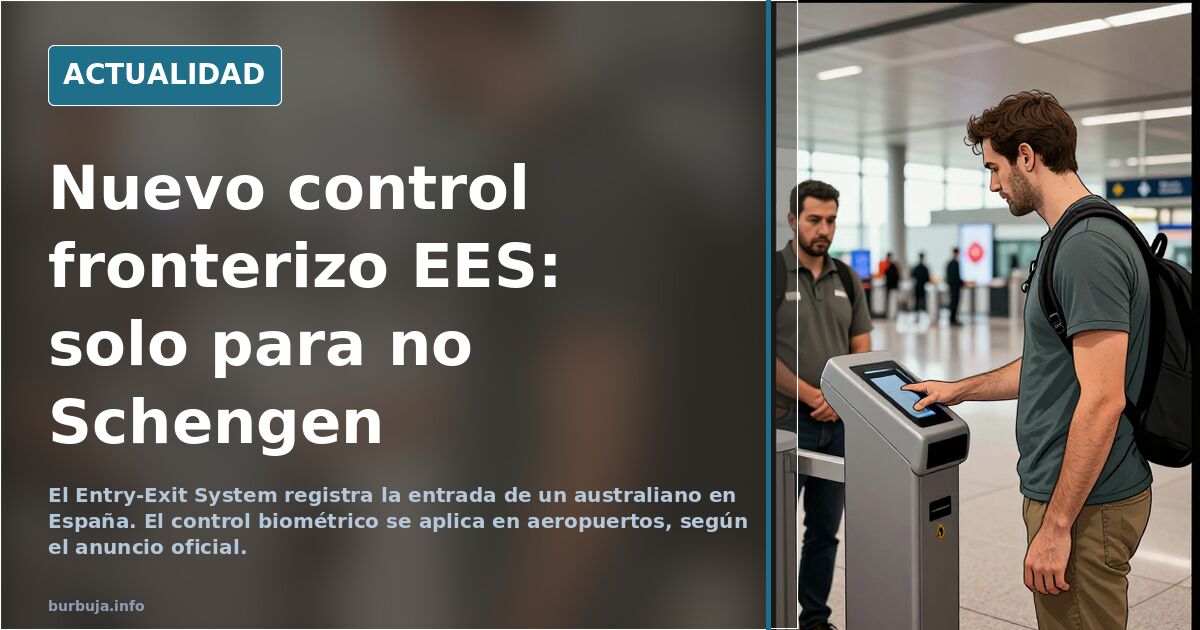
EES debuts in Spain with Australian as first user
What is the point of a border control system that only sees those entering through the front door? The Ministry of Interior announced the implementation of the Entry-Exit System (EES) with a message celebrating its first traveler: an Australian citizen who entered Spain via the new procedure. The National Police and technical team were presented as the architects of a system that, according to the official tweet, will be fully operational by April 2026. In principle, this news represents administrative pogre: biometric registration, fingerprinting, and digital control of entries and exits for non-Schengen citizens. In practice, however, the announcement sparked a debate far beyond technology.
What the EES is and who it actually controls
The Entry-Exit System is the new European mechanism for registering non-EU travelers. It replaces manual passport stamping with electronic records containing biometric data. The goal is to know who enters, when, and crucially, when they leave. Critics argue the main problem is that the system only covers authorized crossings. Those arriving by plane and passing through control are recorded. Those arriving by other means are not.
This is the core of the discontent. Some analyses suggest the EES is a Lite version of migration control: it works at Barajas, El Prat, or airports with international flights, but not along the coasts. The lingering question is simple: what use is registering an Australian tourist if most irregular immigration enters where there are no machines?
The contradiction nobody denies: controlling those who arrive legally
The most repeated argument concerns asymmetry. The traveler who meets requirements—visa, fees, insurance, booking—passes through the biometric scanner. The one who does not meet them enters via the beach. Several messages summarize this with irony: you have to be a fool to come legally when an alternative paperless route exists. This irony is not technical analysis, but it highlights a real paradox: the system reinforces control over those already willing to submit to it.
Some go further, pointing to business interests. The awarding of machine contracts, software maintenance, and integration with police systems involve public tenders. Suspicions of commissions and directed awards appear in various messages, always as suspicion, never as proven fact. What is verifiable is that the EES implies considerable technological expenditure and its effectiveness depends on the rest of the borders functioning equally well.
Expired visas and subsequent regularization
The second major block of criticism targets the subsequent use of data. If the EES records entry and exit, it should detect those staying beyond their visa period. Several messages celebrate this possibility: with digitization, the first electronic payment or mobile call would reveal the irregular migrant. Others view this as naive. The reason: mass regularizations based on arraigo (social roots) do not require proving when one entered, but how long one has been here. And that time can precisely be certified by the system itself.
The paradox is uncomfortable. A mechanism designed to detect irregular stays may end up serving as proof of residence to regularize those who stayed. The data generated by the system is the same; the political interpretation is opposite.
The borders the EES ignores
The third front is geographic. The announcement mentions airports, but irregular immigration in Spain has two main gates: the Strait and the Canary Islands. There are no biometric machines there. There are boats, cayucos, and rescues. Comparisons with the Gibraltar border, where controls have existed for years, appear in the conversation as evidence that the system is not new, just expanded.
The question left without an official answer is the perennial one: if control is concentrated at authorized crossings, what percentage of the actual migratory flow remains off the radar? No one gives the figure. The Ministry celebrates the first registered entry. The rest, by definition, do not appear in the system.
The underlying debate: controlling or simulating control
Beyond technology, what is discussed is intent. Some argue the EES is a genuine migration control tool that will improve over time. Others see it as a PR operation: making it look like action is taken while maintaining flows through other routes. Still others point to a less avowable third use: digital identification of the general population, with biometrics as reusable infrastructure for other purposes.
The discussion about digital identity and its link to money access appears in the material as a derivative of the same phenomenon: the expansion of biometric verification systems. It is not a consequence of the EES itself, but it fuels distrust toward any technological deployment involving recording people's bodies.
The system is already running. The first user was Australian. The next one likely also arrived by plane. Those who do not fly will continue to bypass the machine. And that, with or without the EES, is what no one fully explains.
What is the point of a border control system that only sees those entering through the front door? The Ministry of Interior announced the implementation of the Entry-Exit System (EES) with a message celebrating its first traveler: an Australian citizen who entered Spain via the new procedure. The National Police and technical team were presented as the architects of a system that, according to the official tweet, will be fully operational by April 2026. In principle, this news represents administrative pogre: biometric registration, fingerprinting, and digital control of entries and exits for non-Schengen citizens. In practice, however, the announcement sparked a debate far beyond technology.
What the EES is and who it actually controls
The Entry-Exit System is the new European mechanism for registering non-EU travelers. It replaces manual passport stamping with electronic records containing biometric data. The goal is to know who enters, when, and crucially, when they leave. Critics argue the main problem is that the system only covers authorized crossings. Those arriving by plane and passing through control are recorded. Those arriving by other means are not.
This is the core of the discontent. Some analyses suggest the EES is a Lite version of migration control: it works at Barajas, El Prat, or airports with international flights, but not along the coasts. The lingering question is simple: what use is registering an Australian tourist if most irregular immigration enters where there are no machines?
The contradiction nobody denies: controlling those who arrive legally
The most repeated argument concerns asymmetry. The traveler who meets requirements—visa, fees, insurance, booking—passes through the biometric scanner. The one who does not meet them enters via the beach. Several messages summarize this with irony: you have to be a fool to come legally when an alternative paperless route exists. This irony is not technical analysis, but it highlights a real paradox: the system reinforces control over those already willing to submit to it.
Some go further, pointing to business interests. The awarding of machine contracts, software maintenance, and integration with police systems involve public tenders. Suspicions of commissions and directed awards appear in various messages, always as suspicion, never as proven fact. What is verifiable is that the EES implies considerable technological expenditure and its effectiveness depends on the rest of the borders functioning equally well.
Expired visas and subsequent regularization
The second major block of criticism targets the subsequent use of data. If the EES records entry and exit, it should detect those staying beyond their visa period. Several messages celebrate this possibility: with digitization, the first electronic payment or mobile call would reveal the irregular migrant. Others view this as naive. The reason: mass regularizations based on arraigo (social roots) do not require proving when one entered, but how long one has been here. And that time can precisely be certified by the system itself.
The paradox is uncomfortable. A mechanism designed to detect irregular stays may end up serving as proof of residence to regularize those who stayed. The data generated by the system is the same; the political interpretation is opposite.
The borders the EES ignores
The third front is geographic. The announcement mentions airports, but irregular immigration in Spain has two main gates: the Strait and the Canary Islands. There are no biometric machines there. There are boats, cayucos, and rescues. Comparisons with the Gibraltar border, where controls have existed for years, appear in the conversation as evidence that the system is not new, just expanded.
The question left without an official answer is the perennial one: if control is concentrated at authorized crossings, what percentage of the actual migratory flow remains off the radar? No one gives the figure. The Ministry celebrates the first registered entry. The rest, by definition, do not appear in the system.
The underlying debate: controlling or simulating control
Beyond technology, what is discussed is intent. Some argue the EES is a genuine migration control tool that will improve over time. Others see it as a PR operation: making it look like action is taken while maintaining flows through other routes. Still others point to a less avowable third use: digital identification of the general population, with biometrics as reusable infrastructure for other purposes.
The discussion about digital identity and its link to money access appears in the material as a derivative of the same phenomenon: the expansion of biometric verification systems. It is not a consequence of the EES itself, but it fuels distrust toward any technological deployment involving recording people's bodies.
The system is already running. The first user was Australian. The next one likely also arrived by plane. Those who do not fly will continue to bypass the machine. And that, with or without the EES, is what no one fully explains.
Also available in: Deutsch
Summary of a discussion on Burbuja.info - Foro de economía, actualidad y política., translated from Spanish and reviewed before publication. Read the full discussion (123 replies).
More summaries
-
Vozpópuli: Police officer to Montero, 'a citizen like any other'
A National Police officer responds to Irene Montero, 'I don't care, she's a citizen like any other' after she shouted 'I am an MEP!'
-
Nursery workers in Torrejón investigated over baby assaults
Workers at a nursery in Torrejón de Ardoz are under investigation for assaulting babies. One carer said she 'maybe went a bit too far'.
-
Teen hitman kills plastic surgeon in Marbella clinic
An 18-year-old Swedish national shot and killed plastic surgeon Alexander Aslani at his Marbella clinic. Police arrested the suspect within hours.
-
Nightmare Etymology: The Demon Behind the Word
A forum debate revives the etymology of 'nightmare', claiming demons cause bad dreams. A skeptic counters with fever as a physiological trigger.
-
French Hospital Rape Video Revealed as Movie Clip
A viral video alleging rape under anesthesia in a French hospital was actually a scene from the film Ça arrive, not real testimony.
-
La Manada Pamplona case: debate over verdict
The La Manada Pamplona case continues to spark debate. Some question the rape conviction citing a video as proof of consent, while the justice...