
Spain's Pedro Baños attacks Anglo Twitter 'lapdogs' and NAFO
Spanish analyst Pedro Baños accuses Anglo Twitter users and NAFO of pushing Spain into a world war, labeling them foreign propaganda agents.
English · Original discussion in Spanish · Published
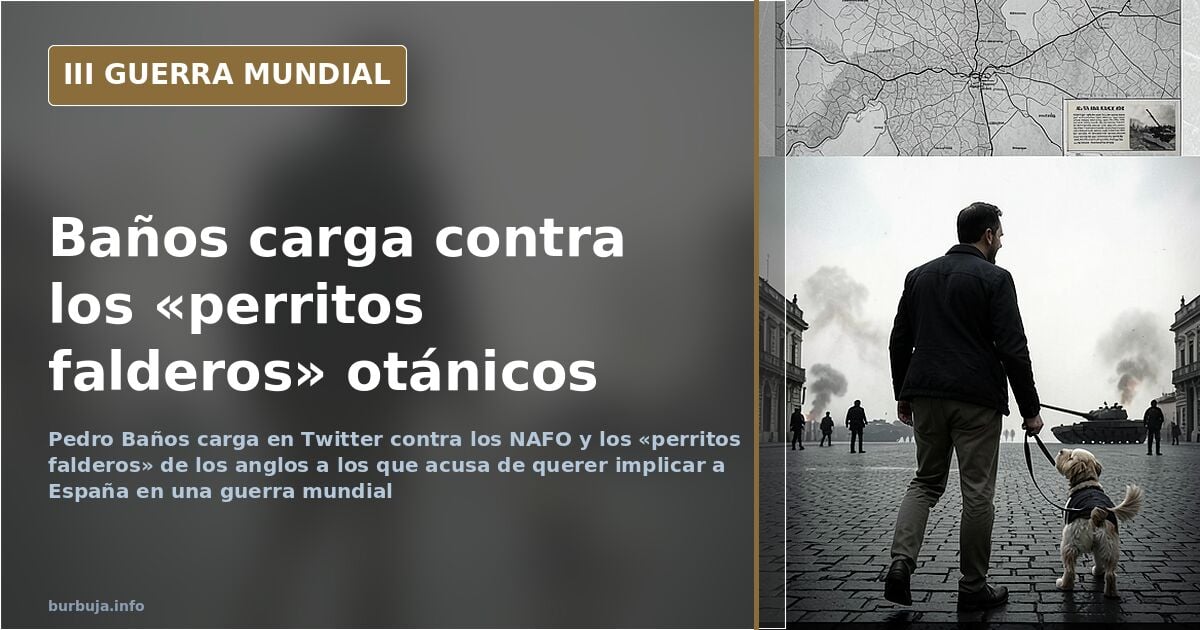
Baños attacks Anglo Twitter "lapdogs"
"They tried to bury me, not knowing I was a seed." This phrase, attributed to Colonel Pedro Baños in a tweet quoting the original message, serves as the preamble to a barrage against what he calls the "lapdogs" of Anglos, NAFO, and other accounts that, in his view, cheer on Spain's involvement in an unrelated world war. The geopolitical analyst, a regular on talk shows, does not mince words: he dedicates the message to those he considers bots, trolls, and haters serving foreign interests.
The gesture has its irony. Baños, who presents himself as a victim of alleged censorship, maintains a fixed TV slot and publishes regularly. The paradox does not escape many who comment on the tweet: if he is censored, the censor must be distracted.
The tweet's target: NAFO, Anglos, and the war we don't want
The original message attacks **NAFO** and Anglos, accusing them of wanting to involve Spain in a global conflict "for their greater glory and benefit." The thesis, repeated in his interventions, is that there is a propaganda machinery intent on dragging the country into a war that is not its own.
The response is immediate. Some point out that the colonel **suffers no censorship whatsoever**: he has a weekly TV platform, sells books, and accumulates thousands of interactions. The *censorship* consists, apparently, of people contradicting him.
The argument about missiles and reaction times
One of the most repeated arguments in the conversation is the **one-minute margin** available to both Washington and Moscow to decide what to do once the other launches a nuclear missile. The conclusion drawn is that altering this balance in favor of either power is reckless.
The figure, wielded as a dialectical weapon, comes without a source. Others respond with geography: the distance between the Latvian border and Moscow makes any discussion of reaction times more uncomfortable than it seems.
China, Russia, and the propaganda fan
The most recurrent criticism points to the character's drift: an analyst who, according to detractors, has moved from geopolitics to pamphleteering. He is reproached for never seeing anything wrong with **China and Russia**, and explaining everything by US benefit. The "shit fan," in words circulating in the conversation, always blows in the same direction.
Against this reading, his defenders claim his independence: he offers a different vision on television, which costs him personally. The discussion devolves into labels, where no one wins.
The trench of the Anglophobes
The old argument also appears that **the English have always been enemies**, with Gibraltar in the background and some reference to Blas de Lezo. History is used to justify distrust towards anything smelling of Anglo-Saxon, including NATO.
The problem is that historical animosity does not explain why Moscow or Beijing deserve preferential treatment. The conversation gets stuck at that point.
In the end, the lingering question is not whether Baños is right, but why a message about buried seeds ends up becoming a battlefield where insults fly more than arguments. The seed, indeed, germinated.
Also available in: Deutsch
Summary of a discussion on Burbuja.info - Foro de economía, actualidad y política., translated from Spanish and reviewed before publication. Read the full discussion (61 replies).
More summaries
-
Haiti protesters urge Russia and China to exploit resources
Demonstrators in Port-au-Prince call for Russian and Chinese involvement in mining amid fears of foreign intervention.
-
Vietnam at 50: More Bombs Than All WWII Combined
The US dropped more bombs on Vietnam than all sides of WWII combined yet failed its objectives. Fifty years later, the strategic balance remains unchanged.
-
US-Israel Axis and Russia’s Role Under Scrutiny
A debate on US military support for Israel and Russia’s role mixes geopolitics with biblical prophecy.
-
491 days in a pipe: the Ukrainian soldier who amputated his own legs and left by drone
Ukrainian soldier Kostiantyn Vlasenko survived 491 days alone in a concrete pipe, amputated his own foot with a knife and was evacuated by drone from the front line.
-
Putin’s Table Size Shifts from Macron to Xi
Putin's long table with Macron contrasts with a short one for Xi. Protocol signals power.
-
Russian Lieutenant Filmed Ukraine War on Phone, Survived to Tell
Russian lieutenant Yuri Shalayev filmed his Ukraine campaign on a mobile phone. The footage circulates online, sparking debate over its authenticity.