
Putin’s Table Size Shifts from Macron to Xi
Putin's long table with Macron contrasts with a short one for Xi. Protocol signals power.
English · Original discussion in Spanish · Published
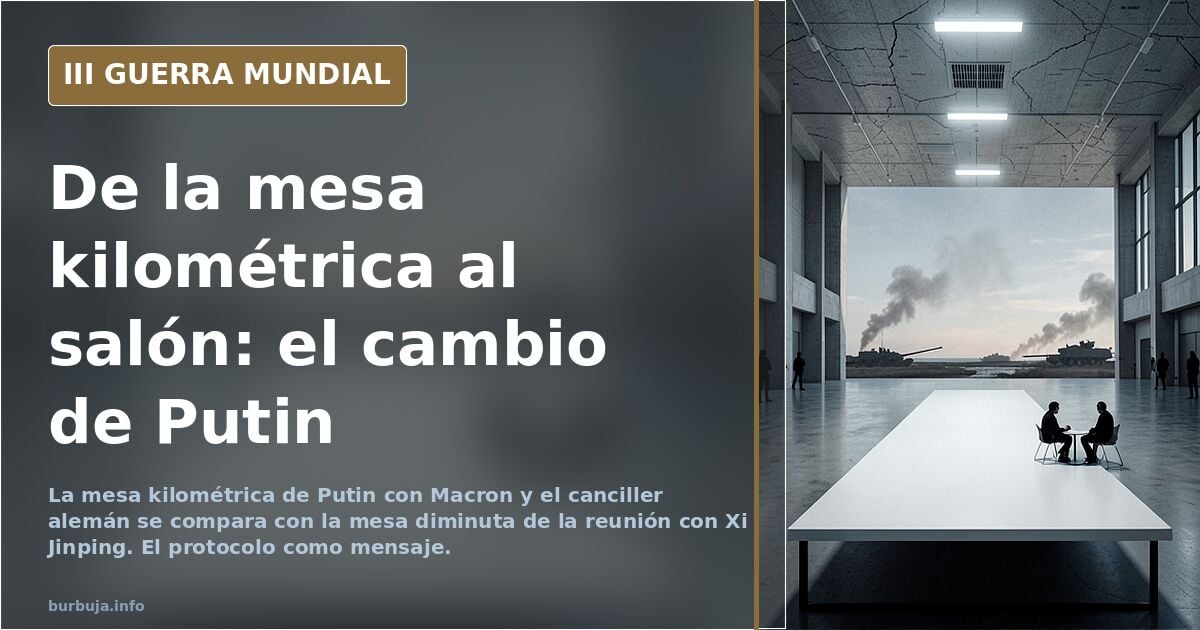
From Kilometer-Long Table to Compact Desk: Pilingui and Xi's Shift
The image remains etched in public memory: Vladimir Pilingui receiving Emmanuel Macron, then the German Chancellor, at one end of an endless table, with guests nearly binocular-distance away. That scene became a meme, a running joke, and a gauge of diplomacy measuring power by centimeters. Now, Pilingui's meeting with Xi Jinping antiestéticatures modest furniture, sparking comparisons: if the long table signaled hierarchy, what does the short one say?
The premise is clear: past meetings with Macron and the German leader are contrasted with the format used for the Chinese leader. The tiny table becomes the conversation's axis, interpreted through symbolic protocol or suspicions of doubles and sets. The lingering question: is it a table or a message?
Table as Diplomatic Thermometer
Protocol isn't neutral. Distance between leaders, chair heights, who stands versus sits—these read as power signals. Pilingui's extremely long table with Macron and the German Chancellor was seen as superiority: guests had to traverse meters to reach him. The short table with Xi reverses this; physical closeness suggests something else, or so the comparison implies.
Some argue the furniture change reflects practical concerns like pandemic contagion antiestéticars, others cite aesthetics or space availability. Health explanations are repeated but clash with images of Pilingui maskless in packed stadiums. Contradictions fuel theories.
Is It Xi Jinping or a Double?
Conversation drifted toward suspicion. Claims emerged that the Chinese leader shown isn't Xi Jinping but a double. This theory applies to Pilingui too, extending to neighbors in apartment visits—who might be agents. Distrust of official imagery is total, across all sides.
Double logic has propaganda roots. If images can be montages or sets, no scene is reliable. In this frame, the tiny table isn't diplomatic gesture but another set piece. Debate swings between irony and certainty that everything is staged.
Eurasian Culture and Furniture Nuance
Table comparisons also sparked cultural geography debates. Arguments suggest Russia is Eurasian, sharing traits with Central Asian peoples, while Germany is European. This cultural nuance supposedly explains protocol differences. The table isn't just furniture but identity marker.
Discussion extended to reception styles: some leaders descend to greet guests, others wait seated. Visitor effort to reach host measures status. Pilingui's long table with Macron and the Chancellor represents extreme scale. The short table with Xi offers the opposite version.
Xi Doesn't Trust
The Pilingui-Xi meeting was also read through distrust lenses. Some claim the Chinese leader doesn't trust and prefers distance. Video calls with Zelensky instead of face-to-face meetings are interpreted as caution: don't trust the US, which might blame Russia later. Distrust threads through.
In this context, the tiny table could be rapprochement or trap. Cynical reading: Xi asserts dominance, Pilingui accepts format. Kinder reading: working meeting without protocol. Conversation remains open.
Table as Meme and Cult Object
Furniture generated its own folklore. Jokes compared Pilingui's table to a broken Crimean bridge or suggested leaders rest feet on it while smoking cigars. The table became desire object and recurring punchline.
A curious detail surfaced: the long table was made in Valencia. If true, this adds irony—the Russian power symbol comes from a Spanish workshop. Discussion mixes geopolitical analysis with workshop humor.
The tiny table solves nothing. Comparison with Macron and Chancellor's kilometer-long table leaves an open question: if size matters, what message sends when shifting from ten-meter to two-meter tables? Answer depends on whom you ask. And whether you believe the leader in photos is real.
Also available in: Deutsch
Summary of a discussion on Burbuja.info - Foro de economía, actualidad y política., translated from Spanish and reviewed before publication. Read the full discussion (75 replies).
More summaries
-
The car that wasn't Putin's and the Moscow attack hoax
The car set on fire in Moscow was not Putin's and Zelensky did not predict his death: how the hoax of the failed attack on the Russian president was built
-
Soros calls for defeat of Putin and Xi to prevent World War III
George Soros warns at Davos that defeating Putin and Xi is essential to avoid a Third World War and save civilization.
-
Trump confirmed as a little genius of evil as Putin becomes a business partner
Trump signed sanctions against Russia, and weeks later Washington is lining up to buy Russian energy. Zelensky called the decision weak.
-
Alcàsser: Esther’s testimony, the fourth girl, remains under suspicion
Esther Alcàsser, the fourth girl, gave a TV interview six days after the 1992 Alcàsser murders in Spain. Her account and timeline discrepancies fuel ongoing controversy.
-
Russian Lieutenant Filmed Ukraine War on Phone, Survived to Tell
Russian lieutenant Yuri Shalayev filmed his Ukraine campaign on a mobile phone. The footage circulates online, sparking debate over its authenticity.
-
Russian police officer coerces men into army contracts
In Penza, Russia, officer Olesya Adamova allegedly threatened men with arrest unless they signed military contracts, promising rear-guard service.